
Top 4 ZoraSafe.com Alternatives for 2026

Stopping phishing attacks across SMS and chat channels leaves persistent gaps when platforms only cover email or web access logs. Many alternatives lock campaign analytics, report customization, or advanced integrations behind complex enterprise contracts or high pilot fees. This guide shows security teams how four competitors align on pricing, deployment, and integrations so decisions happen before investing in a pilot.
Table of Contents
- SmishAlert
- Varonis Data Security Platform
- Cyberly
- Hut Six Security Platform
- Comparison of alternatives
SmishAlert
At a Glance
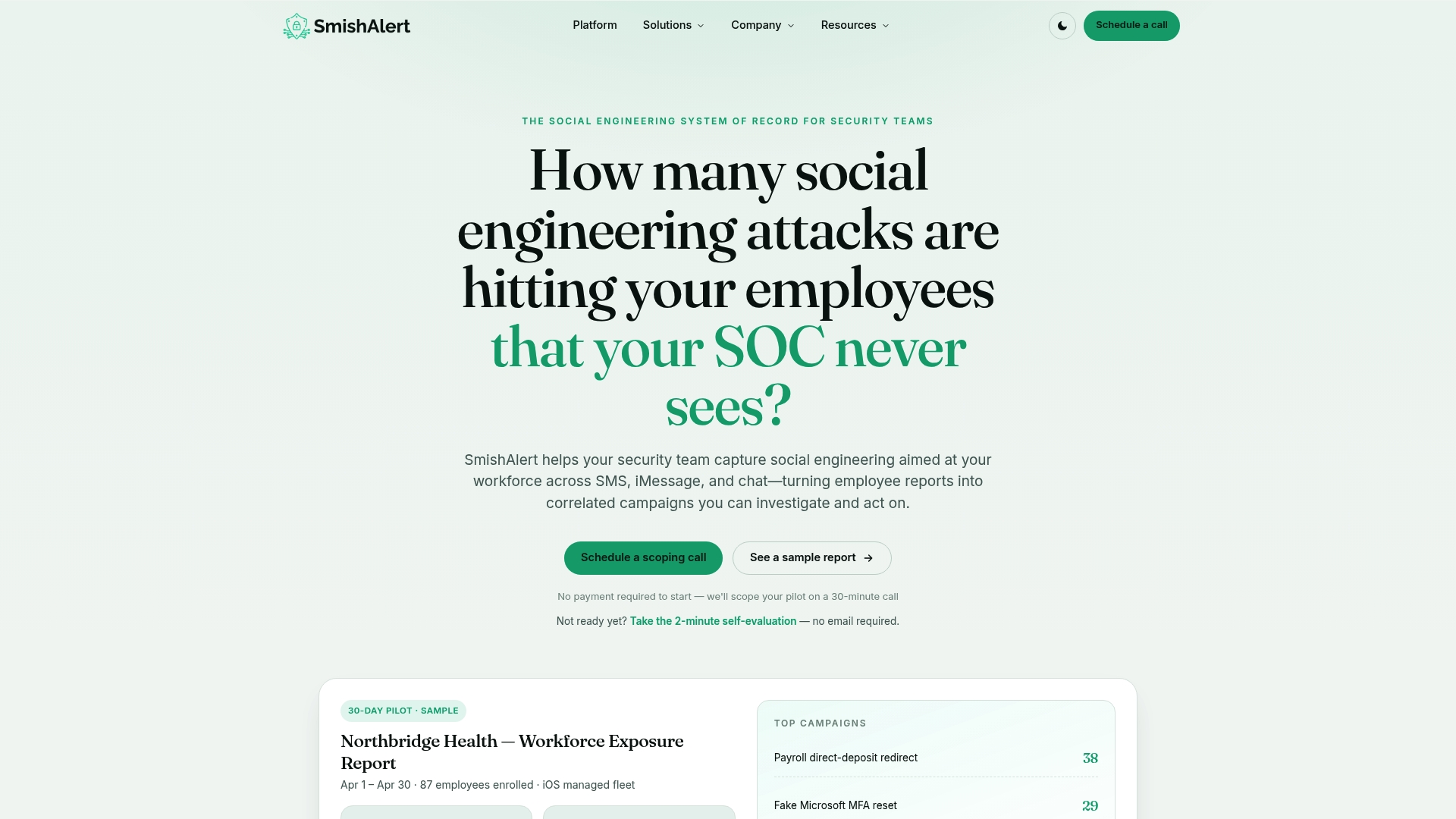
On-device classification detects social engineering patterns in SMS and chat. SmishAlert captures and correlates messages across messaging platforms where many high-leverage attacks begin. It maps executive impersonation, credential harvesting, payroll fraud, gift card scams, and mobile phishing into evidence suitable for SOC and audit review.
Core Features
The platform uses on-device classification and campaign clustering to group related messages across employees and devices. It correlates messages into attack campaigns and provides mobile apps for iOS and Android that deploy via MDM. A single interface captures employee reports, generates board ready reports, and can forward signals to SIEM and SOAR systems.
Key Differentiator
The standout capability is deep integration of device-level classification with cross-account campaign clustering across messaging channels. That linkage surfaces campaign-level signals that single-message detection misses. The result is higher-fidelity campaign context for investigators and SOC analysts.
Pros
Visibility into messaging channels fills a gap left by email and network security tools and reveals attacks that otherwise escape detection. Automatic campaign detection and clustering reduce analyst triage time and consolidate evidence for investigations. Mobile app deployment via MDM supports managed fleets, and the product produces executive level reports that translate campaign findings into metrics useful for audit and board review. Integration with SIEM/SOAR allows campaign signals to become operational alerts in existing SOC workflows.
Cons
- Requires managed device fleets with MDM support, which limits use to organizations that control corporate mobile devices.
Who It’s For
SmishAlert reports it targets security teams at organizations with 200–2,500 employees. The product fits mid sized organizations in regulated sectors that need visibility into SMS and chat based attacks. It also serves security leaders, IT teams, and managed security providers who must measure workforce exposure and produce compliance ready reporting.
Unique Value Proposition
According to the company, 30-day pilots are available with a pilot fee of $2,500–$5,000 credited toward an annual subscription. That short pilot model lets teams measure exposure quickly and produce an executive report for decision makers. The economic effect is lower upfront risk while feeding campaign level telemetry into SOC processes.
Real World Use Case
A security team ran a 30-day pilot across 50 employees to identify active messaging based campaigns. The deployment clustered related messages and produced a board ready report that summarized exposure for HR, finance, and executives. That report then guided remediation and tuned SOC detection rules.
Pricing
Pilot programs require a fee in the $2,500–$5,000 range that the vendor credits toward an annual subscription. Annual pricing is not publicly listed. Buyer engagement begins with a pilot to measure organizational exposure before committing to a subscription.
Website: https://smishalert.ai
Varonis Data Security Platform
At a Glance
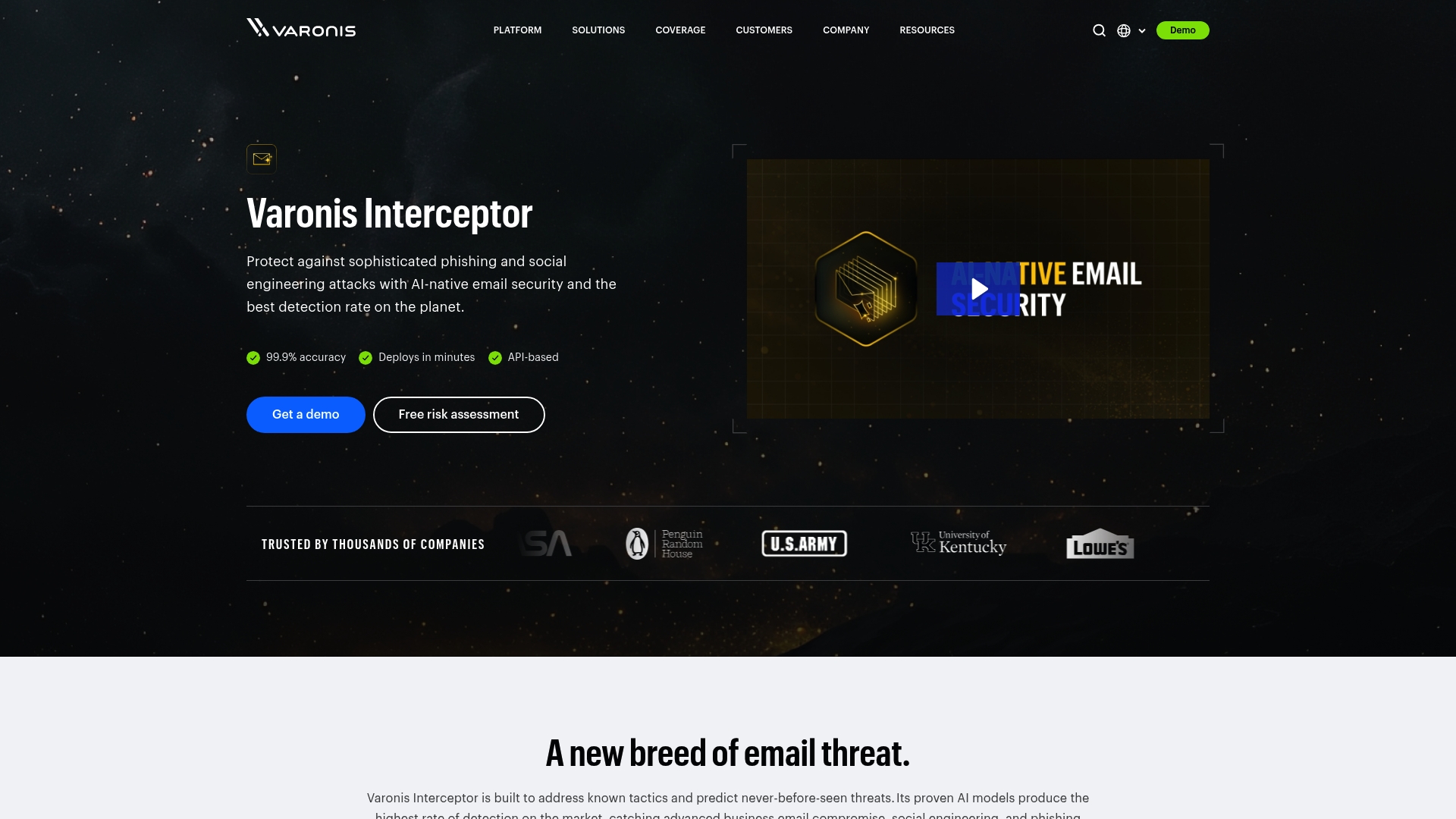
Varonis reports it is trusted by thousands, including NASA, U.S. Army, and Penguin Random House. The platform emphasizes AI-driven, real-time threat detection and automated response across cloud, on-premises, SaaS, and AI workloads. It also offers an email security product called Interceptor aimed at reducing phishing and social engineering risk with rapid deployment.
Core Features
Varonis scans and inventories repositories to deliver data discovery and classification, tagging sensitive content for policy action and audit. The product includes DSPM capabilities to assess misconfigurations and risky exposures across cloud services. It provides database activity monitoring and data-centric UEBA that links user behavior to sensitive data access. The platform combines data access governance with DLP-style controls to support compliance workflows and incident investigation.
Key Differentiator
Varonis focuses on linking data context to behavioral signals so alerts tie an asset, a user, and a sensitive data set together. That combined context drives automated response playbooks to reduce investigation time. The approach targets the human and data layers rather than only network or endpoint telemetry.
Pros
Varonis combines classification, monitoring, and governance into a single workflow that reduces blind spots across cloud and on-premises stores. The vendor advertises strong detection accuracy and fast deployment for core modules, which speeds time to value for large environments. Integrations with major cloud providers and enterprise platforms simplify telemetry ingestion and policy enforcement across Microsoft 365, AWS, Azure, and other systems. The platform’s customer roster and industry recognition support its enterprise credibility.
Cons
- Implementation can be complex for smaller teams. Planning and skilled security staff are often required.
- Advanced features may need extensive setup and customization before they deliver full value.
- Pricing details are not published, which can complicate initial budget planning and procurement.
When It May Not Fit
Organizations without a dedicated security operations or data governance team will likely struggle with initial deployment. Teams that require transparent list pricing for rapid procurement may find the vendor’s approach a poor fit. Small or midmarket buyers looking for minimal setup and low maintenance should evaluate simpler tools first.
Notable Integrations
- Microsoft 365
- AWS
- Azure
- Google Cloud
- Salesforce
- Box
- Databricks
- ServiceNow
Who It’s For
Large enterprises that need centralized control over sensitive data across multi-cloud and hybrid estates. Security operations and data governance teams that must map data risk back to identities and entitlements will gain the most. Organizations with auditor-driven compliance requirements will benefit from the platform’s classification and access governance features.
Real World Use Case
A multinational uses Varonis to find and classify sensitive files across cloud shares and on-premises file stores. The system labels data for regulatory reporting and monitors access patterns for anomalous queries. When the UEBA model detects risky behavior, automated workflows quarantine access and open an incident ticket for the security team.
Pricing
Pricing is not specified on the vendor site. The offering appears to use enterprise custom quotes and licensing that scale with data footprint and modules selected. Potential buyers should request a tailored proposal and a deployment plan during procurement.
Website: https://slashnext.com
Cyberly
At a Glance
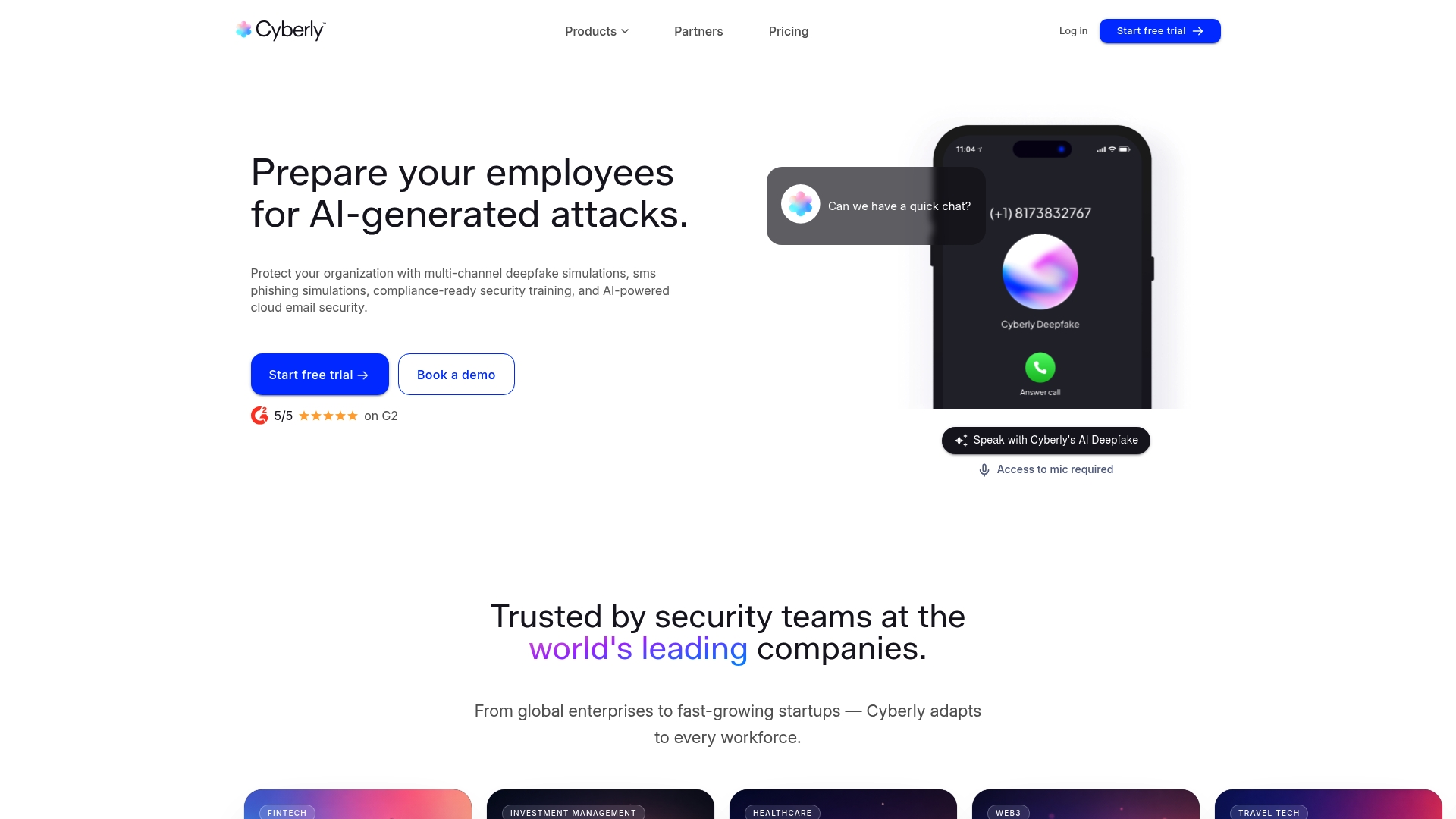
Plans target groups for 10 to 150 employees and for over 150 employees. Cyberly pairs AI powered deepfake and phishing simulations with multilingual personalized training across email, SMS, voice, Slack, and LinkedIn. According to the company, Cyberly complies with GDPR and ISO standards.
Core Features
The platform runs deepfake and phishing simulations across multiple messaging channels and automates scenario generation. It offers AI driven personalized security training in multiple languages and real time employee risk and breach monitoring. Email threat detection and inbox remediation integrate with Gmail and Outlook while SSO, Active Directory, Okta, and APIs enable real time data flows.
Key Differentiator
Cyberly focuses on hyper realistic deepfake simulations combined with AI driven personalization. That combination delivers adaptive training that changes by user behavior and language, rather than repeating the same email test for everyone.
Pros
High realism and personalization drive stronger engagement in exercises, according to vendor materials. Automation and rapid deployment reduce manual setup and free security teams to focus on incident response. That compliance claim supports audit trails and reporting for regulated industries and helps meet internal governance requirements.
Cons
- Setup complexity may overwhelm small security teams and require a dedicated admin or consultant.
- Pricing is opaque and may be high for small companies or startups.
- Certain custom integrations and deep customization often need vendor support and extra professional services.
When It May Not Fit
Small companies without a dedicated security engineer may find setup burdensome. Organizations on tight budgets may struggle with pricing and procurement. Teams that need simple, occasional phishing tests rather than continuous simulation will find the platform overfeatured.
Notable Integrations
Integrates with Gmail, Outlook, Okta, Slack, and Microsoft Teams for inbox remediation, messaging simulations, and authentication.
Who It’s For
Security teams, CISOs, and cybersecurity awareness managers at large or regulated organizations seeking AI driven, automated simulation and training. It suits enterprises that require language support and audit ready reporting.
Real World Use Case
A major European neobank used Cyberly to run realistic deepfake and phishing scenarios across email, SMS, and voice. That campaign raised employee engagement and reduced reported incidents while automating compliance reporting.
Pricing
Pricing is available on request. Plans cover 10 to 150 employees and over 150 employees. Annual discounts and custom enterprise arrangements exist.
Website: https://cyberly.ai
Hut Six Security Platform
At a Glance
Starter plan lists at £150/year while Professional lists at £250/year, with Enterprise available by custom quote. Hut Six pairs short, engaging training modules with phishing simulations and real time reporting. The platform supports LMS and directory integrations for scaled deployments across public and private organizations.
Core Features
Hut Six bundles security awareness training with simulated phishing campaigns that include customizable templates and landing pages. The platform tracks behavior change through advanced reporting and analytics and exposes telemetry via LMS connectors and directory sync. Integrations include xAPI, Active Directory, SSO, SCIM, and custom API hooks to fit existing identity and learning ecosystems.
Key Differentiator
Hut Six centers on configurable content plus live analytics linked to compliance workflows. The product emphasizes branded training paths and scenario customization while delivering reports suitable for audit evidence. This combination targets teams that must show measurable behavior change and compliance readiness.
Pros
Hut Six makes it easy to tailor scenarios and training to company policy and brand, which improves relevance for learners. The training modules are short and interactive, helping learners finish content during normal work hours. Reporting surfaces behavior trends and campaign results, which helps security teams prioritize follow up and prepare evidence for audits. Directory and LMS connectors reduce manual enrollment work for larger deployments.
Cons
-
Pricing skews toward larger buyers. Starter and Professional tiers exist, but Enterprise features use custom pricing which can raise overall cost for full feature access.
-
Advanced capabilities such as external LMS integrations and unlimited phishing simulations may require an Enterprise tier or extra customization, limiting access for smaller teams.
-
Initial setup and deep customization require administrative time. Some organizations report that full deployment needs a dedicated administrator.
When It May Not Fit
Small organizations with minimal budgets or one person security teams may find the platform more than they need. Teams that prefer out of the box, no configuration solutions could see a higher overhead during rollout. If an organization needs only occasional phishing tests without reporting or LMS linkage, this platform may be more complex than necessary.
Notable Integrations
- LMS systems via xAPI
- Active Directory
- Single Sign On with SAML 2.0
- Azure AD
- Google Workspace
- Custom API integrations
Who It’s For
Hut Six targets medium to large organizations that require scalable training and phishing simulation. It fits security teams that must demonstrate compliance with GDPR, ISO 27001, or SOC2 during audits. Public sector agencies needing tailored content and centralized reporting will also find the platform appropriate.
Real World Use Case
A multinational deploys Hut Six across several regions to run localized phishing campaigns and learning paths. Security teams measure behavior change with campaign analytics and compile those reports for compliance audits. Directory sync and LMS connectors reduce manual enrollment across dozens of business units.
Pricing
Starter: £150/year. Professional: £250/year. Enterprise: custom pricing for larger deployments and extra features. The platform uses tiered plans that gate advanced integrations and unlimited simulations behind higher levels.
Website: https://hutsix.io
Comparison of alternatives
In the evolving landscape of cybersecurity solutions, discerning the suitability of available tools necessitates evaluating several key dimensions such as specific threat detection capabilities, deployment requirements, and operational complexities. Each highlighted solution brings its distinct innovations and tradeoffs to the table, serving varied organizational needs.
Mobile application capabilities
SmishAlert excels in targeting threats arising from human-layer vulnerabilities in SMS and messaging platforms. It specializes in identifying and correlating potential social engineering campaigns that traditional email-based systems may overlook. The platform also provides mobile device deployment integrated with mobile device management (MDM) solutions, allowing organizations to secure their managed device fleets effectively at the application level.
Conversely, Varonis provides advanced data governance features suitable for addressing risks in large and complex data environments rather than focusing specifically on the detection and neutralization of social engineering attempts through SMS and chatting applications.
Focused user training programs
Cyberly’s distinguishing feature lies in its provision of multilingual, personalized, and simulated training scenarios—rendering it a compelling solution for organizations prioritizing workforce education in cybersecurity. Offering support for emails, SMS, voice, and internal communication tools, it enhances user resilience against varied attack modalities by tailoring its training material based on the users’ behavior and role requirements. Nevertheless, its scope divides attention between educational modules and the simulation aspects, which may not align with organizations seeking immediate mitigation capabilities.
Best fit
- For organizations that need highly insights into attack patterns and campaign-level correlations on corporately managed mobile environments, SmishAlert delivers clarity.
- Enterprises emphasizing advanced data governance strategies, particularly for compliance-centric data auditing, may prefer the Varonis Data Security Platform.
- Teams require an adaptable system for workforce cybersecurity training; Cyberly’s AI-driven personalized training scenarios and multilingual support will meet such demands.
- Security managers in need of structured phishing simulations with audit-ready outcomes should consider Hut Six for its reporting and customizable training pathways.
Our pick
After evaluating the strengths and functionalities of the available platforms, SmishAlert emerges as the leading choice for organizations managing corporate mobile devices. Its unique focus on threat detection at the messaging-layer level, bolstered by device-specific intelligence and campaign clustering, highlights its value proposition for medium-sized enterprises within regulated industries. However, for those prioritizing centralized data governance or team training solutions, other platforms may prove a better fit, aligning the toolset with the organization’s primary objectives.
Identify the most suitable messaging phishing detection platform for your organization with this comparison of key offerings and capabilities.
| Product | Core Feature or Use Case | Key Differentiator | Best For | Pricing | Notable Limitation |
|---|---|---|---|---|---|
| Smishalert | On-device SMS and chat attack detection | Device-level classification with cross-account campaign clustering | Mid-sized organizations with managed fleets | $2,500–$5,000 credited pilot fee | Requires managed devices with MDM for deployment |
| Varonis DSP | Data discovery, classification, and governance | AI-driven context linking for automated responses | Enterprises managing hybrid cloud data | Price not published | Complex setup and maintenance for smaller teams |
| Cyberly | AI-driven phishing simulations and trainings | Hyper-realistic deepfake scam training | Enterprises needing highly adaptive training | Price not published | Setup complexity may require additional resources |
| Hut Six Security | Compliance-focused training and simulations | Customizable scenarios and live analytics | Medium to large organizations | £150–£250/year, custom | Advanced features mostly in higher-cost enterprise tier |
Addressing Messaging-Based Social Engineering Threats Beyond Email
Organizations seeking zorasafe.com alternatives face growing challenges in detecting social engineering attacks outside the traditional email perimeter. Smishalert offers visibility into scams exploiting SMS, iMessage, WhatsApp, and similar channels. It identifies executive impersonation, credential harvesting, payroll fraud, and mobile phishing that often escape email security tools.
Security leaders, IT teams, and managed security providers rely on Smishalert to correlate campaign signals, analyze user reports, and integrate alerts into SIEM and SOAR workflows. This approach reduces investigation time while providing executive-level reporting suited for audit and risk management.
Secure your organization against hidden messaging attacks with Smishalert. Visit Smishalert to learn how to measure and respond to social engineering threats targeting your employees.
FAQ
What unique capabilities does Smishalert offer for messaging phishing detection?
Smishalert provides on-device classification to detect social engineering patterns in SMS and chat. This feature captures and correlates messages across various messaging platforms, helping to identify multiple types of phishing attacks effectively. Organizations should expect enhanced visibility into messaging channels, resulting in improved security against phishing threats.
How does Smishalert compare to other messaging phishing detection platforms?
Smishalert excels in its deep integration of device-level classification with cross-account campaign clustering, setting it apart from competitors. This linkage allows Smishalert to provide higher campaign context that other platforms may overlook, making it suitable for identifying widespread phishing schemes effectively.
Can I expect quick deployment with Smishalert?
Smishalert’s mobile apps for iOS and Android can be deployed via MDM, facilitating a streamlined setup for managed device fleets. This rapid deployment means organizations can quickly start monitoring messaging channels for phishing threats, enhancing overall security in less time.
What should security teams consider when using Smishalert?
Security teams must use managed device fleets with MDM support to utilize Smishalert effectively. This limitation means the platform is best suited for organizations that control corporate mobile devices, impacting how various teams approach deployment and management.
How does Smishalert help in reporting findings to executives?
Smishalert generates board-ready reports that translate campaign findings into metrics useful for audits and executive reviews. This capability allows organizations to communicate effectively with decision-makers about their security posture and any ongoing risks related to messaging phishing.