
Why SMS Differs from Email for Mobile Staff

SMS is a fundamentally different communication channel than email, delivering near-universal reach and immediate message receipt without requiring internet access, corporate credentials, or a smartphone. For mobile and frontline staff, that distinction is not a minor technical detail. It determines whether a critical alert gets read in seconds or sits unread for days. SMS achieves a 98% open rate compared to email’s 20%, and response times under 4 hours versus 2–3 days for email. Understanding why SMS differs from email for mobile staff is the first step toward building a communication and security posture that actually reaches your workforce.
What technical and operational differences separate SMS from email for mobile staff?
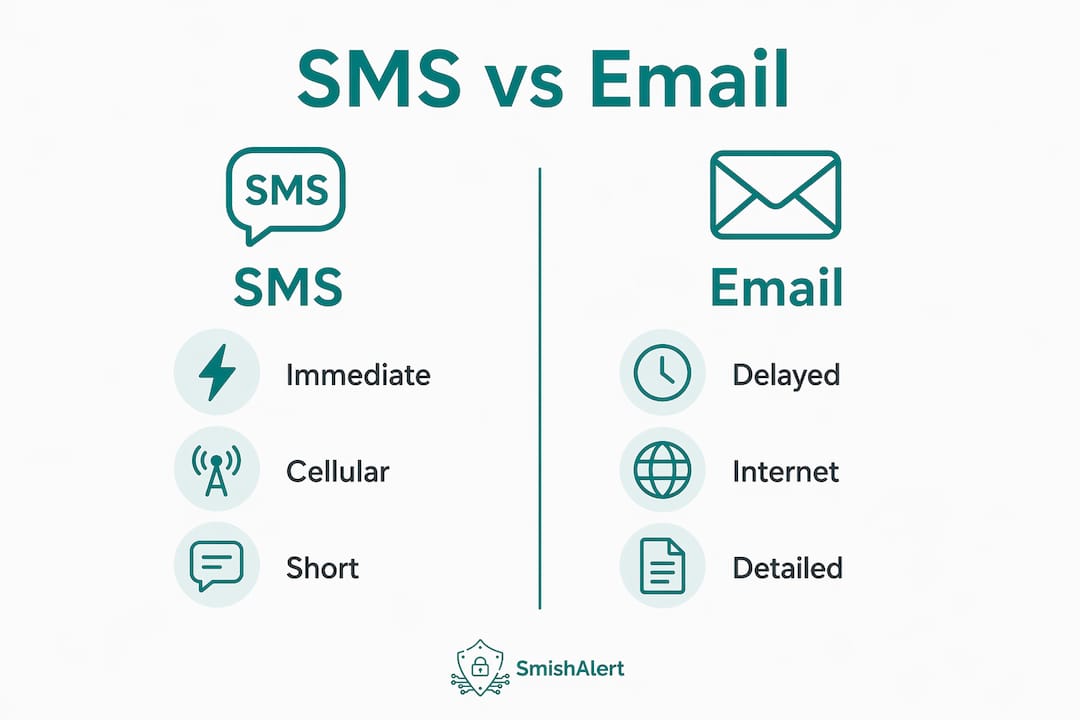
SMS operates over cellular networks using the SS7 signaling protocol. It requires no internet connection, no app, and no corporate account. A message sent via SMS reaches any mobile phone, including basic feature phones and older handsets, as long as the device has cellular signal.
Email depends entirely on internet connectivity. A staff member without Wi-Fi or mobile data cannot receive an email. This is not a theoretical edge case. 83% of frontline workers do not have access to corporate email, making SMS the only viable channel for reaching this group at all.

The format differences are equally significant. SMS is limited to 160 characters of plain text per message segment. Email supports rich formatting, attachments, embedded images, and documents of any length. That constraint is actually an advantage for urgent communication. A 160-character message forces brevity and gets read immediately. A 600-word email with attachments gets deferred.
Two-way communication also works differently across the two channels. SMS supports native two-way messaging without any additional software. Email replies are common but structurally slower, often routed through filters, inboxes, and approval chains before a response reaches the sender.
| Feature | SMS | |
|---|---|---|
| Network requirement | Cellular signal only | Internet connection required |
| Device compatibility | Any mobile phone | Smartphone or computer |
| Message format | 160 characters, plain text | Unlimited, rich formatting |
| Average open rate | 98% | 20% |
| Average response time | Under 4 hours | 2–3 days |
| Two-way capability | Native | Requires inbox management |
How do response rates and engagement differ between SMS and email?
The engagement gap between SMS and email is not marginal. It reflects a structural difference in how people interact with each channel. SMS messages arrive as push notifications on the lock screen. Most people read them within minutes. Email arrives in an inbox that most mobile workers check infrequently, if at all.
Benefits enrollment completion improved by 34% when organizations shifted outreach to SMS. That figure reflects a real operational gain. When workers do not need to log in, find a document, or open a specific app, they complete tasks at a higher rate.
Healthcare provides one of the clearest examples of SMS benefits for mobile teams. SMS adoption for shift alerts reduced no-shows by 32% in healthcare settings. A missed shift in a hospital or care facility is not just an inconvenience. It creates a staffing gap with direct patient safety implications.
Email fatigue compounds the engagement problem. Corporate inboxes receive dozens to hundreds of messages daily. Filters misclassify messages. Workers develop habits of batch-processing email rather than monitoring it in real time. For time-sensitive communication like payroll exceptions, safety alerts, or schedule changes, that delay creates operational risk.
Pro Tip: Reserve SMS for messages that require action within the hour. If the message can wait until the next business day, email is the appropriate channel.
Shifting high-volume repetitive communication to SMS also reduces bottlenecks without requiring additional headcount. Organizations that automate shift reminders, confirmation requests, and status updates via SMS report measurable gains in workflow throughput compared to email-based methods.
What security and regulatory challenges differentiate SMS from email?
SMS carries security risks that email does not. Understanding those risks is not optional for IT and security teams deploying SMS at scale.
The SS7 protocol that routes SMS messages was designed in the 1970s. It has no end-to-end encryption and is vulnerable to interception by anyone with access to the SS7 network. Nation-state actors and sophisticated threat groups exploit these vulnerabilities to intercept messages in transit. This makes SMS categorically unsuitable for transmitting credentials, personally identifiable information (PII), or any sensitive data.
SMS messages stored on personal devices create shadow IT risk. When business communications live on employee phones outside corporate control, organizations lose visibility into that data. If a device is lost, stolen, or the employee leaves the organization, that communication history goes with it. Email, by contrast, is typically archived on corporate servers with audit trails, retention policies, and access controls enforced by the organization.
Regulatory compliance adds another layer of complexity. SMS requires explicit opt-in consent under the Telephone Consumer Protection Act (TCPA) in the United States and under GDPR in Europe. Double opt-in is the recommended standard. Failure to obtain proper consent exposes organizations to significant legal liability. Email compliance requirements, while real, are generally less prescriptive about the consent mechanism.
Key security controls for organizational SMS use:
- Never transmit credentials, passwords, or PII via SMS
- Use SMS as an outbound notification channel only, limiting inbound replies to non-sensitive confirmations
- Deploy centralized SMS archiving to maintain audit trails outside personal devices
- Enforce opt-in documentation for all staff SMS programs
- Route sensitive follow-up tasks through secured portals or apps, with SMS used only as the notification trigger
For teams managing mobile messaging compliance, the distinction between SMS as a notification layer and email as a records layer is the foundational policy decision.
When should organizations use SMS instead of email for mobile teams?
The decision to use SMS over email is not about preference. It follows from message urgency, content type, and the device access profile of the recipient.
Use SMS for the following scenarios:
- Emergency and safety alerts where immediate awareness is required regardless of internet access
- Shift reminders and schedule changes for frontline workers who do not monitor corporate email
- One-time passcodes (OTPs) for multi-factor authentication, where delivery speed directly affects user experience
- Payroll exception notifications that require same-day action from the employee
- Confirmation requests for time-sensitive tasks like benefits enrollment or compliance training completion
Retain email for long-form communication. Formal HR documentation, policy updates, detailed incident reports, and records that require archiving belong in email. Email provides the formatting, attachment support, and audit trail that SMS cannot replicate.
SMS automation removes the manual overhead from high-volume repetitive messages. Organizations that automate shift confirmations and alert broadcasts via SMS free up HR and operations staff for higher-value tasks.
Pro Tip: Never use SMS as the sole delivery mechanism for any communication that requires documented acknowledgment. Pair SMS notifications with a secure portal where the employee completes and records the action.
Security teams should treat SMS as the first signal in the notification chain, not the complete communication. A text message that says “Your payroll information has been updated. Log in to verify at secure portal URL]” is appropriate. A text message containing the actual payroll figures is not. This [enterprise SMS security practice keeps the channel useful while containing its inherent risk.
For organizations managing SMS security across shift handovers, the policy framework matters as much as the technology. Clear rules about what information travels via SMS and what stays in secured systems prevent both data leakage and social engineering exposure.
Pro Tip: Implement a mobile messaging policy that explicitly defines SMS-appropriate content categories before deploying any staff SMS program.
Key Takeaways
SMS outperforms email for mobile staff on reach and speed, but requires strict content controls and compliance frameworks to deploy safely.
| Point | Details |
|---|---|
| SMS reaches further | 83% of frontline workers lack corporate email access, making SMS the only viable channel for this group. |
| Engagement gap is real | SMS achieves a 98% open rate versus email’s 20%, with response times under 4 hours versus 2–3 days. |
| SMS carries unique security risks | SS7 vulnerabilities and lack of encryption make SMS unsuitable for transmitting credentials or PII. |
| Compliance requirements are stricter | SMS requires explicit opt-in consent under TCPA and GDPR; failure to comply creates legal exposure. |
| Use channels for their strengths | SMS belongs on urgent alerts and notifications; email belongs on formal records and long-form content. |
The tradeoff security teams rarely talk about openly
The conversation about SMS versus email in enterprise settings almost always focuses on engagement metrics. Open rates, response times, enrollment completions. Those numbers are real and they matter. What gets less attention is the asymmetry between how easy SMS is to deploy and how difficult it is to govern.
I have seen organizations roll out staff SMS programs in days, driven by a legitimate need to reach frontline workers who were simply not getting critical messages via email. The operational results were immediate and measurable. Shift coverage improved. Payroll exceptions got resolved faster. Workers who had been invisible to corporate communication were suddenly reachable.
The security debt accumulated more slowly. Messages sitting on personal devices with no archiving. Workers forwarding SMS alerts to personal contacts. Threat actors noticing that the organization was now sending SMS from a recognizable short code and building credential-harvesting campaigns that mimicked the format exactly.
The uncomfortable truth is that SMS is indispensable for mobile workforce communication and simultaneously one of the most exploited attack surfaces in the human layer. Those two facts coexist. The answer is not to avoid SMS. It is to treat SMS deployment with the same rigor you apply to any other communication channel that touches your workforce at scale.
Organizations that get this right treat SMS as a notification layer with strict content rules, centralized archiving, and active threat monitoring. They do not treat it as a lightweight alternative to email that requires no governance. The IT security risks unique to SMS are not theoretical. They show up in real incidents, and they are growing as attackers follow the channel where attention has shifted.
— Sophie
How Smishalert addresses SMS security for mobile teams
Mobile staff communication has moved decisively toward SMS and messaging apps. That shift has expanded the attack surface well beyond what traditional email security platforms can see.
Smishalert gives security teams visibility into social engineering threats that arrive through SMS, iMessage, WhatsApp, and other messaging channels. The platform surfaces executive impersonation attempts, credential-harvesting campaigns, payroll fraud, and gift card scams targeting employees outside the corporate perimeter. Security leaders can correlate reported threats, track campaign patterns, and respond before a single click becomes a full compromise. For organizations deploying SMS at scale with mobile and frontline staff, Smishalert’s threat detection platform provides the monitoring layer that keeps the channel secure. Take the 2-minute readiness check to assess your current SMS security posture.
FAQ
What is the main reason SMS outperforms email for frontline workers?
83% of frontline workers lack access to corporate email, making SMS the only channel that reliably reaches them. SMS also requires no internet connection, which matters in field, warehouse, and healthcare environments.
Is SMS secure enough for internal staff communication?
SMS is appropriate for notifications and alerts but not for transmitting sensitive data. The SS7 protocol has known interception vulnerabilities, and messages stored on personal devices create shadow IT risk outside corporate control.
What compliance rules apply to employee SMS programs?
Organizations must obtain explicit opt-in consent from employees before sending SMS under TCPA in the United States and GDPR in Europe. Double opt-in is the recommended standard to avoid legal exposure.
When should organizations use email instead of SMS for staff?
Email is the correct channel for formal HR records, policy documents, detailed incident reports, and any communication that requires long-form content, attachments, or a documented audit trail.
How do attackers exploit organizational SMS programs?
Threat actors monitor the SMS formats organizations use for staff alerts and build smishing campaigns that mimic them exactly, targeting employees with fake payroll notifications or credential-harvesting links that appear legitimate.