
Why Security Frameworks Address Mobile Threats Effectively

Security frameworks address mobile threats by classifying mobile devices as distinct enterprise endpoints that require dedicated controls, not extensions of desktop security policy. Frameworks like NIST SP 800-124 Rev. 2 and OWASP MASVS exist precisely because mobile devices carry unique risks tied to portability, mixed ownership, and persistent connectivity that no generic IT control set adequately covers. The mobile attack surface includes credential harvesting over SMS, executive impersonation via iMessage, and runtime app tampering. Each of these vectors sits outside the corporate perimeter and outside the scope of traditional SIEM or IAM controls. Understanding why security frameworks address mobile threats is the first step toward building defenses that actually hold.
Why security frameworks address mobile threats differently than desktop controls
Mobile security frameworks exist because mobile threat surfaces differ fundamentally from those of traditional endpoints. A desktop workstation sits inside a managed network perimeter, runs software vetted by IT, and rarely changes ownership. A mobile device crosses network boundaries dozens of times per day, may be personally owned, and runs apps downloaded directly by the employee.
NIST SP 800-124 Rev. 2 reflects this reality by specifying controls that have no desktop equivalent: device enrollment, connectivity authorization, configuration baselines for mobile operating systems, and encryption requirements tied to device state. These controls target the specific conditions under which mobile devices operate, not a generic endpoint model.
OWASP MASVS takes the app layer further. Its 8 categories and 24 controls map directly to mobile threat surfaces: storage security, cryptography, network communication, platform interaction, app code quality, and runtime resilience. Version 2.1.0 added privacy as a distinct category, which signals that frameworks evolve as mobile attack vectors evolve. That kind of structured, surface-specific mapping is what separates a mobile security framework from a checklist.

Pro Tip: When scoping a mobile security assessment, start with OWASP MASVS categories covering authentication and storage. These two areas produce the highest density of critical findings relative to testing effort.
How mobile devices expand the enterprise attack surface
Mobile endpoints introduce structural vulnerabilities that desktop security models were never designed to handle. Three conditions define the mobile risk profile: zero client trust, inspectable transport, and exposed local storage. Each one requires a control response that frameworks codify.
Zero client trust means the device cannot be assumed to be in a known, managed state. Rooted or jailbroken devices remove operating system protections entirely, and frameworks must account for this possibility in every control they specify. Inspectable transport means that traffic from a mobile app can be intercepted and analyzed by an attacker on the same network, making certificate pinning and transport layer security enforcement non-optional. Exposed local storage means that sensitive data written to a device’s file system can be read by other apps or by an attacker with physical access.
BYOD policies compound all three conditions. When employees use personal devices for work, IT teams lose visibility into device state, patch level, and app inventory. Ownership fragmentation means a single employee may access corporate resources from a managed iPhone, a personal Android tablet, and a shared family device. Frameworks address this by requiring enrollment verification and posture checks before granting access.
Common mobile-specific attack vectors that frameworks must address include:
- SMS phishing (smishing): Credential harvesting via text messages impersonating IT, HR, or executives
- Malicious app sideloading: Apps installed outside official stores that carry spyware or keyloggers
- Man-in-the-middle on public Wi-Fi: Traffic interception on networks the device joins automatically
- SIM swapping: Attacker takes control of a phone number to bypass SMS-based MFA
- App tampering and repackaging: Legitimate apps decompiled, modified, and redistributed with malicious code
- Insecure data caching: Sensitive tokens or credentials stored in plaintext by poorly written apps
Each vector requires a specific control response. Frameworks provide the structure to assign ownership, define the control, and verify enforcement.
How frameworks operationalize mobile security compliance
Security frameworks convert mobile threat awareness into measurable, auditable controls. SOC 2 examinations test mobile security controls including OS patching, anti-malware deployment, encryption, and change management. Auditors consistently find that organizations have written policies but lack enforceable, measurable controls that verify device posture.
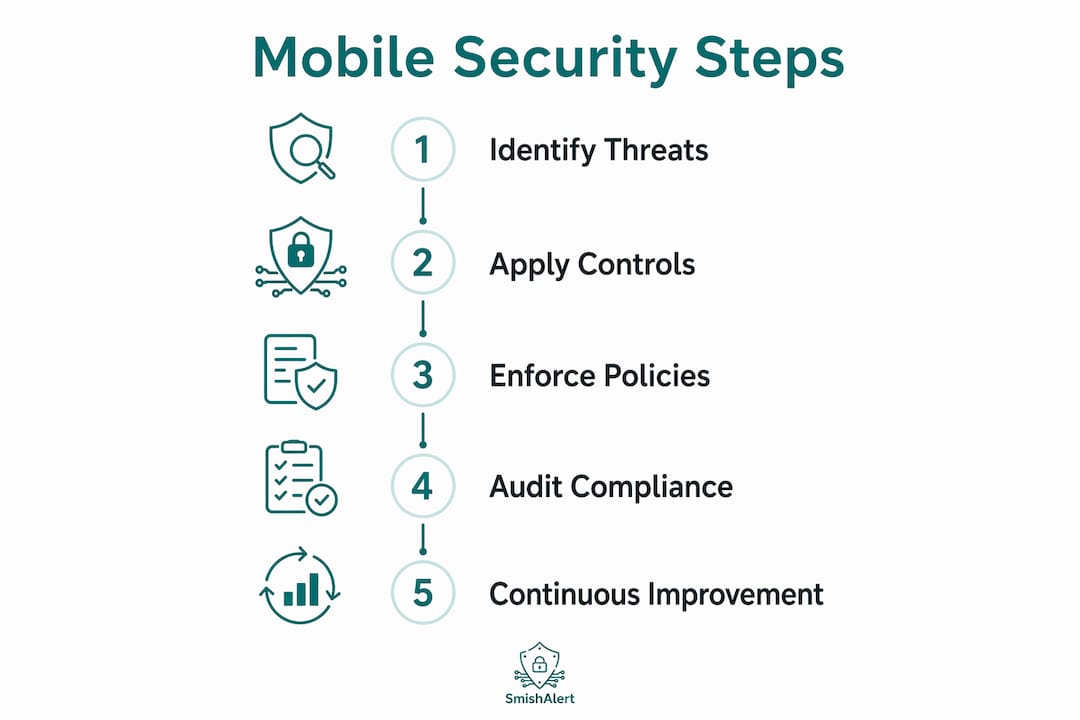
NIST SP 800-124 Rev. 2 gives CISOs a structured way to align budget and reporting to business goals by clarifying which mobile security controls are owned by IT, shared with HR, or delegated to employees. That ownership clarity matters during an audit and during an incident. When a credential harvesting campaign hits the workforce via WhatsApp, the CISO needs to know immediately which team owns the mobile threat detection control and whether it was enforced.
The table below maps common mobile security controls to their compliance context:
| Control | Framework reference | What auditors verify |
|---|---|---|
| Device enrollment | NIST SP 800-124 Rev. 2 | All devices accessing corporate data are enrolled in MDM |
| OS patch enforcement | SOC 2 CC6.8 | Devices run current OS versions within defined patch windows |
| Encryption at rest | NIST SP 800-124 Rev. 2 | Full-disk encryption enabled on all managed devices |
| Anti-malware deployment | SOC 2 CC6.8 | Mobile threat defense agent installed and reporting |
| Configuration baseline | NIST SP 800-124 Rev. 2 | Devices meet defined security configuration profiles |
| Change management | SOC 2 CC8.1 | App and OS changes tracked and approved before deployment |
Pro Tip: Do not treat a written mobile security policy as a passing control. Auditors under SOC 2 and NIST frameworks test enforceability. Verify that your MDM actually blocks non-compliant devices from accessing corporate resources before the audit begins.
App-side vs. server-side controls: why frameworks require both
Client-side mobile app controls are necessary but not sufficient. Apps can be decompiled or modified, which means any security logic embedded solely in the app can be bypassed by an attacker with moderate skill. Frameworks address this by requiring defense-in-depth: app-side controls paired with server-side authorization and monitoring.
OWASP MASVS makes this explicit. Authentication controls in the framework require that the server validates every session token independently, regardless of what the app reports about device state. Authorization checks must occur at the API layer, not just in the app’s UI logic. Runtime integrity checks, such as detecting whether the app is running on a rooted device or inside a debugger, add a layer of tamper detection. But the server must still treat every request as potentially hostile.
The practical implication is that framework-based testing must cover both the app binary and the backend API. OWASP MASVS and its companion guide MASTG support modular testing approaches that adjust depth based on the app’s risk profile. A banking app requires deeper testing of authentication and cryptography controls than an internal directory app. This risk-tiered approach lets security teams align mobile threat policy with actual exposure rather than applying uniform testing to every app in the portfolio.
The server-side requirement also has direct implications for messaging-based attacks. When an employee clicks a credential-harvesting link in a smishing message, the attacker’s goal is to reach a backend system. Server-side controls, including rate limiting, anomalous login detection, and session revocation, are the last line of defense after the mobile endpoint has been compromised.
Key Takeaways
Security frameworks address mobile threats effectively because they map controls to mobile-specific attack surfaces, enforce measurable compliance, and require defense-in-depth across both app and server layers.
| Point | Details |
|---|---|
| Mobile-specific controls are required | NIST SP 800-124 Rev. 2 specifies enrollment, encryption, and connectivity controls that desktop frameworks do not cover. |
| OWASP MASVS maps 8 threat categories | Its 24 controls target storage, cryptography, network, platform, and runtime surfaces unique to mobile apps. |
| Compliance requires enforceability | SOC 2 auditors test whether mobile controls are enforced on device posture, not just documented in policy. |
| Client-side controls alone fail | Apps can be decompiled, so frameworks require server-side authorization and monitoring to complete the defense. |
| BYOD expands ownership risk | Frameworks address mixed-ownership environments by requiring enrollment verification and posture checks before access. |
The enforcement gap is where most mobile programs break down
The frameworks exist. The problem is that most organizations implement them as documentation exercises rather than operational controls. I have reviewed mobile security programs at enterprises that passed SOC 2 audits while running unpatched Android devices with corporate email access. The policy said “devices must be enrolled.” The MDM showed 60% enrollment. Nobody had blocked the other 40%.
NIST SP 800-124 Rev. 2 and OWASP MASVS are only as effective as the enforcement mechanisms behind them. A framework that specifies encryption at rest does nothing if the MDM profile is not pushed to personally owned devices. A framework that requires certificate pinning does nothing if the development team ships an update that removes it to fix a connectivity bug.
The other failure pattern I see consistently is treating mobile as a subset of the desktop security program. Mobile threat modeling requires separate threat actors, separate attack paths, and separate control owners. SMS phishing, SIM swapping, and app tampering do not appear in a standard desktop threat model. Security teams that fold mobile into their existing endpoint program miss these vectors entirely until an incident forces the issue.
The enterprise mobile security gap is not a technology problem. It is an enforcement and scoping problem. Frameworks provide the structure. Security teams must provide the will to enforce it.
— Sophie
Smishalert and the mobile threat layer frameworks miss
Security frameworks define the control structure for mobile defense. They do not provide visibility into the messaging channels where mobile attacks actually begin. SMS phishing, WhatsApp impersonation, and iMessage credential harvesting operate outside the corporate perimeter and outside the scope of MDM or endpoint detection tools.
Smishalert fills that gap. The platform gives security teams visibility into social engineering attacks targeting employees through SMS, iMessage, WhatsApp, and other messaging channels, including executive impersonation, payroll fraud, and gift card scams. Through user reporting, threat analysis, and campaign correlation, Smishalert surfaces the human attack surface that frameworks define but cannot monitor. Security teams can run a 2-minute readiness check to assess their current exposure, or review live campaign examples to understand what active smishing threats look like in the wild. For teams building out a complete mobile defense program, the Smishalert solutions page outlines the full range of messaging threat detection capabilities.
FAQ
What is OWASP MASVS and why does it matter for mobile security?
OWASP MASVS is a mobile application security verification standard that organizes requirements into 8 categories and 24 controls mapped to specific mobile threat surfaces. Security teams use it to scope app security testing and verify that mobile apps meet a defined baseline of protection.
How does NIST SP 800-124 Rev. 2 differ from general endpoint security guidance?
NIST SP 800-124 Rev. 2 specifies mobile-focused controls like device enrollment, configuration baselines, and connectivity authorization that address conditions unique to mobile devices. General endpoint guidance does not account for BYOD ownership models or the zero-trust client conditions that mobile devices create.
Why do organizations fail mobile security audits under SOC 2?
SOC 2 auditors find that organizations frequently have mobile security policies but lack enforceable controls that verify device posture. Common failures include unpatched mobile operating systems and inconsistent MDM enrollment across the device fleet.
Can mobile app security rely on client-side controls alone?
No. Mobile apps can be decompiled or tampered with, which means client-side controls can be bypassed. Frameworks like OWASP MASVS require server-side authorization and monitoring to validate every session independently of what the app reports.
How does smishing fit into a mobile security framework?
Smishing is a mobile-specific attack vector that frameworks like NIST SP 800-124 Rev. 2 acknowledge as part of the mobile threat landscape. Defending against it requires both technical controls and user reporting mechanisms, since smishing attacks arrive through messaging channels that MDM and endpoint tools cannot inspect.