
Why Mobile Messaging Is a Security Blind Spot for IT Teams

Mobile messaging is a security blind spot defined by the gap between what encryption protects and what it leaves exposed. Encrypted channels like RCS and iMessage shield message content from network inspection, but they do nothing to protect the endpoint where messages are decrypted and read. Google Threat Intelligence reports that phishing-as-a-service platforms have already shifted to these encrypted channels to evade SMS filters. The result is a class of attacks that bypass traditional perimeter defenses entirely. Security teams that rely on email gateways and network monitoring are operating without visibility into one of the most active attack surfaces in the enterprise.
Why mobile messaging is a security blind spot for enterprise defenses
The technical term for this problem is “out-of-band attack surface.” It refers to communication channels that operate outside the monitoring perimeter that security teams have built around email, web traffic, and corporate applications. Mobile messaging sits entirely outside that perimeter.
End-to-end encryption (E2EE) is the core reason. When a message travels over WhatsApp, iMessage, or RCS, the content is encrypted at the sender’s device and decrypted only at the recipient’s device. No server in between can read it. That architecture defeats every form of server-side content inspection, including data loss prevention (DLP) tools, secure email gateways, and network packet inspection.
The practical consequence is significant. Encryption protects message transport but shifts security risk entirely to the client device and the metadata layer surrounding each conversation. Security teams lose the content signal they depend on and are left with far weaker indicators.
- WhatsApp: E2EE by default across all message types, including voice and video
- iMessage: E2EE between Apple devices, with fallback to unencrypted SMS for non-Apple recipients
- RCS: E2EE now enabled by default in Google Messages, but carrier implementations vary
Metadata remains visible despite encryption. Timestamps, device identifiers, IP addresses, and contact graphs are all accessible at the network layer. That data is useful for threat hunting, but it does not replace content inspection for detecting phishing lures or credential-harvesting attempts.
Pro Tip: Deploy network telemetry collection at the mobile device management (MDM) layer to capture metadata signals even when message content is encrypted. Behavioral anomalies in contact patterns and timing can surface threats that content inspection cannot.

What endpoint and metadata vulnerabilities do messaging blind spots expose?
Encryption protects the wire. It does not protect the screen. Once a message is decrypted on a device, it is readable by any process with sufficient access. Endpoint malware and screen scraping capture decrypted conversations without ever touching the encrypted transport layer. This is the fundamental flaw in treating E2EE as a complete security solution.
The endpoint risks security teams face include:
- Malware and spyware: Commercial spyware like Pegasus reads messages directly from device memory after decryption, bypassing E2EE entirely
- Screen scraping: Malicious apps with accessibility permissions can capture every message displayed on screen
- Device compromise: A jailbroken or rooted device removes the OS-level sandboxing that isolates messaging app data
- Multi-device architectures: WhatsApp’s linked-device feature creates multiple decryption endpoints, each representing a separate attack surface
Metadata vulnerabilities are equally serious. Silent pings and online status signals leak behavioral data about users even when no message content is exchanged. An attacker can determine when a target is active, which device they are using, and how frequently they communicate with specific contacts. That behavioral profile is enough to craft a convincing social engineering attack.
Sophisticated attackers also exploit SS7 and Diameter signaling protocol weaknesses, trust-on-first-use race conditions in key exchange, and carrier identity management gaps. These vectors do not require breaking encryption. They exploit the infrastructure that surrounds it.
The BBC reported Signal account takeovers where attackers posed as Signal support staff and tricked users into sharing SMS verification codes and PINs. The encryption was never broken. The attack succeeded entirely through social engineering at the endpoint and identity layer. That case illustrates why mobile messaging vulnerabilities cannot be addressed by encryption alone.
How do social engineering attacks evolve to exploit encrypted messaging?
Phishing-as-a-service has industrialized the exploitation of encrypted messaging channels. Attackers use richer formatting and trusted UX in RCS and iMessage to construct phishing lures that look indistinguishable from legitimate brand communications. RCS supports read receipts, branded sender verification, and rich media. Those features make phishing messages more convincing, not less.
The attack chain for a modern mobile phishing campaign typically follows this sequence:
- Reconnaissance: Attacker collects target phone numbers and device types from data broker lists or prior breaches
- Lure delivery: A phishing message arrives via RCS or iMessage, mimicking a bank, delivery service, or internal IT notification
- Credential harvesting: The lure links to a mobile-optimized phishing page that captures credentials or one-time passcodes
- Account recovery exploitation: Attacker uses harvested credentials to trigger account recovery flows, which send SMS codes to the target’s device
- Device linking: QR code and device-link flows allow the attacker to add their own device as a linked endpoint, gaining persistent access to future messages
“Encryption protects the channel. It does not protect the person. Social engineering attacks succeed because they target human behavior, not cryptographic weaknesses.” — Smishalert Threat Analysis Team
Executive impersonation is a particularly effective variant. An attacker sends a WhatsApp or iMessage message appearing to come from a CEO or CFO, requesting a wire transfer or gift card purchase. The message bypasses every email security control because it never touches the email infrastructure. Security teams have no visibility unless they are monitoring messaging-based threats across channels.
The shift to encrypted channels also defeats older filtering heuristics. SMS spam filters rely on keyword matching and sender reputation. RCS and iMessage use different delivery infrastructure, so those filters simply do not apply. The attack surface has expanded while the detection tooling has not kept pace.
What defenses can security teams implement against messaging blind spots?
Effective defense against mobile messaging risks requires controls at three layers: the device, the identity workflow, and the organizational process. No single control is sufficient.
| Defense Layer | Control | What It Addresses |
|---|---|---|
| Device | MDM enrollment with jailbreak/root detection | Removes compromised devices from messaging access |
| Device | EDR agent on mobile endpoints | Detects malware and screen-scraping processes |
| Identity | Out-of-band callback verification | Confirms identity without relying on message-text signals |
| Identity | Conditional access based on device health | Blocks access from unmanaged or compromised devices |
| Process | CISA mobile communications best practices | Provides operational framework for messaging security |
| Process | Security awareness training | Reduces susceptibility to social engineering lures |
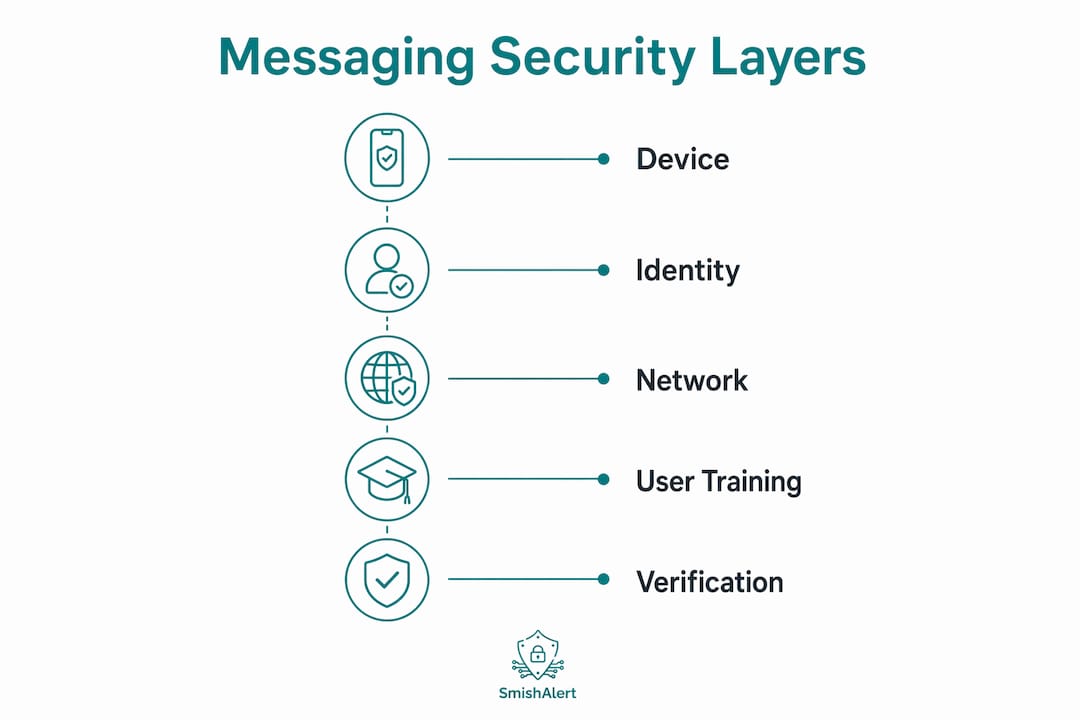
CISA’s 2026 Mobile Communications Best Practice Guidance explicitly states that encryption alone is insufficient. The guidance emphasizes operational controls at the endpoint and people-and-process focus as the primary defense layer. That position reflects the reality that content inspection is no longer viable in E2EE environments.
Out-of-band verification is the most underused control in enterprise security programs. When an employee receives a message requesting a sensitive action, the verification call should happen on a different channel, using a number from the corporate directory, not a number provided in the message itself. This single workflow change defeats the majority of executive impersonation and payroll fraud attacks.
Security awareness training must address messaging-specific scenarios. Generic phishing training focused on email does not prepare employees to recognize RCS phishing lures or Signal account takeover attempts. Training programs should include smishing and mobile phishing scenarios that reflect the actual threat environment employees face.
Pro Tip: Correlate mobile threat reports from employees with SIEM data and IAM logs. A reported smishing attempt targeting an employee’s phone number, combined with a failed login attempt from an unfamiliar IP, is a strong indicator of an active credential-harvesting campaign.
Key takeaways
Mobile messaging is a security blind spot because encryption protects message content but leaves endpoint integrity, metadata signals, and human behavior entirely undefended against social engineering attacks.
| Point | Details |
|---|---|
| Encryption shifts risk, not eliminates it | E2EE protects transport but exposes endpoints, metadata, and user behavior to attack. |
| Endpoints are the primary attack surface | Malware, screen scraping, and device compromise bypass encryption without breaking it. |
| Metadata leaks behavioral intelligence | Silent pings and device signals give attackers enough data to craft targeted social engineering attacks. |
| Phishing-as-a-service targets RCS and iMessage | Attackers use richer messaging UX to build convincing lures that bypass SMS filters entirely. |
| Defense requires device, identity, and process controls | MDM, out-of-band verification, and CISA-aligned operational practices are the core defensive stack. |
The blind spot most security programs still miss
After working through dozens of enterprise security assessments, the pattern is consistent. Organizations invest heavily in email security, endpoint detection, and network monitoring. They treat mobile messaging as a personal communication channel, not a corporate attack surface. That assumption is wrong, and attackers know it.
The most dangerous aspect of this blind spot is not the technical gap. It is the organizational assumption that encrypted means secure. Encryption is a transport control. It says nothing about the security of the device, the identity of the sender, or the judgment of the recipient. When a CFO receives a WhatsApp message from what appears to be the CEO asking for an urgent wire transfer, no amount of E2EE prevents that attack from succeeding if the CFO complies.
Security teams also underestimate how much intelligence attackers extract from metadata alone. Knowing when a target is online, which device they use, and how often they communicate with the finance team is enough to time and tailor an attack with precision. That data is available without ever breaking encryption.
The practical shift security leaders need to make is treating mobile messaging as a telemetry surface. Every reported smishing attempt, every suspicious link click on a mobile device, and every unusual device-linking event is a signal. Aggregating those signals across the organization reveals campaign patterns that no single event would surface. That is the difference between reactive incident response and proactive threat detection.
Overreliance on mail gateway models is the other persistent failure. The tools built for email security do not translate to messaging channels. Security programs need dedicated visibility into SMS, iMessage, WhatsApp, and RCS traffic, with reporting mechanisms that bring employee-reported threats into a centralized analysis workflow.
— Sophie
How Smishalert addresses mobile messaging blind spots
Security teams cannot defend what they cannot see. Smishalert provides the visibility layer that traditional security stacks miss entirely, capturing and correlating social engineering attacks delivered through SMS, iMessage, WhatsApp, and other messaging channels.
The Smishalert platform gives security teams a structured way to receive employee-reported messaging threats, correlate them into campaigns, and identify patterns like executive impersonation, credential harvesting, and payroll fraud before they result in compromise. Unlike email security tools, Smishalert operates at the human layer of the attack chain, where messaging-based threats actually land. Teams looking to understand their current exposure can start with a social engineering exposure assessment to map the messaging attack surface before the next campaign arrives.
FAQ
What makes mobile messaging a security blind spot?
Mobile messaging is a security blind spot because end-to-end encryption prevents server-side content inspection, leaving security teams without visibility into phishing lures, credential-harvesting attempts, and social engineering attacks delivered through channels like RCS, iMessage, and WhatsApp.
Does end-to-end encryption make messaging secure?
End-to-end encryption protects message content in transit but does not protect the endpoint device, the metadata surrounding each conversation, or the user’s behavior. Attackers exploit all three layers without breaking encryption.
How do attackers bypass encrypted messaging security?
Attackers bypass encrypted messaging security through endpoint malware, screen scraping, social engineering at the identity layer, and exploitation of device-linking and account recovery flows. The BBC documented Signal account takeovers where attackers used SMS code sharing to hijack accounts without ever breaking E2EE.
What is phishing-as-a-service in the context of mobile messaging?
Phishing-as-a-service platforms now deliver attacks through RCS and iMessage specifically because those channels bypass SMS spam filters and offer richer formatting that makes phishing lures more convincing. Google Threat Intelligence identified this shift as an active and growing threat vector.
What controls reduce mobile messaging security risks?
The most effective controls are MDM enrollment with jailbreak detection, EDR agents on mobile endpoints, out-of-band callback verification for sensitive requests, and security awareness training that covers messaging-specific attack scenarios. CISA’s 2026 Mobile Communications Best Practice Guidance provides the operational framework for implementing these controls.