
The Mobile Security Investment Case for Executives

The mobile security investment case is the business rationale that quantifies how proactive spending on mobile security reduces financial exposure and protects company valuation. The industry term for this discipline is mobile security ROI analysis, and it sits at the intersection of risk management, compliance, and capital allocation. A single data breach costs an average of $4.45 million, covering fines, legal fees, and reputational damage. That figure alone reframes mobile security from an IT line item into a board-level financial decision. Organizations that treat mobile security as optional are not saving money. They are deferring a much larger bill.
What is the mobile security investment case, and why does it matter now?
The mobile security investment case is a structured argument that connects security spending to measurable business outcomes. It answers the question every CFO asks: what happens if we do not invest, and what do we gain if we do?
Mobile devices now sit at the center of enterprise operations. Employees access payroll systems, customer data, and financial platforms from phones and tablets every day. That access creates an attack surface that extends well beyond the corporate firewall. Threats like credential harvesting, executive impersonation, and smishing campaigns target employees directly through SMS, iMessage, and WhatsApp, channels that traditional email security platforms do not monitor.

Liability for mobile security breaches rests primarily on the app owner unless contracts explicitly assign responsibility elsewhere. That legal reality means the financial consequences of a breach land on your organization, not your vendor. Building the investment case starts with accepting that reality and pricing the risk accurately.
What are the financial impacts of neglecting mobile security?
Neglecting mobile security creates three categories of financial harm: direct incident costs, legal liability, and long-term reputational damage.
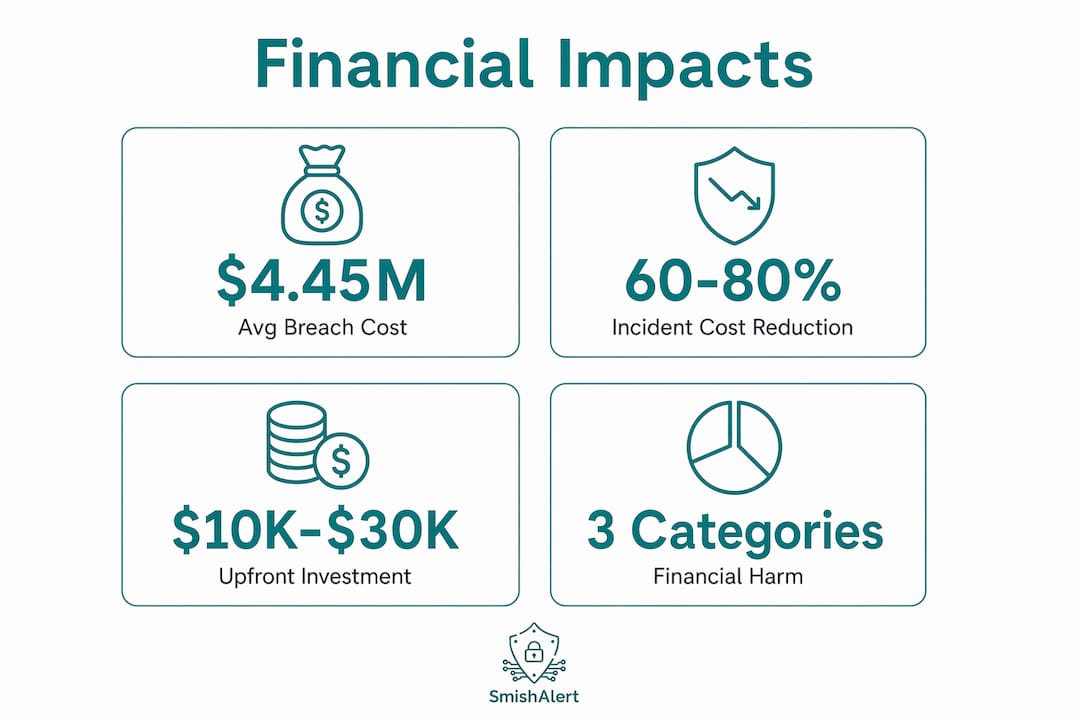
The $4.45 million average breach cost is a floor, not a ceiling. That figure covers regulatory fines under frameworks like GDPR and HIPAA, legal defense costs, customer notification expenses, and the operational disruption that follows a compromise. Reputational damage compounds those costs over months and years as customer churn accelerates and new business slows.
Mobile app security, liability, and IP risk are interconnected. A breach that exposes customer data often triggers parallel IP disputes, particularly when proprietary algorithms or trade secrets are accessed. Organizations that treat security and IP protection as separate functions face avoidable losses on both fronts.
The lifecycle cost comparison is stark. Consider these categories of financial exposure:
- Regulatory fines: GDPR penalties reach up to 4% of global annual revenue. HIPAA fines reach $1.9 million per violation category per year.
- Legal defense: Breach litigation routinely runs six figures before settlement.
- Customer attrition: Research consistently shows that a significant share of customers stop using a service after a publicized breach.
- Remediation costs: Delaying security investment increases vulnerability accumulation and drives up remediation costs over time.
The pattern is consistent. Organizations that defer mobile security investment do not avoid costs. They concentrate them into a single, high-impact event.
How much does it cost to invest in mobile security effectively?
Proactive mobile security investment falls into two budget categories: upfront architecture costs and ongoing operational costs.
Upfront investment of $10,000–$30,000 covers secure architecture design, threat modeling, and secure coding practices embedded during development. Annual maintenance and monitoring typically runs $5,000–$15,000, covering penetration testing, vulnerability scanning, and incident response readiness. These figures reflect a security-by-design approach, where controls are built in rather than bolted on after launch.
The cost comparison against incident exposure is direct:
| Budget category | Typical cost | Incident alternative |
|---|---|---|
| Upfront security architecture | $10,000–$30,000 | $4.45M average breach cost |
| Annual maintenance and monitoring | $5,000–$15,000 per year | Legal fees alone often exceed $100,000 |
| Penetration testing | $5,000–$20,000 per engagement | Regulatory fines up to millions |
| Total 3-year proactive investment | ~$45,000–$120,000 | Single breach: $4.45M+ |
Companies that invest proactively in mobile security spend 60%–80% less on security-related incidents over the product lifecycle. That reduction reflects fewer breaches, faster detection when incidents do occur, and lower remediation costs because controls were already in place.
Pro Tip: Budget mobile security as a dedicated line item in your annual technology spend, not as an optional add-on. Security costs embedded in project budgets get cut first when timelines compress. A standalone line item survives budget reviews because it carries explicit risk justification.
For a detailed breakdown of how to structure that budget, the security budget checklist from Smishalert maps mobile threat categories to specific spending priorities.
What are the strategic business benefits of investing in mobile security?
Mobile security investment does more than reduce breach risk. It actively drives business value across three dimensions: company valuation, customer trust, and competitive positioning.
Mobile app security is now a core driver of technology company valuation, with investors prioritizing companies that embed security by design. That shift reflects a broader recognition that a single publicized breach can erode years of brand equity and suppress acquisition multiples. Security is no longer a cost center. It is a value-protecting asset.
The strategic benefits extend across the organization:
- Customer trust: Demonstrable security practices reduce churn and support premium pricing. Customers pay more for services they trust with their data.
- Faster development cycles: Security built into the development process reduces late-stage rework. Teams ship faster when they are not retrofitting controls after the fact.
- Regulatory compliance: Meeting GDPR, HIPAA, and SOC 2 requirements becomes a byproduct of good security practice rather than a separate compliance project.
- Investor confidence: Due diligence processes now include security posture assessments. Companies with documented security programs close funding rounds faster.
“Mobile security investments have shifted from a cost center to a value-driving core asset in tech company valuation. Investors now treat security posture as a direct indicator of operational maturity.” — Proactive Investors
The enterprise defense guide from Smishalert details how security-by-design practices translate directly into valuation and resilience outcomes for technology products.
How should executives build a compelling mobile security investment case?
Building a persuasive investment case requires translating technical risk into language that resonates with financial and operational leadership. The following steps create a structured argument that survives budget scrutiny.
-
Quantify the risk exposure. Start with the $4.45 million average breach cost and adjust it for your industry, data volume, and regulatory environment. A healthcare organization with HIPAA obligations faces a materially different risk profile than a retail company. Specificity makes the number credible.
-
Frame the ask around business outcomes. Successful investment pitches emphasize protecting customer data and accelerating development, not technical compliance checkboxes. CFOs respond to revenue protection arguments. CIOs respond to operational efficiency gains. CMOs respond to brand reputation data.
-
Address each stakeholder’s primary concern. The CFO wants to see the cost-benefit ratio. The CTO wants to know how security integrates with the development pipeline. The CMO wants assurance that a breach will not become a headline. Build one slide for each audience.
-
Show quick wins alongside long-term value. Early investments in mobile device management policies, employee reporting programs, and phishing simulation reduce visible risk within 90 days. Those early results build credibility for the larger, multi-year security program.
-
Integrate with the broader cybersecurity strategy. Mobile security does not stand alone. Connect it to existing SIEM integrations, IAM policies, and incident response plans. Leadership approves investments that fit a coherent framework, not isolated tools.
-
Commit to ongoing measurement. Define metrics before the investment is approved: number of reported phishing attempts, mean time to detection, and reduction in credential-harvesting incidents. Metrics turn security from a faith-based investment into a managed program.
Pro Tip: Treat the mobile security investment case as an ongoing dialogue with leadership, not a one-time pitch. Quarterly updates showing threat trends and program outcomes keep security visible and prevent budget cuts when other priorities compete.
Closing the mobile security gap requires connecting investment decisions to measurable risk reduction, which Smishalert’s enterprise resources address directly.
Key takeaways
The strongest mobile security investment case connects proactive spending directly to breach cost avoidance, valuation protection, and measurable risk reduction across the organization.
| Point | Details |
|---|---|
| Breach costs dwarf investment | A single breach averages $4.45M; proactive security costs $45,000–$120,000 over three years. |
| Liability defaults to the owner | App owners bear legal and financial consequences unless contracts explicitly transfer responsibility. |
| Proactive investment cuts incident costs | Organizations investing early spend 60%–80% less on security incidents over the product lifecycle. |
| Security drives valuation | Investors now treat security posture as a direct indicator of operational maturity and company value. |
| Frame for each stakeholder | CFOs need cost-benefit ratios; CTOs need integration clarity; CMOs need brand protection assurance. |
The case executives keep getting wrong
The most common mistake I see executives make is treating mobile security as a technology problem with a technology budget. It is not. It is a financial risk with a financial solution, and the investment case has to be built that way.
When security teams present breach statistics without connecting them to the organization’s specific revenue exposure, the numbers feel abstract. A $4.45 million average means nothing to a CFO who has never seen a breach. What lands is a calculation that says: given our customer data volume, our regulatory environment, and our current detection gaps, our expected annual loss exposure is X. That is a number a CFO can act on.
The second mistake is treating the investment case as a one-time event. Security budgets get cut when they are not defended continuously. The organizations that maintain strong mobile security programs treat them like any other business function: they report metrics, they show trends, and they connect outcomes to business results every quarter.
Early and consistent investment avoids the accumulation of vulnerabilities that make remediation exponentially more expensive later. The executives who understand this stop asking whether they can afford mobile security. They start asking whether they can afford to delay it.
— Sophie
How Smishalert supports your mobile security investment
Mobile security investment covers architecture, monitoring, and compliance. But the attack surface extends further. Smishing campaigns, executive impersonation, and credential harvesting through SMS and messaging apps operate entirely outside the corporate perimeter, and most security programs have no visibility into them.
Smishalert gives security teams that visibility. Through user reporting, threat analysis, and campaign correlation, Smishalert surfaces messaging-based social engineering attacks before they result in compromise. It complements your existing mobile security investment by closing the gap that email security and mobile device management platforms leave open. Security leaders can explore Smishalert’s solutions to see how messaging threat detection fits into a complete mobile security program.
FAQ
What is the mobile security investment case?
The mobile security investment case is the financial and strategic argument for allocating budget to mobile security controls. It quantifies breach risk, compares proactive costs against incident costs, and connects security spending to business outcomes like valuation protection and regulatory compliance.
How much does a mobile security breach cost on average?
The average cost of a single data breach is $4.45 million, covering regulatory fines, legal fees, customer notification, and reputational damage. That figure makes proactive investment of $10,000–$30,000 upfront a straightforward financial decision.
What is mobile device management and how does it fit the investment case?
Mobile device management, or MDM, is a system that enforces security policies on employee devices, including encryption, remote wipe, and application controls. MDM is one component of a broader mobile security investment strategy that also includes threat detection and employee awareness programs.
How do executives calculate mobile security ROI?
Mobile security ROI is calculated by comparing the expected cost of a breach (adjusted for probability and organizational exposure) against the total cost of proactive security controls. Organizations investing proactively spend 60%–80% less on security incidents over the product lifecycle.
Who is legally liable for a mobile security breach?
Liability defaults to the app owner or the organization operating the mobile platform unless contracts explicitly transfer responsibility to a development agency or vendor. Executives should review all vendor agreements to confirm where liability is assigned before a breach occurs.