
Remote Mobile Device Threat Examples: 2026 Guide

Remote mobile device threats are defined as attacks that compromise smartphones and tablets from a distance, without requiring physical access to the target device. Smishing campaigns, mobile banking Trojans like Mamont, Accessibility Service exploits, and zero-click vulnerabilities such as CVE-2026-0073 represent the most active remote mobile device threat examples security teams face in 2026. Mobile banking Trojan packages increased 50% in Q1 2026, with Mamont accounting for 73.5% of detections. That figure signals a threat environment that has moved well beyond opportunistic attacks into organized, scalable campaigns. This guide examines each threat category with the technical depth IT leaders need to assess exposure and prioritize defenses.
1. remote mobile device threat examples: smishing and social engineering
Smishing is defined as phishing delivered via SMS, iMessage, WhatsApp, or similar messaging channels, designed to manipulate recipients into clicking malicious links or disclosing credentials. Unlike email phishing, smishing bypasses most corporate perimeter controls because the attack occurs on a personal or corporate mobile device outside the monitored network.
Attackers impersonate trusted brands such as tax authorities, parcel carriers, and financial institutions to create urgency. A common scenario involves an SMS claiming a tax refund is pending, with a link to a convincing replica of the IRS or HMRC portal. The victim enters credentials, which are harvested in real time. The attacker then uses those credentials to initiate remote access fraud or account takeover.

Distribution methods include fake app stores, shortened URLs, and QR codes embedded in physical mail. The payload is often a malicious APK that installs silently after the victim grants permissions. Once installed, the app can intercept SMS codes, log keystrokes, and exfiltrate contact lists.
Common smishing indicators security teams should train employees to recognize:
- Unsolicited messages referencing account issues, package deliveries, or tax refunds
- URLs that mimic legitimate domains with minor character substitutions (e.g., “irs-refund.net”)
- Requests to install an app from a link rather than an official app store
- Messages that create artificial urgency (“Your account will be suspended in 24 hours”)
- Sender numbers that do not match the organization’s known short codes
Pro Tip: Configure your mobile threat defense platform to flag messages containing URL shorteners combined with financial keywords. That combination is a reliable early indicator of a smishing campaign in progress.
Understanding how remote access fraud starts via SMS helps security teams trace the full attack chain before compromise occurs.
2. BTMOB RAT and android accessibility service abuse
BTMOB is an Android remote access Trojan (RAT) that exploits the Android Accessibility Service to achieve full device takeover without requiring root access. It is sold as Malware-as-a-Service for $700 per month, which means technically unsophisticated actors can deploy enterprise-grade attack capabilities against your workforce.
The Accessibility Service was designed to assist users with disabilities by allowing apps to interact with the device interface on their behalf. BTMOB abuses this permission to approve system dialogs, intercept notifications, and execute actions the user never authorized. This makes user training significantly less effective, because the malware operates below the user’s awareness threshold.
BTMOB has been observed in active campaigns targeting Brazil, Argentina, Spain, Portugal, and Mexico. The geographic spread reflects the MaaS model: operators purchase access and run campaigns independently, adapting lures to local languages and institutions.
BTMOB’s documented capabilities include:
- Overlay attacks that display fake login screens over legitimate banking apps
- Real-time screen streaming to a remote command-and-control server
- Remote command execution including app installation and file exfiltration
- SMS interception to capture one-time passwords
- Keylogging across all installed applications
- Automated approval of permission dialogs without user interaction
- Persistence mechanisms that survive device reboots
SMS-based MFA provides no protection against BTMOB. The Trojan intercepts the authentication code before the user sees it. Security teams should treat SMS MFA interception as a confirmed attack vector and migrate high-risk accounts to hardware security keys or FIDO2-compliant authenticator apps.
Pro Tip: Audit which enterprise apps request Accessibility Service permissions during onboarding. Legitimate productivity apps rarely need this permission. Any app requesting it outside of known accessibility tools warrants immediate investigation.
3. zero-click exploits and configuration vulnerabilities
CVE-2026-0073 is a critical Android vulnerability scored 8.8 by CVSS v3.1 that enables adjacent network attackers to bypass wireless ADB authentication with no user interaction required. ADB (Android Debug Bridge) is an administrative interface comparable to SSH. When exposed on a local network, it grants shell-level access to the device.
The exploit requires three conditions: Developer Options enabled, Wireless Debugging active, and the attacker sharing the same network segment as the target device. Enterprise environments create this scenario routinely. QA engineers, developers, and field technicians frequently work on devices with these settings active, often connected to shared Wi-Fi at offices, hotels, or conference venues.
Many enterprise MDM policies do not disable Developer Options or Wireless Debugging, particularly on devices classified as developer or test units. Those devices often hold the same access credentials and VPN profiles as standard employee devices. The attack surface is wider than most MDM dashboards reveal.
| Enterprise Setting | Exposure Risk | Recommended Control |
|---|---|---|
| Developer Options enabled | High | Disable via MDM policy for all non-developer roles |
| Wireless Debugging active | Critical | Block via MDM; require explicit approval per session |
| Outdated OS version | High | Enforce minimum OS version in MDM enrollment policy |
| Risky Wi-Fi connections | Medium | Deploy always-on VPN with network trust enforcement |
| Jailbroken or rooted device | Critical | Block enrollment; trigger immediate incident response |
53% of organizations had devices with critically outdated operating systems, and 1 in 850 devices was found jailbroken. Both conditions amplify the risk from CVE-2026-0073 and similar zero-click exploits. Outdated devices may lack the patches that close the authentication bypass, even after the vendor releases a fix.
Pro Tip: Treat Wireless ADB Debugging the same way you treat RDP exposure on Windows servers. Neither should be active on production devices without explicit, time-limited authorization and network segmentation.
4. overlay phishing and SMS interception attacks
Overlay attacks are a distinct category of mobile device attack scenarios where malware renders a fake graphical interface layer over a legitimate app to capture credentials before they reach the real application. OverlayPhantom is a documented Android banking Trojan that supports real-time screen streaming and executes over 30 remote commands, making it one of the more capable overlay threats currently active.
The attack sequence is precise. The malware monitors which app the user opens. When a targeted banking or corporate app launches, OverlayPhantom renders a pixel-perfect fake login screen on top of it. The user enters credentials into the fake interface. The malware captures and transmits them, then dismisses the overlay so the real app loads normally. The victim has no indication anything went wrong.
Real-time screen streaming compounds the risk. The attacker observes the session live and can intervene to complete fraudulent transactions while the device owner is still logged in. This capability converts a credential theft tool into a full session hijacking platform.
Protective measures for overlay and SMS interception threats:
- Deploy mobile threat defense (MTD) solutions that detect overlay activity at the OS level
- Enforce app allowlisting through MDM to prevent unauthorized APK installation
- Migrate all authentication flows away from SMS OTP to TOTP apps or hardware keys
- Monitor for Accessibility Service grants on non-approved applications
- Require certificate pinning in corporate mobile apps to detect man-in-the-middle conditions
- Alert on devices that establish unexpected outbound connections to unknown IP ranges
Mobile phishing protection deployed without MDM is achievable and addresses the gap for BYOD environments where full MDM enrollment is not feasible.
5. mobile malware delivered via fake app stores
Fake app stores are a primary distribution channel for mobile malware examples including banking Trojans, spyware, and RAT payloads. Attackers register domains that visually mimic the Google Play Store or regional app marketplaces, then serve malicious APKs to visitors arriving via smishing links or search engine poisoning.
The social engineering layer is deliberate. A smishing message tells the recipient their banking app needs an urgent security update, with a link to the fake store. The victim downloads and installs what appears to be a legitimate update. The installed APK requests Accessibility Service permissions under the guise of “enhanced security features.” Once granted, the attacker has persistent, privileged access.
This distribution method is effective because it combines two attack vectors: the urgency of a social engineering message and the apparent legitimacy of a familiar interface. Security teams should treat any app installation originating outside of Google Play or the Apple App Store as a high-severity event requiring immediate investigation.
Business cybersecurity threats in 2026 increasingly rely on this combination of social engineering and technical exploitation, making detection at the human layer as important as detection at the network layer.
6. risky wi-fi and network-level remote threats
Network-level attacks against mobile devices exploit insecure or attacker-controlled Wi-Fi to intercept traffic, inject malicious content, or redirect users to credential-harvesting sites. 18% of enterprise devices connected to risky Wi-Fi networks, a figure that reflects the reality of a distributed workforce using mobile devices in airports, hotels, and co-working spaces.
An attacker operating a rogue access point can perform SSL stripping against apps that do not enforce certificate pinning, downgrade TLS connections, or inject malicious JavaScript into unencrypted web sessions. Corporate VPN clients on mobile devices are the primary control, but they are only effective when the always-on VPN policy is enforced and the device is enrolled in MDM.
The intersection of risky Wi-Fi and enabled Wireless Debugging creates the conditions for CVE-2026-0073 exploitation. A device connected to a shared hotel network with Developer Options active is exposed to any attacker on the same subnet. That is not a theoretical scenario. It is a routine risk for traveling executives and field engineers.
Key takeaways
Remote mobile device threats in 2026 require layered defenses that address social engineering, malware, configuration vulnerabilities, and network exposure simultaneously.
| Point | Details |
|---|---|
| Smishing is the entry point | Most mobile compromises begin with an SMS or messaging-based lure that bypasses perimeter controls. |
| Accessibility Service abuse bypasses MFA | Trojans like BTMOB intercept SMS codes and approve dialogs without user involvement, making SMS MFA ineffective. |
| Zero-click exploits target configurations | CVE-2026-0073 requires no user interaction; disabling Developer Options and Wireless Debugging via MDM closes the primary attack path. |
| Overlay attacks are invisible to users | OverlayPhantom and similar tools capture credentials before they reach the legitimate app, requiring OS-level detection. |
| MaaS lowers the attacker barrier | BTMOB’s $700/month model means sophisticated RAT capabilities are accessible to low-skill threat actors at scale. |
The configuration gap is the threat you’re probably underestimating
After working across enterprise mobile security programs, the pattern I see most consistently is not a failure of technology. It is a failure of configuration governance. Organizations invest in MDM platforms, deploy mobile threat defense agents, and train employees on phishing awareness. Then a developer device with Wireless Debugging enabled connects to a conference Wi-Fi network, and none of those controls matter.
CVE-2026-0073 crystallizes this problem. The vulnerability is not exotic. It exploits a debugging interface that should never be active on a production device. The fact that it carries a CVSS score of 8.8 and requires no user interaction should prompt every security leader to audit their MDM policies this week, not next quarter.
The MaaS model for tools like BTMOB changes the threat calculus further. When a capable RAT is available for $700 per month, the attacker population expands dramatically. You are no longer defending against nation-state actors or organized crime exclusively. You are defending against anyone with a credit card and a grievance. That requires detection capabilities at the human layer, not just the network layer.
SMS-based MFA deserves a direct statement: it is not a second factor against an attacker running BTMOB or OverlayPhantom. It is a false sense of security. The migration to FIDO2 hardware keys or TOTP-based authenticators is not optional for high-risk accounts. It is overdue.
The mobile endpoint protection challenges in 2026 are real, but they are addressable. The organizations that close the configuration gap and build visibility into messaging-based threats will be significantly better positioned than those still relying on perimeter controls that mobile devices routinely bypass.
— Sophie
How Smishalert surfaces messaging threats before they escalate
Security teams cannot defend against threats they cannot see. Smishalert provides visibility into smishing campaigns, executive impersonation, credential harvesting via SMS, and other social engineering attacks that occur entirely outside the corporate perimeter.
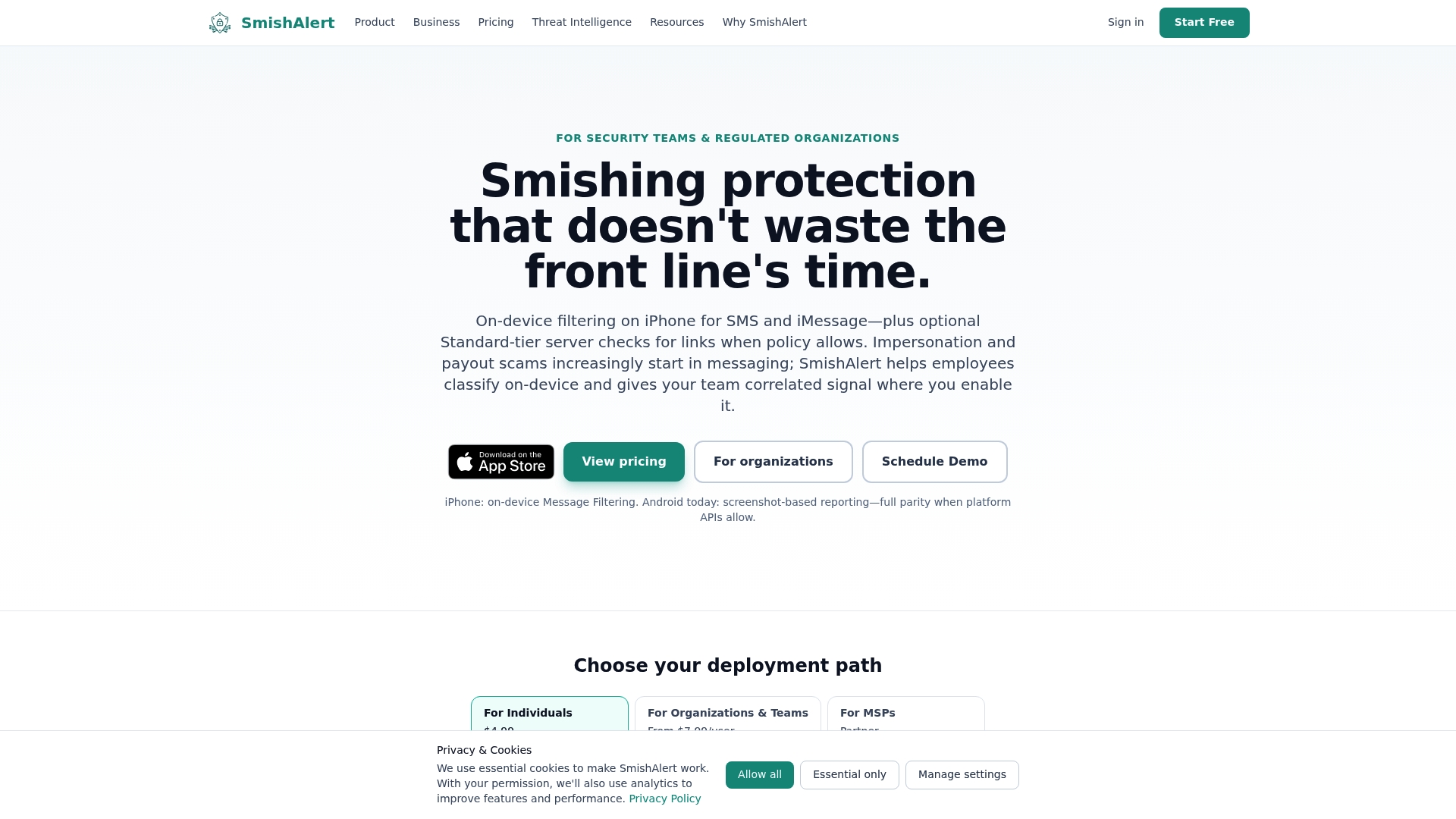
Smishalert correlates user-reported messages across your organization to identify active campaigns, map the human attack surface, and detect emerging threats before they result in account compromise or lateral movement. The platform covers SMS, iMessage, WhatsApp, and other messaging channels where traditional email security has no reach. For security leaders who need to understand their organization’s exposure to social engineering attack types, Smishalert delivers the telemetry and campaign correlation that turns individual reports into actionable intelligence. Request your 30-day exposure assessment to measure your current messaging-based risk.
FAQ
What are the most common remote mobile device threats?
The most common remote mobile device threats include smishing, banking Trojans like Mamont, RATs such as BTMOB, overlay malware, and zero-click exploits like CVE-2026-0073. Mobile banking Trojan installation packages increased 50% in Q1 2026, confirming these threats are accelerating.
How does smishing differ from email phishing?
Smishing delivers phishing lures via SMS, iMessage, or WhatsApp, bypassing corporate email security gateways entirely. The attack reaches the device directly, often outside business hours and outside monitored network environments.
Why is sms-based MFA ineffective against modern mobile malware?
Trojans like BTMOB intercept SMS authentication codes before the user sees them, using Android Accessibility Service to read and forward the codes to the attacker. Hardware security keys and FIDO2-compliant authenticator apps are the recommended replacement for high-risk accounts.
What is a zero-click mobile exploit?
A zero-click exploit compromises a device without requiring any user interaction, such as clicking a link or installing an app. CVE-2026-0073 exploits Android’s Wireless ADB Debugging interface to grant remote shell access to any attacker on the same network segment.
How can security teams detect overlay attacks on mobile devices?
Overlay attacks are detected through mobile threat defense solutions that monitor Accessibility Service grants and flag unauthorized overlay activity at the OS level. Enforcing app allowlisting and migrating away from SMS OTP authentication reduces the impact when overlay malware does reach a device.