
Pricing Mobile Messaging Security Managed Services in 2026

The price of a mobile messaging security managed service is not a single line item. It is a layered structure of platform fees, per-message processing charges, and carrier delivery costs that must be evaluated together to produce an accurate budget. Industry examples like Infobip AgentOS illustrate this clearly: platform fees start at $530/month plus $0.07456 per outbound message interaction, with inbound messages free. For IT security professionals assessing mobile messaging security costs against social engineering risk, understanding each cost layer is the difference between a well-scoped security investment and a budget that collapses under real-world usage.
What are the primary cost components in mobile messaging security managed services?
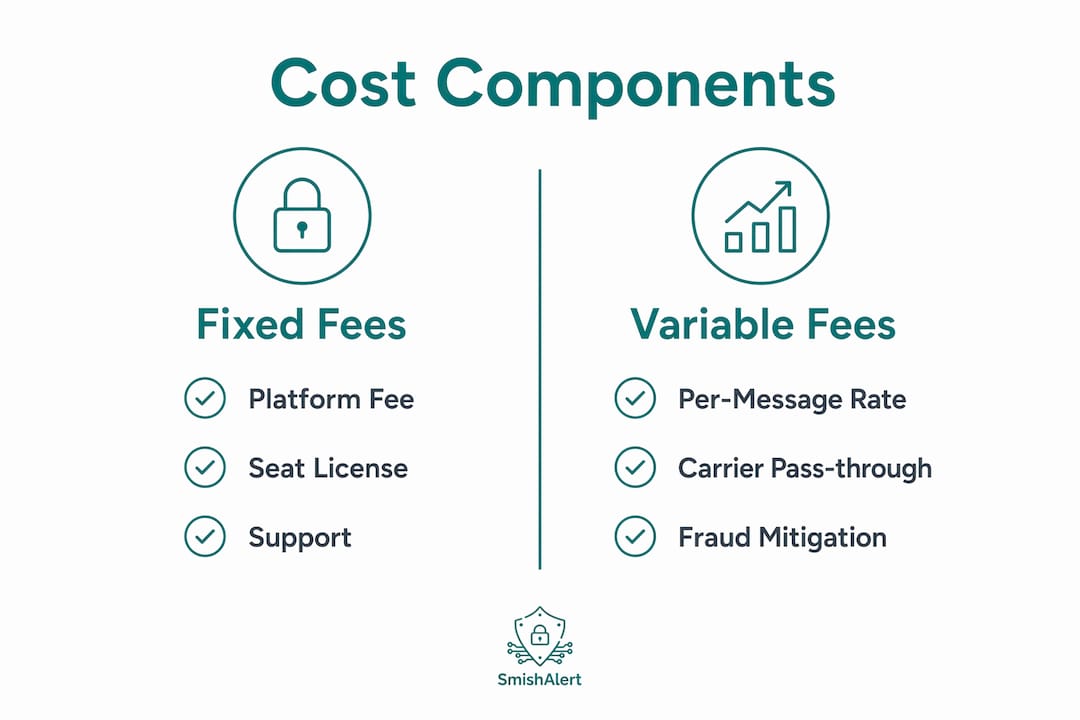
Managed mobile messaging security pricing breaks into three distinct layers, and conflating them is the most common budgeting mistake security teams make.
Platform subscription fees are the fixed monthly base cost. They cover access to the vendor’s infrastructure, management console, reporting, and support. These fees are typically locked at contracted rates regardless of message volume growth. Infobip, for example, states that platform fees remain fixed at contracted rates, with volume increases prompting a vendor recommendation for tier upgrades rather than automatic cost hikes. This gives security teams predictable baseline spend.

Per-message processing fees apply to outbound messages and vary by vendor. Some providers, like Aircall, publish tiered per-user plans ranging from $20 to $62 per user per month, with SMS at $0.01 per message and MMS at $0.04 per message. This model makes cost projection straightforward when you know your monthly message volume.
Carrier and CPaaS delivery fees are where budgets get ambiguous. These are telecom pass-through charges added on top of advertised rates. ReadySMS data shows AT&T charges $0.0040 per segment per outbound message, while T-Mobile and Verizon charge $0.0030. At 100,000 messages per month, that adds $300 to $400 in carrier fees alone, on top of every other line item.
Additional cost factors include:
- Minimum monthly charges that apply even at low message volumes
- Volume tier thresholds that may require contract renegotiation as usage scales
- 10DLC registration fees for US SMS campaigns, which are one-time but non-trivial
- Fair usage policies that cap message rates without triggering automatic tier upgrades
Pro Tip: Always request an itemized quote that separates platform fees, per-message processing, carrier pass-through, and registration costs. Vendors who bundle these into a single “all-in” rate make it impossible to audit your actual spend or identify waste.
How do channel choices and message types affect managed messaging security costs?
Channel selection is one of the highest-leverage cost decisions in any SMS security managed service deployment. The price difference between channels is not marginal. It is structural.
| Channel | Cost per OTP message | Security notes |
|---|---|---|
| SMS OTP | $0.01 to $0.51 | Vulnerable to SIM swap, SS7 attacks |
| WhatsApp OTP | $0.001 to $0.055 | End-to-end encrypted, lower fraud exposure |
| iMessage (dedicated line) | $39 to $98/month line fee | Apple ecosystem only, no SMS fallback |
The cost difference between SMS and WhatsApp OTP is significant: switching 100,000 monthly OTP messages from SMS to WhatsApp can save $7,600 per month. That figure assumes mid-range SMS pricing, but even at the low end, WhatsApp OTP delivers 50 to 99 percent cost reduction per message. The security profile also improves, since WhatsApp OTP uses end-to-end encryption and is less exposed to SS7 interception and SIM swapping attacks.
iMessage adds a different cost structure. Providers like Blooio offer dedicated iMessage lines at $98 per month for inbound-only dedicated lines, with shared starter plans at $39 per month. These are separate from per-message fees and represent a fixed overhead that only makes sense if your user base is predominantly Apple device users.
The practical constraint with WhatsApp OTP is coverage. WhatsApp requires an active account and internet connectivity. SMS reaches any mobile number globally without those prerequisites. A well-designed messaging security architecture uses WhatsApp as the primary channel for cost and security efficiency, with SMS as an automatic fallback for users who cannot receive WhatsApp messages. This hybrid approach captures most of the cost savings while maintaining coverage.
Pro Tip: Audit your user base before committing to a channel mix. If 70 percent of your employees use WhatsApp, routing OTP and security alerts through WhatsApp first can cut your monthly messaging costs significantly while improving the security posture of those interactions.
How do fraud prevention and security features influence mobile messaging managed service pricing?
Fraud prevention is not a premium add-on. It is a cost control mechanism. Without it, a significant portion of your messaging budget funds attacker infrastructure rather than legitimate security operations.
SMS pumping fraud, also called International Revenue Share Fraud (IRSF), exploits per-message billing by triggering large volumes of OTP requests to premium-rate numbers. The financial impact is direct and measurable. Without protection, fraudulent OTP traffic can waste $500 to $2,500 per 100,000 OTP sends monthly, representing 5 to 15 percent of total message volume consumed by fraud. With a full defense stack, that waste drops to under 0.5 percent.
The cost of fraud defense is near zero compared to those savings. Rate limiting, country allow-listing, and anomaly detection are features that most mature managed messaging platforms include at no additional charge. The real cost is in the evaluation work required to confirm a vendor actually implements them effectively.
Key fraud prevention features that directly reduce messaging costs:
- Rate limiting per user or IP to cap the number of OTP requests in a given window
- Country allow-listing to block OTP delivery to regions where your users do not operate
- CAPTCHA or behavioral challenge gates before OTP generation to filter bot-driven requests
- Per-success billing models that charge only for verified authentications, not every message sent
The billing model itself matters here. Per-message billing makes organizations vulnerable to OTP pumping attacks because every fraudulent request generates revenue for the attacker and cost for the victim. Per-success billing, where charges apply only when a user completes verification, removes the financial incentive for pumping attacks entirely. When evaluating secure messaging pricing options, ask vendors directly whether they offer per-success billing and what fraud controls are included at each tier.
The security ROI calculation is straightforward. If your organization sends 500,000 OTP messages per month and 10 percent are fraudulent without protection, you are paying for 50,000 wasted messages. At $0.05 per SMS, that is $2,500 per month in pure waste. A fraud defense layer that costs $200 per month and reduces fraud to 0.5 percent saves $2,275 monthly. That is the kind of math that belongs in every security budget checklist for mobile threats.
What are common pricing models and how to evaluate vendor quotes?
Vendor quotes for managed mobile messaging services rarely arrive in a standard format. Understanding the underlying pricing models helps you normalize competing proposals for fair comparison.
The three dominant models are:
- Per-user subscription plus per-message fees. This is the most transparent structure. You pay a fixed monthly amount per seat and a variable rate per message. Aircall’s Advanced Messaging is a clear example of this model.
- Platform fee plus per-interaction processing. Infobip AgentOS uses this structure. The platform fee covers infrastructure access, and each outbound interaction carries a processing charge. This model works well for high-volume deployments where the per-interaction cost decreases at scale.
- Bundled packages with message allowances. Some vendors include a fixed message volume in the monthly fee, with overage charges above the threshold. These are harder to evaluate because overage rates are often significantly higher than the effective in-bundle rate.
When reviewing any vendor quote, require the following line items in writing:
| Line item | What to verify |
|---|---|
| Platform or seat fee | Fixed monthly cost, contract term, and cancellation terms |
| Per-message processing fee | Rate per SMS, MMS, WhatsApp, and iMessage separately |
| Carrier pass-through fees | Itemized by carrier and region |
| Registration fees | 10DLC, short code, or toll-free registration costs |
| Fraud protection tier | What controls are included and at what cost |
| Overage rates | Cost per message above any included volume |
Total cost is often higher than advertised per-message prices due to layered fees. Transparency from providers is the clearest signal of a trustworthy vendor relationship. Any quote that cannot be broken into these components should be treated as incomplete.
Project your total monthly cost by multiplying your expected message volume by the per-message rate, adding carrier pass-through, and adding the fixed platform fee. Run this calculation at your current volume, at 2x volume, and at 5x volume to understand how costs scale before signing a contract.
How to optimize costs and ensure value in mobile messaging security subscriptions
Cost optimization in mobile security service packages does not mean buying the cheapest option. It means maximizing the ratio of legitimate security outcomes to total spend.
Practical steps to reduce cost without reducing protection:
- Negotiate volume discounts upfront. Most vendors offer tiered pricing that rewards higher committed volumes. If your organization’s messaging needs are predictable, committing to a volume tier in exchange for a lower per-message rate is straightforward savings.
- Invest in fraud prevention to reduce waste. As the OTP pumping math above shows, fraud defense pays for itself quickly. Prioritize vendors who include rate limiting and country allow-listing at no additional cost.
- Audit your channel mix quarterly. Messaging patterns change as your user base evolves. A quarterly review of which channels are delivering the best cost-per-legitimate-verification ratio keeps spend aligned with actual usage.
- Require detailed billing. Monthly invoices should itemize every fee category. Aggregated billing obscures waste and makes it impossible to identify anomalies that could indicate fraud or misconfiguration.
- Align spend with risk tolerance. Organizations in high-fraud verticals like financial services or healthcare should weight their spend toward fraud prevention features even if the upfront cost is higher. The indirect cost of a successful credential-harvesting attack through SMS far exceeds the cost of prevention.
Pro Tip: Calculate your effective cost per legitimate verification rather than your cost per message sent. This single metric accounts for fraud waste, fallback message costs, and channel mix efficiency, giving you a true picture of what your messaging security program actually costs per protected authentication.
Key takeaways
Effective mobile messaging security managed service pricing requires evaluating platform fees, per-message costs, carrier pass-through charges, and fraud prevention capabilities together, not as separate line items.
| Point | Details |
|---|---|
| Pricing is always layered | Platform fees, per-message rates, and carrier charges must all be evaluated together for accurate budgeting. |
| Channel choice drives cost | Switching from SMS OTP to WhatsApp OTP can reduce per-message costs by 50 to 99 percent while improving security. |
| Fraud prevention reduces net spend | Unprotected OTP fraud wastes 5 to 15 percent of message volume; a defense stack cuts that to under 0.5 percent. |
| Billing model affects fraud exposure | Per-success billing removes the financial incentive for SMS pumping attacks and should be a vendor evaluation criterion. |
| Transparency signals vendor quality | Itemized quotes covering all fee categories are the baseline requirement for fair vendor comparison. |
Why sticker price is the wrong place to start
When I evaluate managed messaging security pricing, the first thing I do is ignore the headline number. The platform fee or per-message rate on the front page of a vendor’s pricing page tells you almost nothing about what you will actually spend in production.
The real evaluation starts with fraud exposure. If a vendor cannot tell you what percentage of OTP traffic on their platform is fraudulent, and what controls they have in place to stop it, that gap in transparency is a cost risk. An unprotected deployment at a seemingly low per-message rate can cost more than a well-protected deployment at a higher rate, once fraud waste is factored in.
I have also seen organizations underestimate carrier pass-through fees consistently. These charges are real, they vary by carrier and region, and they compound at scale. A security team that budgets based on the advertised per-message rate and ignores carrier fees will face a billing surprise within the first quarter.
The vendors worth investing in are those who publish itemized pricing, include fraud controls at the base tier, and can show you historical fraud rates on their platform. Pricing transparency and security efficacy are not separate considerations. They are the same signal about how a vendor operates.
For organizations with evolving messaging needs, the ability to scale without automatic cost hikes matters as much as the entry price. Platforms that lock platform fees at contracted rates while allowing volume growth give security teams the budget predictability they need to plan effectively.
— Sophie
How Smishalert supports cost-effective messaging security
Smishalert is built for security teams that need visibility into messaging-based social engineering threats across SMS, iMessage, WhatsApp, and other channels. Where traditional security platforms stop at the email perimeter, Smishalert surfaces threats that arrive through mobile messaging, including executive impersonation, credential harvesting, and payroll fraud.
For organizations evaluating managed messaging security solutions, Smishalert provides the threat detection and campaign correlation capabilities that reduce the human attack surface without requiring MDM deployment. Understanding where your organization is exposed is the first step toward spending your messaging security budget on the right controls. Explore the Smishalert platform capabilities to see how visibility translates into measurable risk reduction.
FAQ
What does a mobile messaging security managed service typically cost?
Pricing includes a platform subscription fee, per-message processing charges, and carrier delivery fees. A concrete example is Infobip AgentOS at $530 per month plus $0.07456 per outbound message interaction.
Why is WhatsApp OTP cheaper than SMS OTP for security messaging?
WhatsApp OTP costs $0.001 to $0.055 per message compared to $0.01 to $0.51 for SMS OTP, a reduction of 50 to 99 percent. WhatsApp also offers end-to-end encryption, which reduces exposure to SS7 and SIM swap attacks.
What are carrier pass-through fees in SMS security managed services?
Carrier pass-through fees are telecom charges added on top of per-message rates. AT&T charges $0.0040 per segment and T-Mobile and Verizon charge $0.0030 per segment, which adds hundreds of dollars monthly at scale.
How does SMS pumping fraud increase mobile messaging security costs?
SMS pumping fraud generates fraudulent OTP requests that consume your message budget. Without protection, fraud can waste 5 to 15 percent of monthly OTP volume, costing $500 to $2,500 per 100,000 messages sent.
What should I require in a vendor quote for managed messaging security?
Require itemized line items covering platform fees, per-message rates by channel, carrier pass-through fees, registration costs, fraud protection tier details, and overage rates before signing any contract.