
Mobile Threat Detection Best Practices for Security Teams

Mobile threat detection best practices are methods and controls that proactively identify and mitigate threats targeting mobile devices through layered defense across application, network, and device layers. Security teams face a growing attack surface where smishing, credential harvesting, and mobile phishing operate entirely outside the corporate perimeter. About 90% of exploited mobile vulnerabilities have publicly available patches at the time of exploitation. That single statistic defines the gap between known risk and actual organizational readiness.
1. What are the core layers of mobile threat defense?
Effective Mobile Threat Defense covers three distinct layers: application, network, and device/OS. Each layer catches threats the others miss. Relying on a single layer is the most common structural failure in enterprise mobile security programs.
Application layer detection focuses on malicious app behavior and permission abuse. Threats at this layer include apps that silently exfiltrate contacts, access the microphone without user interaction, or sideload secondary payloads after installation. Security teams should enforce app allowlisting and monitor runtime permissions continuously.

Network layer controls detect rogue access points, man-in-the-middle attack indicators, and suspicious DNS queries. A device connecting to a spoofed corporate Wi-Fi network will appear compliant to an MDM platform while actively transmitting credentials to an attacker. Network-level telemetry catches this.
Device and OS layer checks cover jailbreak and root detection, system integrity verification, and firmware tampering indicators. A jailbroken device bypasses OS-level sandboxing, which makes every app on that device a potential attack vector.
- App-layer: behavioral monitoring, permission auditing, sideload detection
- Network-layer: rogue AP detection, SSL inspection, DNS anomaly alerts
- Device/OS-layer: integrity checks, jailbreak detection, firmware validation
Pro Tip: Deploy controls at all three layers before adding any AI-assisted triage. AI cannot compensate for missing telemetry sources.
2. How to implement patch management and device hygiene
Patch management is the highest-return practice in any mobile security strategy. About 90% of exploited vulnerabilities are patched before attackers use them. The problem is deployment lag, not patch availability. Security teams must enforce automatic OS and app updates across all managed and unmanaged devices.
Authentication hygiene is equally critical. Government cybersecurity bodies advise against SMS-based MFA due to SIM-swapping and interception risks. Authenticator apps and biometric authentication are the recommended replacements. SMS OTPs remain the weakest link in most enterprise authentication chains.
Mobile security best practices include enforcing full-device encryption, enabling biometric authentication, vetting app sources, and disabling unnecessary connections. Bluetooth left active on an executive’s device in a conference venue is an open attack surface. Disabling it when not in use costs nothing and removes a real vector.
- Enforce automatic OS and app updates across all device types
- Replace SMS MFA with authenticator apps or hardware tokens
- Require full-device encryption on all corporate-connected devices
- Disable Bluetooth, NFC, and location services when not actively needed
- Restrict app installs to approved stores or enterprise catalogs
Pro Tip: Treat unmanaged personal devices accessing corporate resources the same as managed devices for patch compliance. BYOD policies that exempt personal phones from update requirements create the largest gaps in mobile security programs.
3. How does integrating MTD complement MDM?
MDM platforms enforce policy. They do not detect active threats. MDM alone cannot detect malicious apps or network attacks. MTD fills that gap with behavioral detection and automated security responses. Security teams that rely solely on MDM have visibility into device configuration but zero visibility into active compromise.
MDM platforms can mark devices compliant even under active attack. MTD integration enables risk-based automated responses such as conditional access blocking. When an MTD sensor detects a man-in-the-middle attack, it can revoke the device’s access token before a human analyst even sees the alert.
The gap between device management and threat detection is where most breaches originate. Security leaders need both tools working in concert, not as separate programs.
| Capability | MDM | MTD |
|---|---|---|
| Device enrollment and policy enforcement | Yes | No |
| App allowlisting and remote wipe | Yes | Limited |
| Malicious app behavioral detection | No | Yes |
| Network attack detection | No | Yes |
| Automated conditional access response | No | Yes |
| Jailbreak and root detection | Basic | Advanced |
4. What role does AI play in mobile threat detection?
AI is best used to rank app risk and reduce operational noise. AI-assisted triage is essential; fully automated blocking is risky. An AI model can flag 500 suspicious apps in seconds, but only a human analyst can determine whether a flagged app is a legitimate business tool or a genuine threat.
AI models in mobile threat detection perform three core functions:
- Behavioral anomaly detection: identifying deviations from baseline device behavior, such as a device suddenly accessing new network endpoints at 2 a.m.
- App risk ranking: scoring apps by permission requests, network behavior, and code characteristics to prioritize analyst review
- Continuous model retraining: updating detection logic as attacker tactics shift, reducing the half-life of any static rule set
“AI cannot replace human analysts in mobile threat detection. It is best used to rank app risk and focus analyst attention where most needed.”
Strong mobile security requires continuous machine learning updates and human oversight to adapt to changing attacker tactics and reduce false positives. Security teams that deploy AI without analyst review pipelines consistently report alert fatigue and missed detections within six months.
5. What practical strategies reduce smishing and mobile phishing risk?
Smishing and mobile phishing are the fastest-growing vectors in the mobile threat space. They operate outside email security controls and bypass most MDM policies entirely. Real-time URL scanning and behavioral detection reduce phishing risks across SMS, iMessage, WhatsApp, and other messaging channels.
Security teams can apply these steps to build a practical defense:
- Deploy real-time URL scanning across all messaging channels. Malicious links in SMS messages often use URL shorteners or lookalike domains that evade static blocklists.
- Enable behavioral detection for phishing patterns. Repeated link-click events from a single device, especially to newly registered domains, are strong phishing indicators.
- Enforce VPN use on untrusted networks. Encrypted connections prevent credential interception on rogue access points.
- Integrate threat intelligence feeds. Platforms like Smishalert surface live campaign data, including executive impersonation attempts, payroll fraud lures, and gift card scams targeting employees through messaging apps.
- Build a user reporting workflow. Employees who receive suspicious SMS messages need a one-tap reporting mechanism. Reported messages feed threat intelligence and improve detection accuracy over time.
- Correlate messaging threats with identity events. A smishing attempt followed by an unusual IAM login attempt is a high-confidence indicator of an active attack chain. Connecting mobile messaging threat visibility to SIEM workflows closes this detection gap.
Pro Tip: Smishing campaigns frequently target executives and finance teams with payroll fraud and wire transfer lures. Segment your user reporting data by role to identify which employee groups are being actively targeted.
6. Why client-side telemetry is the detection gap most teams miss
Mobile threat detection must collect telemetry from the device runtime environment, not just network logs. Obfuscated malware and encrypted command-and-control traffic are invisible to network-only monitoring. Runtime telemetry captures what the device is actually doing, not just what traffic it generates.
Many security teams fail by treating mobile threat detection as a server-side extension, neglecting the client-side runtime telemetry needed to detect obfuscated threats. This is the single most common architectural mistake in enterprise mobile security programs. The fix requires deploying on-device agents that collect process-level, file-system, and API call telemetry.
Mobile security experts recommend layered defense combining MDM, MTD, and strong identity management rather than relying on single solutions. Telemetry pipelines that feed into a SIEM or XDR platform give analysts the context needed to distinguish a false positive from a genuine lateral movement attempt. Security teams building enterprise defense strategies for mobile should treat client-side telemetry as a non-negotiable baseline, not an advanced feature.
Key takeaways
Mobile threat detection requires layered defense across application, network, and device layers, combined with MTD integration, AI-assisted triage, and human analyst oversight to detect and contain threats before compromise.
| Point | Details |
|---|---|
| Patch management is the highest-return control | About 90% of exploited vulnerabilities are patched before exploitation; enforce automatic updates. |
| MDM does not detect active threats | MTD fills the gap with behavioral detection and automated conditional access responses. |
| AI assists but does not replace analysts | Use AI to rank app risk and reduce noise; require human review before blocking decisions. |
| Client-side telemetry is non-negotiable | Network logs alone miss obfuscated and encrypted malicious activity on the device. |
| Smishing requires dedicated detection | Real-time URL scanning and user reporting workflows are the core controls for messaging-based phishing. |
What I’ve learned about mobile threat detection that most guides skip
The most persistent problem I see in enterprise mobile security programs is not a technology gap. It is a visibility gap. Security teams invest heavily in endpoint detection for laptops and servers, then treat mobile devices as a policy problem rather than a detection problem. MDM compliance reports give a false sense of control. A device can be fully compliant on paper and actively compromised at the same time.
The shift that actually moves the needle is treating every mobile endpoint as an untrusted client. That means deploying on-device agents, collecting runtime telemetry, and feeding that data into the same SIEM workflows used for server-side events. Teams that do this start seeing attack chains they were completely blind to before, particularly smishing attempts that precede credential theft by hours or days.
AI tools have improved significantly since 2024, but the teams getting the most value from them are the ones that kept analysts in the loop. Fully automated blocking based on AI scoring alone generates enough false positives to erode trust in the system within weeks. The teams that use AI to prioritize and humans to decide consistently outperform fully automated approaches on both detection rate and false positive reduction.
The other underrated practice is user reporting. Employees who receive a suspicious SMS and have a one-tap way to report it are one of the most effective early-warning systems available. That signal, combined with threat intelligence from platforms like Smishalert, gives security operations teams the context to identify active campaigns before they reach a broader employee population.
— Sophie
Smishalert gives security teams visibility into messaging-based threats
Security teams that have closed the endpoint and network detection gaps often discover a third gap: threats arriving through SMS, iMessage, and WhatsApp that never touch the corporate perimeter. Smishalert is built specifically for this problem.
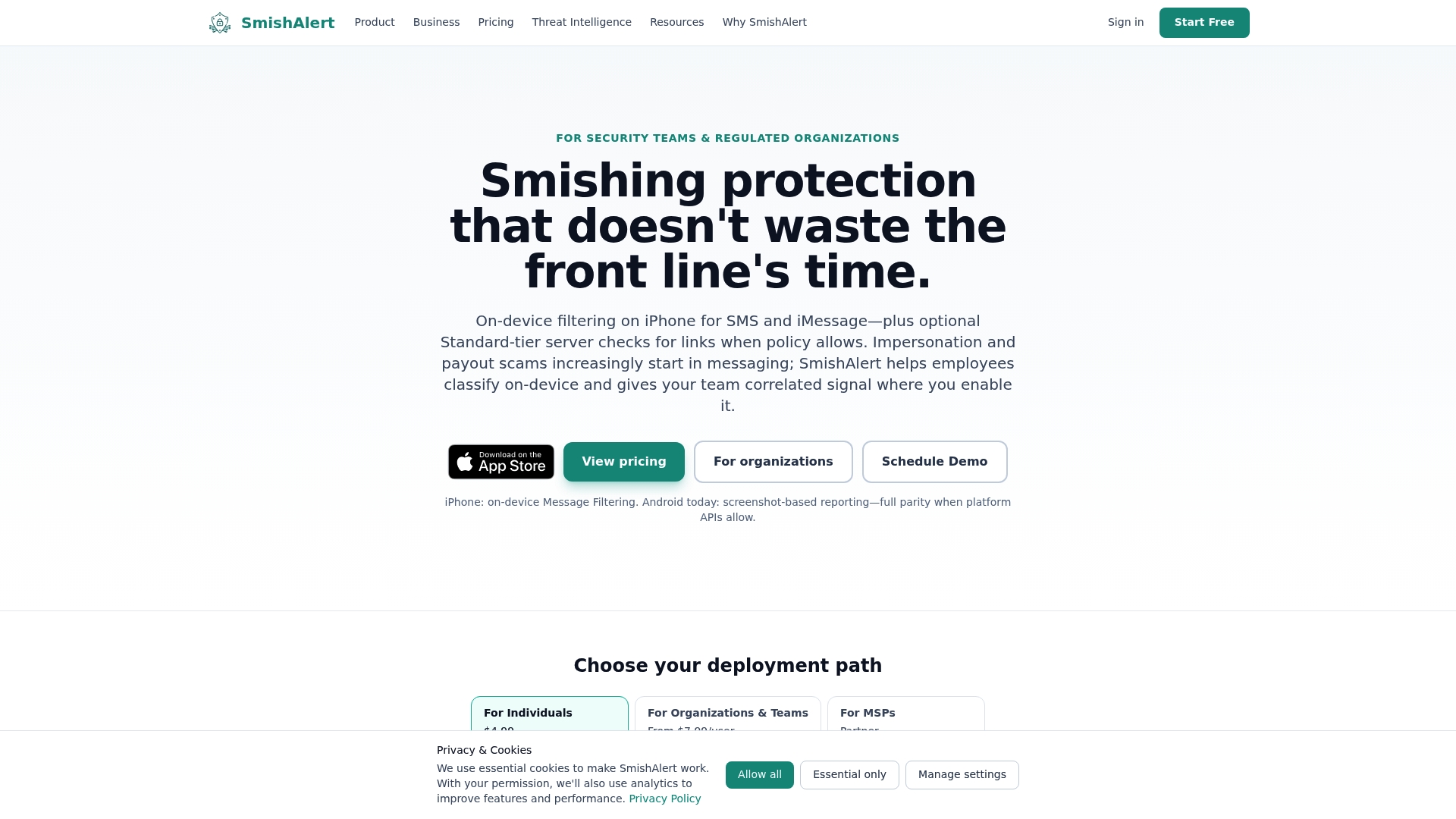
Smishalert surfaces social engineering attack types including executive impersonation, credential harvesting, payroll fraud, and gift card scams targeting employees through messaging channels. The platform captures user-reported threats, correlates campaigns, and feeds intelligence back to security operations teams. Security leaders who want to assess their current exposure can complete a 2-minute readiness check to identify gaps in their messaging threat coverage. For teams building or expanding a mobile security program, Smishalert integrates directly with existing MDM and MTD frameworks.
FAQ
What are mobile threat detection best practices?
Mobile threat detection best practices are layered controls covering application, network, and device/OS layers that proactively identify and contain threats before compromise. They include patch management, MTD integration, AI-assisted triage, and real-time phishing detection.
Why is MDM not enough for mobile security?
MDM enforces device policy but cannot detect active threats like malicious apps or network attacks. MTD tools provide behavioral detection and can trigger automated responses such as conditional access blocking when a threat is detected.
How does AI improve mobile threat detection?
AI ranks app risk and detects behavioral anomalies faster than manual review. Human analysts must remain in the loop for final decisions, as fully automated blocking produces false positives that degrade detection program effectiveness.
What is the best way to detect smishing attacks?
Real-time URL scanning across SMS and messaging apps, combined with behavioral detection for phishing patterns and a user reporting workflow, provides the most effective defense against smishing and mobile phishing campaigns.
Why is SMS-based MFA a security risk?
Government cybersecurity bodies advise against SMS-based MFA because it is vulnerable to SIM-swapping and interception attacks. Authenticator apps and biometric authentication are the recommended replacements for enterprise environments.