
Mobile Security's Role in Security Budgets: 2026 Guide

Mobile security is defined as the practice of protecting organizational devices, applications, and data from threats that originate outside the traditional network perimeter. The role of mobile security in security budgets has shifted from a line-item afterthought to a primary risk driver, and the numbers justify that shift. 72% of organizations experienced at least one mobile app security incident in the past year. Mobile phishing exposure increased by 20% in a single quarter in 2025. Security leaders who still treat mobile as a secondary concern are making a budget decision that carries measurable financial consequences. Mobile Threat Defense (MTD), penetration testing, and unified endpoint management are no longer optional line items. They are the core of any defensible security posture.
How does mobile security influence overall security budget allocations?
Mobile devices are now central to how breaches begin. Only 35% of organizations have deployed MTD, despite mobile devices being involved in 59% of recent incidents. That gap between adoption and exposure is where budget decisions carry the most risk.
The financial case for mobile security investment is direct. The average cost of a mobile app security breach reached $6.99 million. Professional penetration testing costs between $7,000 and $35,000 per platform. The math is not complicated. Spending $35,000 to test a mobile application is not an expense. It is cost avoidance against a potential $6.99 million loss.

Risk-based budgeting maps each spending decision to a specific, quantified threat. Security leaders who align budget lines to mobile risks gain faster board approval and better return on investment than those who present a generic technology list. The mobile attack surface, including SMS phishing, credential harvesting via messaging apps, and executive impersonation, must appear as named risk categories in the budget, not as vague “mobile security” line items.
| Investment Type | Typical Cost | Breach Cost Avoided |
|---|---|---|
| Mobile app penetration testing | $7,000–$35,000 per platform | Up to $6.99M per incident |
| Mobile Threat Defense platform | Varies by vendor | Reduces incident investigation costs |
| Managed Detection and Response | Subscription model | Reduces dwell time and lateral movement |
| Security awareness training (mobile focus) | Low per-seat cost | Reduces credential-harvesting success rate |
Pro Tip: When presenting mobile security budget requests, anchor every line item to a specific threat scenario and its estimated financial impact. CFOs respond to cost avoidance framing, not feature lists.
What are common challenges and pitfalls in budgeting for mobile security?
The most common budgeting failure is purchasing mobile security tools without the analyst capacity to operate them. Adding more software without analyst capacity causes alert fatigue. Security teams end up with dashboards full of signals and no one to act on them. The result is wasted spend and a false sense of coverage.
A second failure mode is treating mobile devices as secondary endpoints. Traditional SIEM and IAM platforms were built around network perimeters. They produce blind spots by treating mobile devices as secondary, which means threats arriving through SMS, WhatsApp, or iMessage go unlogged and uninvestigated. Security leaders who rely solely on email security platforms miss an entire category of social engineering risk.
Common pitfalls in mobile security budgeting include:
- Tool sprawl without consolidation: Purchasing separate solutions for mobile device management, MTD, and endpoint detection creates fragmentation. Vendor consolidation reduces licensing costs and improves telemetry correlation.
- No mobile-specific incident response playbook: Without defined procedures for mobile phishing or credential harvesting via messaging apps, response times increase and breach costs rise.
- Underestimating staffing requirements: Investments lacking skilled personnel degrade defense capabilities. Tools do not operate themselves.
- Ignoring managed services: Managed Detection and Response (MDR) providers often deliver better coverage per dollar than expanding an internal team, particularly for organizations with limited security staff.
Pro Tip: Target 40–50% of your security budget on people and services, and 30–40% on technology. Reversing that ratio is the most common reason mobile security programs underperform.
How can organizations justify mobile security investments to leadership?
Security leaders who win budget approval frame mobile security spending as risk-aligned cost avoidance, not as a technology purchase. That framing speaks directly to how CFOs and boards evaluate financial decisions. A $6.99 million average breach cost is a number a CFO understands. A “next-generation MTD platform” is not.
Risk quantification converts cybersecurity budgets into measurable business outcomes. The process requires attaching a probability and a financial impact to each mobile threat scenario. Executive impersonation via SMS, payroll fraud through WhatsApp, and credential harvesting through mobile phishing are not abstract threats. Each has a documented cost range and a documented frequency.
A structured justification follows this sequence:
- Name the specific threat. Identify the mobile attack vector, such as SMS phishing targeting finance staff, with documented incident data from your industry.
- Quantify the financial exposure. Use breach cost benchmarks, regulatory fine estimates, and operational downtime costs to build a realistic loss range.
- Present the control cost. Show the cost of MTD, penetration testing, or user reporting tools against the exposure figure.
- Demonstrate residual risk. Show what risk remains after the investment, and what additional spend would be required to reduce it further.
- Align to a business outcome. Connect the investment to a specific business priority, such as protecting payroll systems, securing executive communications, or maintaining regulatory compliance.
Budget requests emphasizing risk-aligned cost avoidance gain faster approval than those focused on technical capabilities or threat lists. That is not a soft observation. It reflects how financial decision-makers are trained to evaluate risk.
What practical strategies improve mobile security budget integration?
Effective mobile security budget integration requires a framework built around four operational pillars: lifecycle management, identity enforcement, layered threat defense, and scalable support. Successful mobile security programs prioritize unified visibility across these pillars rather than adding fragmented tools that each address a single attack vector.
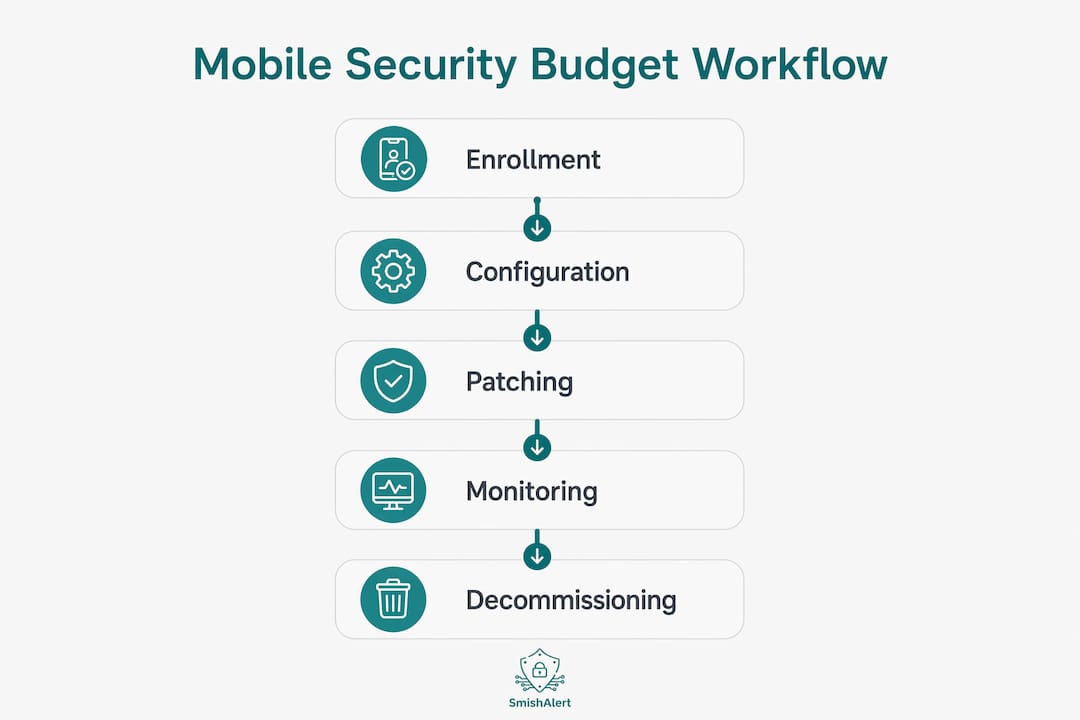
Lifecycle management means budgeting for device enrollment, configuration, patching, and decommissioning as a continuous operational cost, not a one-time project. Identity enforcement means IAM controls extend to mobile devices, so that compromised credentials harvested through a smishing attack cannot be used to access corporate systems. Layered threat defense means combining MTD with user reporting capabilities so that threats detected by technology and threats reported by employees both feed into the same telemetry pipeline.
The following allocation framework gives security leaders a starting point for distributing mobile security spend across functional areas:
| Budget Category | Recommended Allocation | Primary Function |
|---|---|---|
| People and managed services | 40–50% | Analyst capacity, MDR, security awareness training |
| Technology platforms | 30–40% | MTD, unified endpoint management, SIEM integration |
| Testing and assessment | 10–15% | Penetration testing, red team exercises, app security audits |
| Incident response readiness | 5–10% | Playbook development, tabletop exercises, retainer fees |
Scalable support models matter because mobile threat volume grows with workforce size. Organizations that build mobile security programs on fixed-cost tools without scalable analyst support find that coverage degrades as the device fleet expands. Managed security providers who specialize in mobile threat detection offer a more predictable cost structure for organizations scaling past a few hundred endpoints. Reviewing the security budget checklist for mobile threats helps security leaders confirm that each of these pillars has a corresponding budget line before the fiscal year begins.
Key Takeaways
Mobile security budget decisions that are not tied to quantified risk scenarios consistently underperform and leave organizations exposed to threats that traditional perimeter tools cannot detect.
| Point | Details |
|---|---|
| Mobile is a primary breach vector | Mobile devices are involved in 59% of incidents, yet only 35% of organizations have MTD deployed. |
| Breach cost dwarfs prevention cost | A $6.99M average breach cost makes $7,000–$35,000 in penetration testing a clear financial priority. |
| Staffing determines tool effectiveness | Allocate 40–50% of the security budget to people and services before expanding technology spend. |
| Risk framing wins board approval | Presenting mobile security as cost avoidance, not a technology purchase, accelerates executive approval. |
| Unified visibility reduces waste | Consolidating mobile threat telemetry into a single pipeline eliminates blind spots and duplicate spend. |
What I’ve learned about mobile security budgets that most guides won’t tell you
The most persistent blind spot I see in mobile security budgeting is not a technology gap. It is a visibility gap that organizations have decided to accept. Security teams know that employees receive SMS phishing attempts, WhatsApp impersonation messages, and credential-harvesting links through iMessage. They also know that none of those events appear in their SIEM. The budget decision to not address that gap is often framed as a resource constraint, but it is actually a risk acceptance decision that has not been formally documented or approved.
The organizations that close this gap fastest are not the ones with the largest budgets. They are the ones that treat mobile threat data as operational intelligence, not as a compliance checkbox. When a finance employee reports a payroll fraud attempt via SMS, that report is a signal. It tells you which threat actor is active, which employees are being targeted, and which attack pattern is in use. Organizations that capture and correlate those signals build a threat picture that informs every subsequent budget decision.
The second observation is about the mobile security gap in enterprises and how long it persists after it is identified. Security leaders often acknowledge the gap in a quarterly review, add it to the roadmap, and then watch it stay on the roadmap for 18 months while email security and endpoint detection receive renewed funding. Mobile threat defense gets deferred because it lacks a vocal internal champion and because the incidents it prevents are invisible until they are not. Building a mobile security budget line requires the same internal advocacy that endpoint detection received five years ago. The data now supports that case clearly.
— Sophie
How Smishalert supports mobile security budget decisions
Security leaders who need to justify mobile security spend require more than threat statistics. They need operational data showing what attacks are actually targeting their organization.
Smishalert captures and correlates social engineering attacks delivered through SMS, iMessage, WhatsApp, and other messaging channels, giving security teams the telemetry they need to quantify mobile risk in financial terms. The Smishalert platform surfaces executive impersonation attempts, credential-harvesting campaigns, payroll fraud, and gift card scams before they result in compromise. That visibility converts anecdotal mobile risk into documented incident data, which is exactly what a CFO needs to approve a budget line. Security leaders can review the full range of Smishalert solutions to identify which capabilities map to their highest-priority mobile threat scenarios.
FAQ
What is the role of mobile security in security budgets?
Mobile security defines a distinct risk category within the overall security budget, covering devices, applications, and messaging channels outside the corporate perimeter. Budget allocations for Mobile Threat Defense, penetration testing, and user reporting tools directly reduce the financial exposure from mobile-originated breaches.
How much does a mobile security breach cost on average?
The average cost of a mobile app security breach is $6.99 million. Professional penetration testing to prevent such breaches costs between $7,000 and $35,000 per platform, making prevention the clear financial choice.
Why do so few organizations have Mobile Threat Defense deployed?
Only 35% of organizations have MTD deployed, despite mobile devices being involved in 59% of recent incidents. The primary reasons are budget prioritization toward traditional endpoint tools and a lack of visibility into mobile-specific threat telemetry.
How should security leaders frame mobile security budget requests?
Security leaders should present mobile security investments as risk-aligned cost avoidance, linking specific threat scenarios to their documented financial impact. That framing converts a technology request into a business risk decision that CFOs and boards are equipped to evaluate.
What is the recommended budget split between people and technology in mobile security?
The recommended allocation is 40–50% of the security budget on people and managed services, and 30–40% on technology platforms. Reversing that ratio by over-investing in tools without analyst capacity is the most common cause of underperforming mobile security programs.