
Mobile Security Service Gap: What IT Leaders Must Know

A mobile security service gap is defined as the measurable difference between the mobile security controls an organization requires and the protections actually deployed. This gap includes missing controls, partially implemented policies, and ineffective mechanisms that leave devices, identities, and applications exposed. For IT security teams, understanding what is mobile security service gap means recognizing that compliance checklists and mobile device management (MDM) enrollment alone do not equal protection. Frameworks like NIST CSF, ISO 27001, and CIS Controls provide the structured lens needed to measure these gaps accurately. The organizations most at risk are those that confuse device management with device security.
What is a mobile security service gap in enterprise environments?
A mobile security service gap is a mismatch between required mobile controls and those actually implemented, including controls that are missing, partially deployed, or simply not working as intended. The industry term for this measurement process is cybersecurity gap analysis. Gap analysis differs from a general security posture review because it measures control-by-control distance from a target framework, producing a specific inventory of deficiencies rather than a broad risk score.
Security leaders often discover these gaps after an incident. A device passes MDM compliance checks, yet an attacker has already harvested credentials through a messaging-based phishing campaign. The gap was not in enrollment status. It was in runtime visibility and social engineering detection. Identifying the gap before that incident requires a deliberate audit across three distinct control layers: device trust, application risk, and identity lifecycle.

The consequences of unaddressed mobile security gaps extend beyond individual device compromise. Attackers use mobile endpoints as entry points for lateral movement into corporate networks, SIEM blind spots, and IAM bypass. Closing these gaps is not a one-time project. It is a continuous operational discipline.
What causes mobile security service gaps in MDM?
MDM was designed for fleet management and compliance reporting, not for runtime threat detection. That architectural decision creates a fundamental visibility gap. MDM can confirm that a device is enrolled, running an approved OS version, and encrypted. It cannot tell you what processes are running, whether a malicious payload is executing, or whether a user just responded to a credential-harvesting SMS.
The specific threats that MDM misses by design include:
- Process-level malware execution running after enrollment without triggering any compliance flag
- Messaging-based phishing attacks delivered through SMS, iMessage, or WhatsApp outside the corporate perimeter
- Behavioral anomalies such as unusual data exfiltration patterns or session hijacking
- Zero-day exploits targeting unpatched app dependencies that MDM has no visibility into
Organizations that rely on compliance checklists such as “device is managed” and “device is encrypted” miss runtime threats entirely. That reliance creates a false sense of security. A device can be fully MDM-compliant and actively compromised at the same time.
Pro Tip: Complement MDM with endpoint threat detection technologies, such as Mobile Threat Defense (MTD) platforms, that provide runtime process visibility and behavioral telemetry. MDM handles enrollment and policy. MTD handles what happens after.
The mobile endpoints that are hardest to protect are those where security teams assume MDM coverage equals security coverage. Separating those two concepts is the first step toward closing the MDM-related service gap.
How do identity governance gaps widen mobile security risk?
MDM is a control surface, not an identity governance model. Device posture must be explicitly linked to access lifecycle management to prevent stale permissions from persisting on managed devices. Without that link, a device can remain enrolled and compliant while the user account it belongs to carries excessive privileges from a previous role.
The joiner, mover, and leaver lifecycle events are where identity governance gaps most commonly appear on mobile:
- Joiner: A new employee receives a managed device with default entitlements that exceed their actual role requirements.
- Mover: An employee changes departments. MDM updates the device profile. IAM does not revoke the previous role’s access entitlements.
- Leaver: An employee departs. The device is wiped. The associated cloud application tokens and API credentials are not revoked.
MDM controls do not automatically enforce access entitlement changes during these lifecycle events. That disconnection leads to managed devices with persistent, overexposed accounts. An attacker who compromises a leaver’s mobile session inherits all of those residual permissions.
Aligning mobile endpoint controls with identity lifecycle management closes this gap. The practical approach is to use MDM telemetry signals, such as device enrollment status and compliance state, as triggers within identity governance workflows. When a device falls out of compliance, access entitlements should be automatically reviewed or suspended.
Pro Tip: Feed MDM compliance events directly into your IAM platform as conditional access signals. A non-compliant device should trigger an entitlement review, not just a helpdesk ticket.
What are mobile application layer security gaps?
The application layer is where mobile security gaps are most underestimated. 76% of mobile apps installed on enterprise devices present risks including explicit policy violations and unknown third-party dependencies. That figure means the majority of apps on managed devices carry risk that neither MDM nor standard MTD solutions are built to assess continuously.
The table below shows where common app-layer gaps occur and what security teams typically miss:
| Gap area | What MDM/MTD checks | What gets missed |
|---|---|---|
| App permissions | Installation-time permissions | Runtime permission changes and scope creep |
| Third-party dependencies | App store approval status | Vulnerable SDKs and supply chain risk |
| Behavioral monitoring | App presence on device | Data exfiltration patterns post-install |
| Trust verification | Login-time integrity check | Continuous session and behavior validation |
Security controls that only occur at login or build time leave trust gaps that attackers exploit between verification events. An app that passes integrity checks at install can later receive an update that introduces malicious behavior. Without continuous runtime telemetry, that change goes undetected.
Mobile app security cannot rely solely on pre-release testing. Continuous runtime telemetry is the only way to detect emerging threats after deployment. Security teams need a model that binds identity, device, and app signals together across the full mobile lifecycle, not just at discrete checkpoints.
Pro Tip: Audit your managed app catalog quarterly for third-party SDK vulnerabilities. App store approval does not equal ongoing security. Treat installed apps as living attack surfaces, not static artifacts.
How to identify and close mobile security service gaps
Structured gap analysis is the most effective method for identifying service gaps in mobile security. Frameworks like NIST CSF, ISO 27001, and CIS Controls provide control-by-control benchmarks that let security teams measure exactly where coverage falls short. The output is a prioritized remediation roadmap, not a general risk narrative.
A practical gap identification process follows these steps:
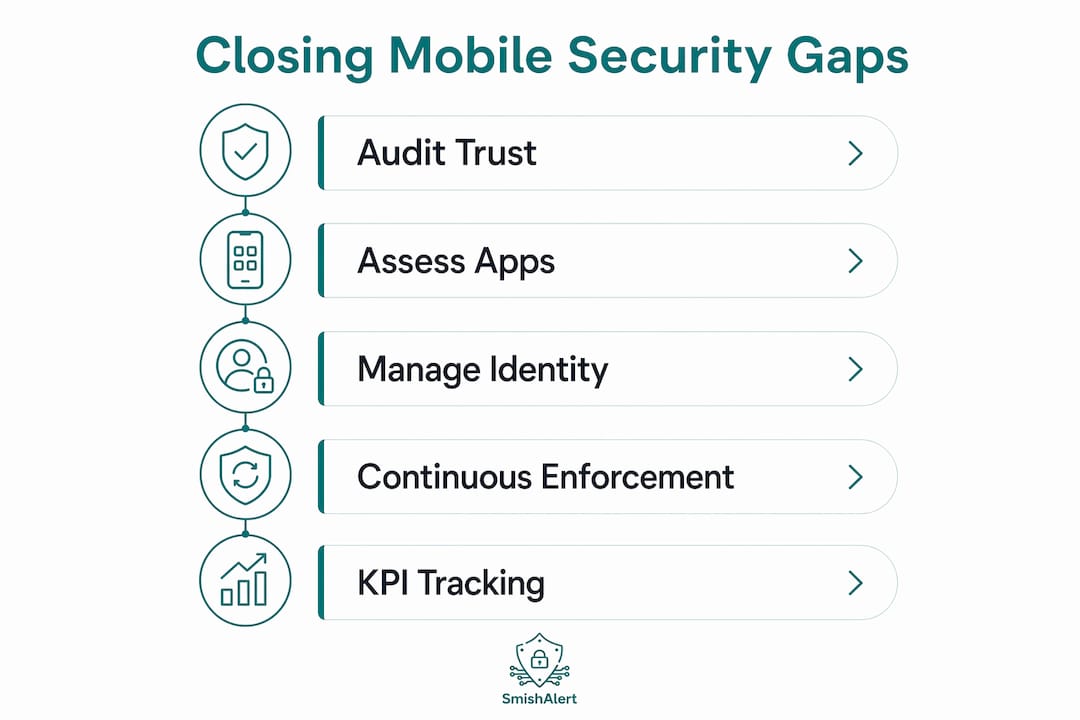
- Audit device trust separately. Inventory all enrolled devices, confirm MDM policy enforcement, and identify devices operating outside management scope.
- Assess application risk independently. Review installed apps for policy violations, third-party dependencies, and permission scope. Do not assume MDM enrollment implies app-level safety.
- Map identity lifecycle controls. Audit IAM entitlements against current role assignments. Flag stale permissions from mover and leaver events that MDM did not trigger for review.
- Test runtime detection coverage. Simulate behavioral anomalies and messaging-based phishing scenarios to verify whether existing controls generate alerts or remain blind.
- Prioritize remediation by risk and effort. Use the gap analysis output to rank deficiencies by potential impact, exploitability, and implementation cost.
The comparison below illustrates the difference between a compliance-focused approach and a gap-analysis-driven approach:
| Approach | What it measures | What it misses |
|---|---|---|
| Compliance checklist | Device enrollment, OS version, encryption | Runtime threats, identity lifecycle, app behavior |
| Gap analysis (NIST CSF) | Control-by-control coverage against target state | Nothing by design. Gaps are the output. |
When auditing mobile security, separating device trust, app-level risk, and identity lifecycle into distinct audit tracks prevents one layer from masking gaps in another. Teams that audit all three together often find that MDM compliance scores obscure significant identity and application exposure.
Closing gaps requires continuous enforcement, not one-time remediation. Building KPIs around compliance metrics without runtime threat monitoring fails to detect modern mobile breaches. Effective gap closure means replacing static checkpoints with continuously enforced controls that bind identity, device, and app context together. Smishalert’s guidance on closing the mobile security gap in enterprises outlines how organizations can structure that transition operationally.
Key Takeaways
A mobile security service gap is not a configuration error. It is a structural deficiency in how organizations deploy, integrate, and continuously enforce mobile controls across device, identity, and application layers.
| Point | Details |
|---|---|
| Define the gap precisely | A service gap is the measurable distance between required controls and those actually deployed. |
| MDM is not enough | MDM provides compliance visibility but cannot detect runtime threats or behavioral anomalies. |
| Identity lifecycle is a gap source | Joiner, mover, and leaver events create stale entitlements that MDM does not automatically resolve. |
| App layer risk is underestimated | 76% of enterprise mobile apps carry risks that standard MDM and MTD tools do not continuously assess. |
| Gap analysis drives remediation | NIST CSF, ISO 27001, and CIS Controls provide the control-by-control benchmarks needed to prioritize fixes. |
The MDM confidence problem is bigger than most teams admit
The most persistent mobile security challenge I have observed is not a technology gap. It is a confidence gap. Security teams deploy MDM, see green compliance dashboards, and conclude that mobile is covered. That conclusion is operationally dangerous.
MDM was never designed to answer the questions that matter most during an active incident: What is this device doing right now? Did this user respond to a phishing message? Is this app exfiltrating data to an unauthorized endpoint? Those questions require runtime telemetry, behavioral analysis, and social engineering visibility. MDM provides none of those.
The organizations that close mobile security gaps fastest are those that treat MDM as one input into a broader control model, not as the model itself. They integrate MDM compliance signals into IAM workflows. They run continuous app risk assessments. They instrument messaging channels for social engineering detection. That combination produces the runtime visibility that compliance dashboards cannot.
The cultural challenge is real. Stakeholders see MDM enrollment rates and assume coverage. Gaining buy-in for additional investment requires translating gap analysis findings into business risk language. Show the entitlement exposure from leaver events. Show the app-layer vulnerabilities on managed devices. Show the messaging-based phishing attempts that MDM never logged. Numbers tied to specific risk scenarios move budgets faster than framework citations.
The direction for 2026 and beyond is clear. Mobile security must operate as a continuously enforced, lifecycle-wide trust model. Static checkpoints are the gap.
— Sophie
How Smishalert addresses mobile security service gaps
Security teams that have closed their MDM and identity governance gaps often discover a third blind spot: messaging-based social engineering. Executive impersonation, credential-harvesting SMS campaigns, and payroll fraud attempts arrive through channels that sit entirely outside the corporate perimeter and outside MDM visibility.
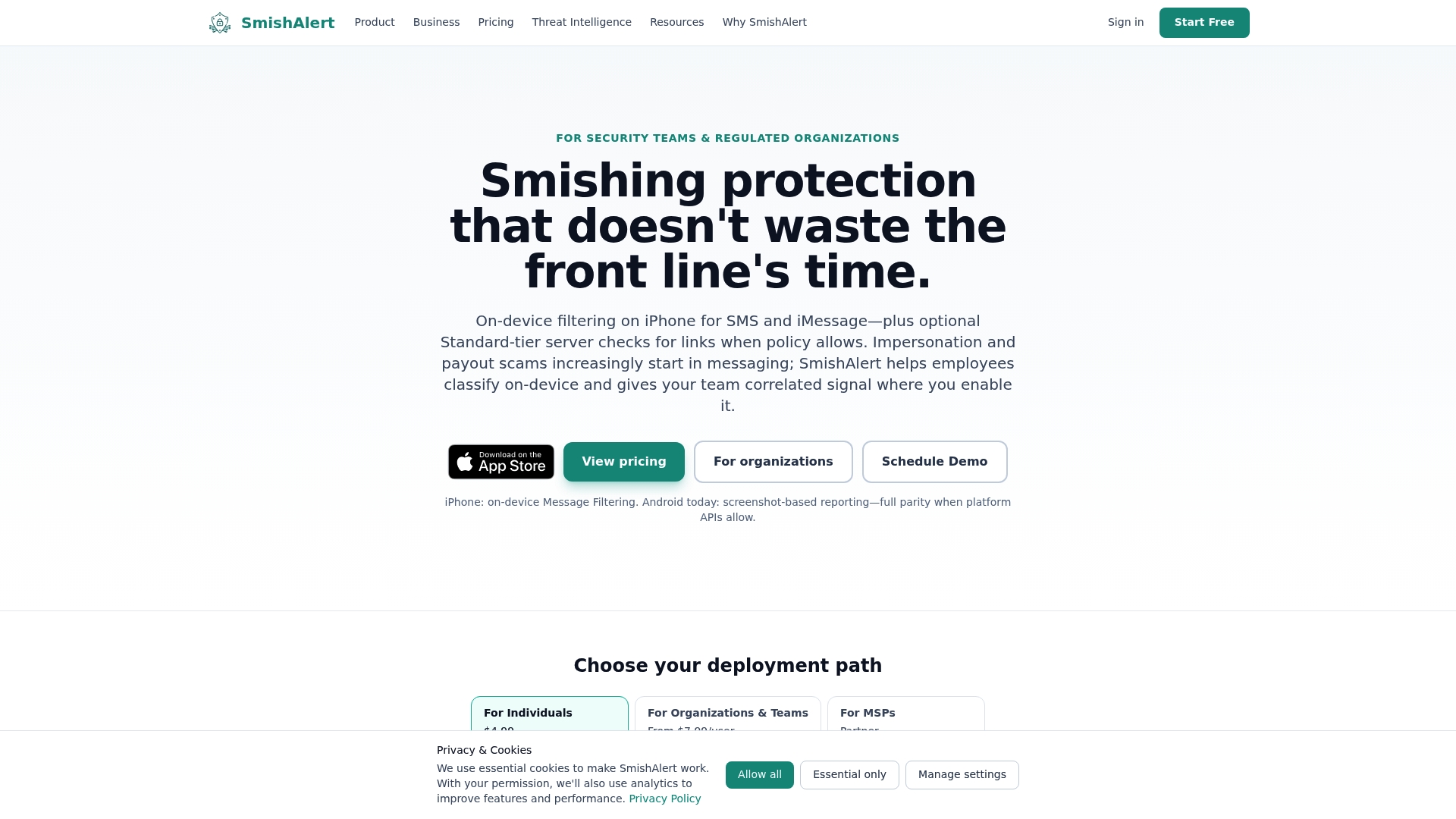
Smishalert provides the runtime visibility layer that MDM cannot. Through user reporting, threat analysis, and campaign correlation across SMS, iMessage, and WhatsApp, Smishalert surfaces the social engineering attacks that precede credential compromise and lateral movement. Security teams gain a clear picture of their human attack surface on mobile. The Smishalert platform captures, correlates, and reports on messaging threats in real time. To measure your current exposure, request a 30-day exposure assessment and identify the social engineering gaps your existing controls are not detecting.
FAQ
What is a mobile security service gap?
A mobile security service gap is the measurable difference between the mobile security controls an organization requires and those actually deployed. It includes missing, partially implemented, and ineffective controls identified through structured gap analysis using frameworks like NIST CSF or CIS Controls.
Why does MDM leave mobile security gaps?
MDM was designed for device compliance and fleet management, not runtime threat detection. It cannot monitor process-level behavior, detect messaging-based phishing, or flag behavioral anomalies occurring after enrollment.
What is a mobile device management security gap in identity governance?
A mobile device management security gap in identity governance occurs when MDM-managed device posture is not linked to user entitlement lifecycle events. Joiner, mover, and leaver transitions create stale or excessive permissions that MDM does not automatically revoke.
How do you close mobile security service gaps?
Close mobile security service gaps by auditing device trust, application risk, and identity lifecycle as separate control tracks. Use NIST CSF or CIS Controls to benchmark each layer, then prioritize remediation by risk and implement continuous enforcement rather than one-time checks.
Why are mobile application layer gaps hard to detect?
App-layer gaps are hard to detect because MDM and MTD tools typically assess apps at installation, not continuously. Third-party SDK vulnerabilities, runtime permission changes, and behavioral anomalies after install remain invisible without ongoing telemetry and app risk monitoring.