
Mobile Messaging Threat Visibility: 2026 SOC Guide

Mobile messaging threat visibility is the real-time detection and analysis of malicious activity targeting employees through SMS, iMessage, WhatsApp, and other messaging channels. The industry term for the underlying technology is Mobile Threat Defense (MTD), and it sits at the center of any credible enterprise response to smishing and mobile phishing. Traditional security stacks were not built for this problem. Verizon DBIR 2026 data shows mobile messaging attacks achieve a 40% higher click-through rate than email phishing simulations. That gap tells SOC analysts and IT leaders exactly where the next breach is most likely to start.
Why does mobile messaging threat visibility fail with traditional tools?
Traditional endpoint detection and response (EDR), network telemetry, and mobile device management (MDM) platforms share a structural blind spot: they cannot inspect the content of encrypted messaging applications. End-to-end encryption in WhatsApp, Signal, and iMessage is the feature that protects user privacy. It is also the feature that blocks network-level inspection entirely.
The problem runs deeper than encryption alone. State-sponsored actors now exploit native app features, such as WhatsApp’s device linking capability, to establish persistent access without triggering any EDR alert. The attack does not involve malware in the traditional sense. It uses a legitimate app function. No signature matches. No anomaly fires in the SIEM.
Smishing compounds the challenge because it is a social engineering attack, not a technical exploit. Smishing uses urgent text messages with malicious links or fake login pages to trick users into surrendering credentials or installing malware. The threat lives in human behavior, not in a packet payload. Conventional logs capture none of it.
The malware risk downstream of a successful smishing attack is also growing fast. Mobile banking trojans rose 50% in Q1 2026, with Securelist reporting 162,275 banking-trojan-related packages detected on Android. That figure reflects how quickly attackers monetize a credential obtained through a single smishing message.
Key gaps that traditional tools cannot close:
- Encrypted content inspection: Network DLP and proxy tools have no visibility inside end-to-end encrypted channels.
- Social engineering signals: User behavior during a smishing interaction produces no log entry in MDM or EDR.
- Native feature abuse: Device linking, account transfers, and verification prompt manipulation occur inside legitimate app flows.
- BYOD coverage: Personal devices enrolled only in MDM receive configuration management, not active threat detection.
- Cross-channel correlation: A smishing link clicked on a personal phone does not appear in corporate network logs.
Pro Tip: If your SOC is treating mobile as a low-priority surface because you see no alerts, that silence is the problem. Zero alerts from encrypted messaging channels means zero visibility, not zero threats.
How does mobile threat defense improve visibility into mobile threats?
MDM manages device configuration and policy compliance. MTD detects active threats at the device and operating system level. NIST SP 800-124 Rev. 2 explicitly recommends behavioral threat detection to close the gap that MDM leaves open. The two tools are complementary, not interchangeable.
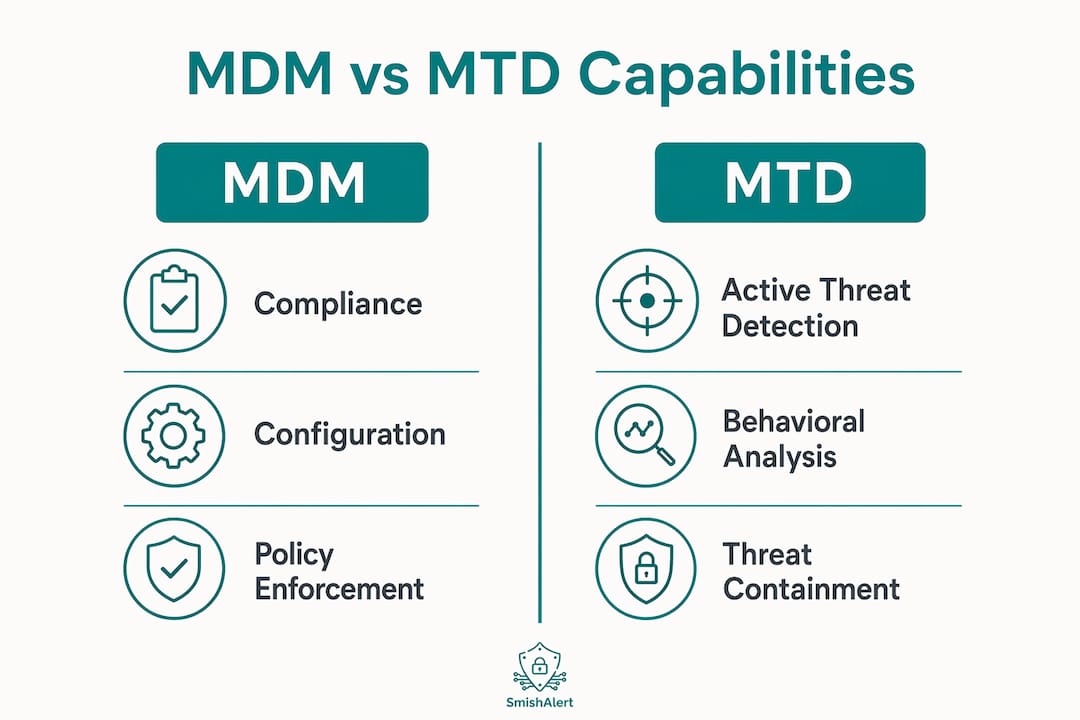
MTD agents deployed on endpoints generate telemetry that network tools cannot. That telemetry includes app behavior audits, OS integrity checks, URL and link analysis within SMS and messaging apps, and detection of malicious configuration profiles. When a user receives a smishing link and taps it, an MTD agent can flag the URL against threat intelligence feeds before the page loads.
The detection workflow in a mature MTD deployment follows a clear sequence:
- App audit: MTD scans installed applications for known malicious packages and behavioral anomalies, including sideloaded APKs on Android.
- Network threat detection: The agent identifies rogue Wi-Fi networks, SSL stripping attempts, and man-in-the-middle conditions that amplify smishing risk.
- URL and link analysis: Outbound links from SMS and messaging apps are checked against threat intelligence in real time.
- OS integrity verification: Jailbroken or rooted devices are flagged immediately, as they remove the security controls MTD depends on.
- Automated response: Confirmed threats trigger Conditional Access policies, blocking the device from corporate resources until remediation is complete.
The Conditional Access integration is where MTD moves from detection to containment. A device flagged by MTD can be quarantined from Microsoft 365, Okta-protected applications, or any IAM-gated resource within seconds of detection. That speed matters because effective containment requires telemetry quality that supports automated blocking before rapid credential compromise occurs.
MTD has real limitations worth acknowledging. It requires agent deployment, which creates friction on BYOD devices. Privacy concerns from employees are legitimate and must be addressed in policy before rollout. MTD also does not provide content-level visibility into encrypted messages. It detects behavioral signals around those messages, not the messages themselves.
Pro Tip: Treat MTD deployment as a detection layer, not a content inspection tool. Set expectations with leadership accordingly. MTD tells you a threat occurred and where. It does not tell you what was said.
What are the key detection signals for smishing and encrypted messaging attacks?
With content inspection unavailable, detection shifts to behavioral anomalies and correlated endpoint signals. NCSC guidance specifically identifies unexpected device linking, new linked device notifications, and unsolicited verification prompts as early warning indicators of messaging app compromise.
These signals are detectable without reading message content. They appear in audit logs, endpoint telemetry, and user-reported events. The challenge is that most organizations have no process for collecting or acting on them.
| Detection Signal | Source | Threat Indicator |
|---|---|---|
| Unexpected device linking | App audit log / user report | Account takeover via device pairing |
| Unsolicited verification prompt | User report | Credential stuffing or account transfer attempt |
| Group chat participant changes | App audit log | Infiltration or impersonation campaign |
| New linked device notification | Endpoint telemetry | Persistent access established by attacker |
| SMS link click to unknown domain | MTD URL analysis | Active smishing interaction |
User reporting is an undervalued detection channel. When employees are trained to recognize and report smishing attempts, they become sensors in the human layer of the attack surface. A single reported smishing campaign can surface a threat that no automated tool detected. Smishalert is built around this principle, treating user reports as first-order threat intelligence rather than noise.
Multi-factor authentication governance also reduces the attack surface directly. Reducing reliance on SMS-based OTP for privileged access significantly diminishes smishing attack surfaces. Phishing-resistant authentication methods such as FIDO2 hardware keys or authenticator apps remove the credential-harvesting payoff that makes smishing profitable for attackers.
MDM alone vs. MTD with detection analytics: what is the real difference?
The comparison between MDM-only deployments and MTD-augmented environments is not close. MDM and MTD must be deployed together for a complete mobile security posture. MDM achieves compliance. MTD provides active threat detection.
| Capability | MDM Only | MDM + MTD + Analytics |
|---|---|---|
| Device configuration enforcement | Yes | Yes |
| Malicious app detection | No | Yes |
| Smishing link analysis | No | Yes |
| Behavioral anomaly detection | No | Yes |
| Automated Conditional Access response | No | Yes |
| SOC alert integration (SIEM) | Limited | Full telemetry feed |
| BYOD threat visibility | Minimal | Agent-dependent |
The SOC impact of this gap is measurable. Mobile messaging threats produce faster user interaction and credential compromise than email phishing. An analyst working from MDM logs alone will see no signal until after a credential is used in a downstream attack. By that point, lateral movement may already be underway.
Adding MTD with SIEM integration changes the analyst workflow. Alerts arrive with device context, threat classification, and recommended response actions. Decision latency drops. Containment becomes a policy-driven automated action rather than a manual investigation. For SOC teams managing hundreds of endpoints, that difference in response time directly affects breach outcomes.
The most effective enterprise posture combines MDM for compliance, MTD for active detection, user awareness training for the human layer, and a platform like Smishalert for detecting phishing in SMS and messaging apps that fall outside the corporate perimeter entirely.
How can security teams improve mobile messaging threat detection in practice?
Improving visibility into mobile threats requires changes across technology, policy, and people. No single tool closes every gap.
- Deploy MTD agents with Conditional Access integration. Select an MTD solution that feeds alerts directly into your SIEM and triggers automated quarantine via your IAM platform. Microsoft Intune, Jamf, and similar MDM platforms support MTD integrations through published APIs.
- Enforce corporate messaging policies. Restrict unauthorized messaging apps on managed devices. Define which channels are approved for business communication and enforce that policy through MDM configuration profiles. Review mobile messaging policy best practices to build a defensible baseline.
- Run smishing awareness training with simulations. Phishing simulation platforms that include SMS scenarios give SOC teams data on employee click-through rates and reporting behavior. Use that data to prioritize high-risk user groups for additional training.
- Integrate user reporting into threat intelligence workflows. Build a process for employees to report suspicious messages and route those reports into your threat analysis pipeline. Smishalert captures, correlates, and analyzes user-reported smishing attempts across SMS, iMessage, and WhatsApp at scale.
- Migrate privileged access away from SMS-based OTP. Replace SMS authentication for high-value accounts with FIDO2 or TOTP authenticator apps. This single change removes the most common credential-harvesting payoff from smishing attacks.
- Tune detection rules for mobile-specific ATT&CK techniques. Map your MTD alert categories to MITRE ATT&CK for Mobile. Prioritize detection rules for initial access techniques including smishing (T1660) and device linking abuse.
Pro Tip: Start your MTD rollout on corporate-owned devices before tackling BYOD. You will resolve the technical integration challenges before you face the privacy policy negotiations that BYOD requires.
Smishing protection best practices for enterprise environments also recommend enabling two-step verification on all messaging apps used for business communication. This single control blocks the most common account takeover vector in WhatsApp and Telegram targeting campaigns.
Key takeaways
Mobile messaging threat visibility requires behavioral detection at the endpoint layer because encryption makes content inspection impossible across SMS, iMessage, and WhatsApp.
| Point | Details |
|---|---|
| MTD closes the MDM gap | MDM manages compliance; MTD detects active threats like smishing links and malicious apps in real time. |
| Behavioral signals are the detection surface | Unexpected device linking, verification prompts, and group chat changes are detectable without reading message content. |
| Smishing outperforms email phishing | Mobile messaging attacks achieve a 40% higher click-through rate, making mobile the higher-priority threat surface. |
| Automated response reduces breach risk | MTD integrated with Conditional Access contains compromised devices before lateral movement begins. |
| User reporting is a detection layer | Employee-reported smishing attempts surface threats that automated tools miss, especially on personal devices. |
The blind spot that keeps growing
The operational reality for most SOC teams in 2026 is that mobile messaging sits in a detection dead zone. Encryption is not going away. Social engineering does not trigger signatures. And the attack surface keeps expanding as employees use WhatsApp, iMessage, and Signal for work conversations that never touch corporate infrastructure.
What concerns me most is not the sophistication of the attacks. It is the organizational assumption that silence equals safety. When MDM shows no alerts from messaging channels, many teams interpret that as low risk. The correct interpretation is that the telemetry does not exist, not that the threats do not.
The shift toward behavioral detection is the right direction, but it requires investment in MTD, SIEM integration, and user reporting workflows that most organizations have not prioritized. The teams that are ahead of this problem treat mobile messaging events as upstream triggers in the attack chain. They correlate endpoint detections with identity analytics to reconstruct incident context. They do not wait for a credential to appear in a downstream alert before they start investigating.
The future of this space will involve tighter integration between MTD telemetry, IAM signals, and platforms that specialize in the human layer of the attack surface. The organizations that build those integrations now will have a measurable advantage when the next smishing campaign hits their workforce.
— Sophie
How Smishalert closes the mobile visibility gap
Security teams that have deployed MDM and MTD still face a critical gap: threats delivered through messaging channels outside the corporate perimeter, including executive impersonation, payroll fraud, and gift card scams targeting employees on personal devices.
Smishalert is built specifically for this problem. The Smishalert platform captures user-reported smishing attempts across SMS, iMessage, and WhatsApp, correlates them into campaign-level intelligence, and delivers structured threat data that SOC analysts can act on. It complements MTD and MDM deployments by covering the human layer that automated tools cannot reach. Security leaders, IT teams, and managed security providers use Smishalert to measure their organization’s exposure to messaging-based social engineering and detect emerging attack campaigns before they result in compromise. Explore the full range of social engineering threats Smishalert surfaces across mobile channels.
FAQ
What is mobile messaging threat visibility?
Mobile messaging threat visibility is the ability to detect, analyze, and respond to malicious activity targeting employees through SMS, iMessage, WhatsApp, and similar channels in real time. It relies on behavioral detection and user reporting because end-to-end encryption blocks content inspection.
How does MTD differ from MDM for mobile security?
MDM enforces device configuration and compliance policies, while MTD actively detects threats including malicious apps, smishing links, and OS exploits. NIST SP 800-124 Rev. 2 recommends deploying both together for complete mobile endpoint protection.
Why is smishing more effective than email phishing?
Verizon DBIR 2026 data shows mobile messaging attacks achieve a 40% higher click-through rate than email phishing simulations. Mobile messages feel more personal and urgent, and they arrive outside the security controls that filter corporate email.
What behavioral signals indicate a messaging app compromise?
NCSC identifies unexpected device linking, unsolicited verification prompts, and new linked device notifications as early indicators of messaging app account takeover. These signals appear in audit logs and endpoint telemetry without requiring content inspection.
How can organizations reduce sms-based phishing risk without full MTD deployment?
Migrating privileged access away from SMS-based OTP to FIDO2 or TOTP authenticator apps removes the primary credential-harvesting payoff from smishing attacks. Combining that change with user reporting workflows provides meaningful visibility even before full MTD deployment is complete.