
Mobile Messaging Policy Best Practices for Security Teams

Mobile messaging policy best practices are defined as the layered governance controls, technical enforcement mechanisms, and compliance workflows that protect organizations from SMS-based social engineering, credential harvesting, and regulatory exposure. In 2026, the threat surface has expanded well beyond email: smishing, SIM swapping, and executive impersonation via WhatsApp and iMessage now represent primary attack vectors that most security programs still underestimate. Frameworks from CISA, NIST SP 800-63, and the CTIA Messaging Principles provide the regulatory scaffolding, while technologies including MDM, CASB, FIDO2/WebAuthn, and mobile threat defense supply the technical controls. The policies that actually work combine all of these layers rather than treating any single control as sufficient.
1. Mobile messaging policy best practices start with replacing SMS-based MFA
SMS one-time passwords are not a secure authentication factor for sensitive systems. CISA and NIST guidance explicitly recommend against SMS-based MFA, citing interception, SIM swap attacks, and credential-harvesting campaigns as documented, repeatable exploits. This is not a theoretical risk. Attackers routinely port a victim’s number to a new SIM, intercept the OTP, and complete account takeover within minutes.
Phishing-resistant MFA replaces SMS OTPs with controls that cannot be intercepted over a mobile network:
- FIDO2/WebAuthn hardware keys (YubiKey, Google Titan) bind authentication to a physical device and a specific origin, making credential replay impossible.
- Biometric authenticators embedded in managed devices provide strong assurance without requiring a separate token.
- App-based TOTP authenticators (Microsoft Authenticator, Duo) are a meaningful improvement over SMS, though they remain susceptible to real-time phishing without additional controls.
- Certificate-based authentication via MDM-enrolled devices ties identity to a managed endpoint, not a phone number.
Policy mandates should specify that SMS OTPs are prohibited for any system classified as sensitive or above, with a documented migration timeline and exception approval process. Security teams should also layer real-time mobile threat defense alongside MFA upgrades, since authentication hardening alone does not prevent users from clicking credential-harvesting links delivered via SMS.
Pro Tip: When rolling out FIDO2 keys, pair the deployment with a phishing simulation that targets the legacy SMS MFA flow. The simulation data will accelerate executive buy-in for the migration timeline.
2. Device and app management as enforcement infrastructure
Technical policy without enforcement infrastructure is a document, not a control. MDM enrollment is the baseline requirement for any device accessing corporate messaging channels. Platforms like Microsoft Intune, Jamf Pro, and VMware Workspace ONE enforce device health checks, certificate provisioning, and app allow-listing before a device can connect to corporate resources.

For BYOD environments, containerization separates personal and corporate messaging at the OS level. Managed app configurations on iOS and Android restrict copy-paste, screenshot, and data-sharing functions within corporate messaging clients, preventing accidental or intentional data leakage. BYOD smishing risks are particularly acute because personal devices lack the telemetry visibility that enrolled corporate devices provide.
CASB and DLP integrations extend policy enforcement to cloud-delivered messaging. Microsoft Defender for Cloud Apps and Netskope can inspect messaging API traffic, flag policy violations in real time, and block transmission of regulated data such as PII, PHI, or payment card information through unauthorized channels. Policy-as-code enforcement embedded in APIs and routing logic provides far more consistent governance than static PDF policies distributed to employees.
Pro Tip: Audit your MDM enrollment rates quarterly. Unenrolled devices accessing corporate messaging are a blind spot that attackers actively exploit, particularly in organizations with high contractor or seasonal workforce populations.
3. Compliance and consent requirements shaping messaging policy
Regulatory alignment is not optional for organizations running business text messaging programs. The CTIA Messaging Principles require documented opt-in and opt-out consent flows, explicit brand identification in every message, and inclusion of opt-out instructions. Non-compliance with CTIA rules results in message filtering by carriers, delayed campaign approvals, and regulatory exposure under TCPA.
The Campaign Registry (TCR) vetting process now governs 10DLC messaging in the United States. Organizations must register their brand and campaign use cases, and unregistered traffic faces aggressive filtering. Security teams should work with legal and marketing to audit all outbound SMS programs and confirm TCR registration status before any new campaign launches.
Rate limiting and bot detection on SMS sending endpoints address a separate but related compliance risk. Per-number and per-IP rate limits combined with device fingerprinting and exponential backoff reduce SMS pumping fraud and unauthorized OTP requests. These controls belong in the technical policy specification, not just the vendor contract.
Privacy policy and terms of service disclosures must reference the organization’s messaging program explicitly. Consent records should be stored with timestamps, source channel, and the specific consent language presented, retained for a minimum period aligned with applicable state privacy laws.
4. Detecting and responding to social engineering via mobile messaging
Detection of smishing and related attacks requires integrating mobile threat telemetry into existing SOC workflows. Metadata from SMS, RCS, MDM, CASB, and mobile threat defense ingested into a SIEM enables behavioral analytics that surface early-stage compromise indicators invisible from message content alone. SIM swap events, anomalous API call patterns, and sudden changes in device registration are all detectable signals when the right data feeds are connected.
Smishing simulation training is a direct countermeasure to the social engineering risk. SMS attack vectors produce higher click rates than email phishing because users apply less scrutiny to text messages. Organizations that limit simulations to email miss the channel where employees are most vulnerable. Simulation programs should include executive impersonation scenarios, fake IT help desk messages, and payroll redirect lures, all delivered via SMS to reflect real attacker tradecraft.
Help desk and credential reset procedures are a critical hardening target. Attackers use smishing to harvest enough personal information to pass knowledge-based authentication at the help desk, then reset credentials and complete account takeover. Policies must require out-of-band identity verification for all password reset requests, with no exceptions for urgency.
Incident response playbooks must include a dedicated mobile messaging track. When a user reports a suspicious SMS, the response workflow should capture the sender ID, message content, and any URLs, correlate against known campaign indicators, and trigger a device health check if the user interacted with any link.
Sender ID monitoring and customer-reporting channels provide an additional detection layer for spoofing campaigns targeting your brand or executives. Smishalert’s enterprise smishing protection guidance covers how to operationalize these reporting workflows within a security program.
5. Comparing mobile messaging platforms for enterprise security
Not all messaging channels carry equal risk, and effective mobile communication guidelines require tiering platforms by data sensitivity and available controls.
| Platform | Encryption | MDM/Archiving support | Recommended use case |
|---|---|---|---|
| SMS | None (transport layer only) | Metadata logging only | Low-sensitivity notifications, MFA replacement required |
| RCS | E2EE optional (MLS standard) | Limited archiving hooks | Low-sensitivity internal comms with explicit restrictions |
| Microsoft Teams | E2EE with compliance archiving | Full MDM and DLP integration | Internal collaboration, sensitive discussions |
| Slack (Enterprise Grid) | E2EE with DLP and eDiscovery | Full MDM and CASB integration | Project communication, regulated data with controls |
| WhatsApp Business | E2EE, limited archiving | No native MDM integration | External customer comms only, no sensitive data |
SMS remains the highest-risk channel because it carries no native encryption and offers no content-level archiving. Encrypted RCS platforms introduce a different problem: end-to-end encryption creates archiving gaps that conflict with retention requirements under SEC Rule 17a-4, FINRA, and HIPAA. Policies must explicitly prohibit sensitive business conversations on platforms that cannot produce compliant archives.
Metadata logging is the practical compliance solution for channels where content archiving is not feasible. Logging sender, recipient, timestamp, message length, and device identifiers provides an audit trail without requiring content access. Centralized metadata retention for at least 12 months is the documented standard for enabling incident response and regulatory audit.
Automated policy enforcement via MDM, CASB, and DevOps integrations prevents unauthorized channels from being used in the first place. When a new messaging app is detected on an enrolled device, policy-as-code triggers an alert, blocks corporate data access, and routes the event to the SOC. This is the operational difference between a messaging policy that governs behavior and one that merely documents intent.
Pro Tip: Map your messaging platform inventory before writing policy. Most organizations discover three to five unauthorized messaging apps in active use by employees once they run an MDM app inventory audit.
Key takeaways
Effective mobile messaging security requires phishing-resistant authentication, MDM enforcement, CTIA-compliant consent workflows, behavioral threat detection, and platform-tiered governance working together as a unified control set.
| Point | Details |
|---|---|
| Replace SMS MFA immediately | CISA and NIST mandate phishing-resistant alternatives like FIDO2/WebAuthn for all sensitive systems. |
| Enforce MDM enrollment as a baseline | Unenrolled devices accessing corporate messaging create blind spots that attackers actively exploit. |
| Register and document consent workflows | CTIA and TCR compliance requires timestamped opt-in records and explicit brand identification in every message. |
| Ingest mobile telemetry into your SIEM | Metadata from MDM, CASB, and mobile threat defense surfaces early-stage compromise indicators before content-level detection is possible. |
| Tier platforms by data sensitivity | SMS is restricted to low-sensitivity notifications; regulated data requires platforms with compliant archiving and DLP integration. |
Why most messaging policies fail before they’re tested
Security teams often build mobile messaging policies the same way they built email policies a decade ago: a governance document, an annual training module, and a checkbox in the compliance audit. That approach fails for mobile because the attack surface is fundamentally different. SMS reaches employees on personal devices, outside corporate perimeter controls, at hours when their guard is lowest. The policy has to account for that reality, not assume it away.
The most common gap I see is the absence of any detection capability for what happens after a smishing link is clicked. Organizations invest in blocking known malicious URLs at the email gateway but have no equivalent visibility into SMS-delivered links. A user clicks a credential-harvesting link on their personal iPhone, enters their corporate credentials, and the SOC has no signal until the attacker uses those credentials from an anomalous IP three hours later. By then, lateral movement has already begun.
The second gap is help desk hardening. Social engineering attacks increasingly use SMS to harvest just enough personal information to pass knowledge-based authentication at the IT help desk. Policies that require out-of-band verification for credential resets close this vector, but they require explicit procedural documentation and regular testing. Tabletop exercises that simulate a smishing-to-help-desk attack chain reveal weaknesses faster than any audit.
The forward trajectory is toward AI-driven behavioral analytics that correlate mobile threat signals with identity and access management telemetry in real time. Organizations that build the data pipeline now, connecting MDM, CASB, mobile threat defense, and SIEM, will be positioned to operationalize those detections as they mature. Those that wait will be retrofitting infrastructure under incident conditions.
— Sophie
How Smishalert supports mobile messaging security programs
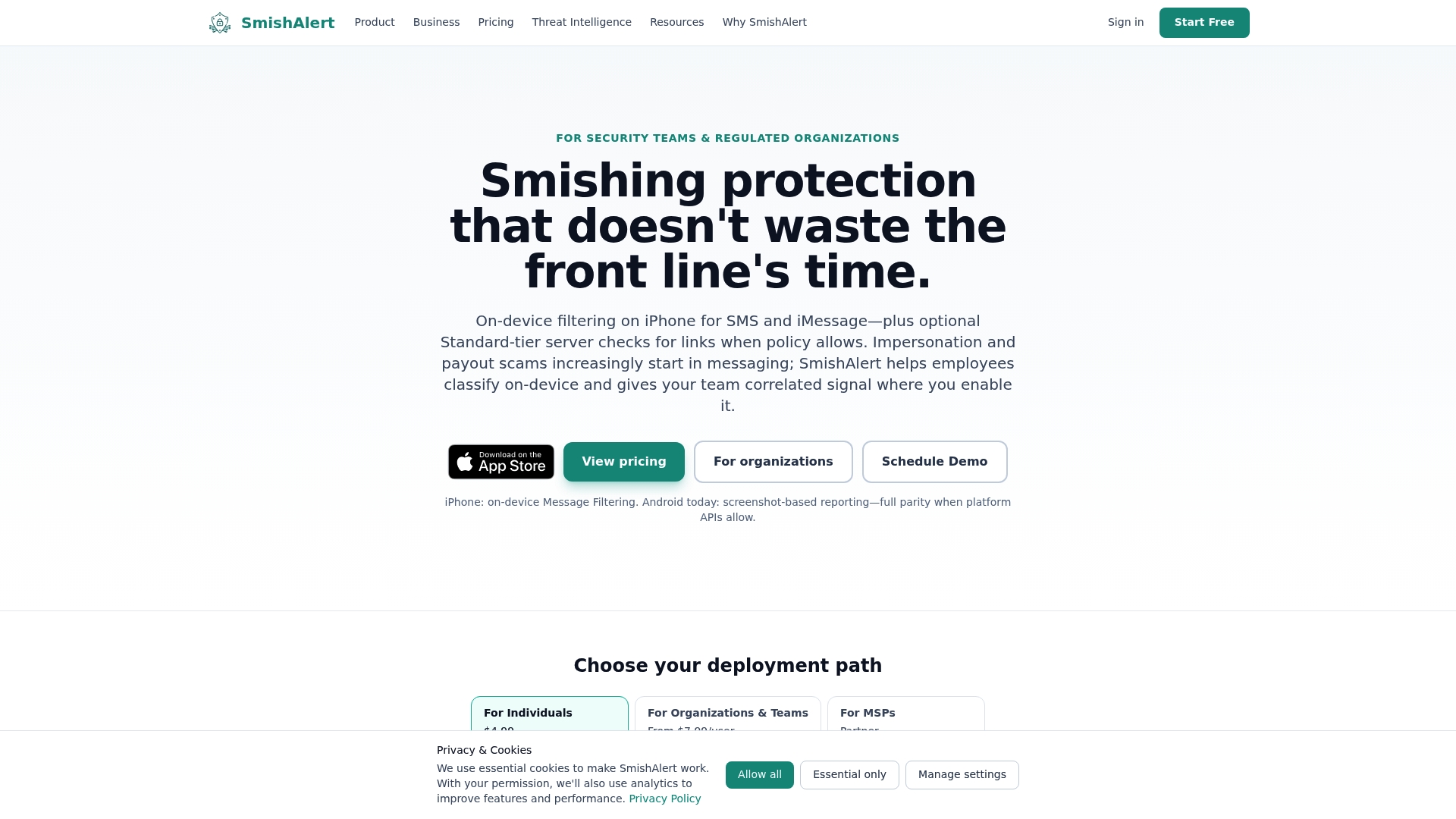
Smishalert gives security teams the visibility into messaging-based social engineering that traditional email security platforms cannot provide. The Smishalert platform captures, correlates, and reports on smishing campaigns targeting your employees across SMS, iMessage, WhatsApp, and other channels, including executive impersonation, credential harvesting via SMS, payroll fraud, and gift card scams. Metadata analysis and campaign correlation surface threats before they result in compromise, while user reporting workflows integrate directly into SOC processes. For security leaders building or maturing a mobile messaging security program, Smishalert aligns with the compliance and detection requirements covered in this article.
FAQ
What is the biggest risk with SMS-based MFA?
SMS one-time passwords are vulnerable to SIM swap attacks and real-time interception, allowing attackers to complete account takeover without ever accessing the target device. CISA and NIST SP 800-63 both recommend replacing SMS OTPs with phishing-resistant alternatives like FIDO2/WebAuthn for sensitive systems.
How long should organizations retain mobile messaging metadata?
Centralized logging of messaging metadata should be retained for at least 12 months to support incident response and regulatory audit requirements. Content archiving requirements vary by industry, with SEC Rule 17a-4 and HIPAA imposing longer retention periods for regulated communications.
What does CTIA compliance require for business SMS programs?
CTIA Messaging Principles require documented opt-in and opt-out consent flows, explicit brand identification in every message, and inclusion of opt-out instructions. Non-compliance results in carrier filtering, delayed campaign approvals, and TCPA exposure.
How do you detect smishing attacks targeting employees?
Smishing detection requires ingesting mobile threat telemetry, including SIM swap events, suspicious API calls, and device registration changes, into a SIEM for behavioral analytics. User reporting channels and sender ID monitoring provide additional detection coverage for spoofing campaigns.
Should organizations allow WhatsApp for internal business communication?
WhatsApp Business is appropriate only for external customer communications involving non-sensitive data. Its limited MDM integration and archiving gaps make it unsuitable for internal discussions involving regulated, confidential, or sensitive business information.