
Mobile Device Messaging Security Checklist for IT Teams

A mobile device messaging security checklist is a structured set of technical and policy controls that security teams use to verify, enforce, and audit protections across SMS, RCS, iMessage, WhatsApp, and other messaging channels on employee devices. CISA released updated mobile communications guidance in march 2026, urging organizations to apply messaging best practices to counter nation-state cyber espionage targeting encrypted channels. The threat is not theoretical. Mobile messaging sits outside the corporate perimeter, which means traditional email security tools provide zero visibility into smishing, executive impersonation, credential harvesting, and payroll fraud attacks delivered by text. This checklist covers the technical controls, policy requirements, encryption validation steps, and spyware mitigations your program needs to address that gap.
1. What belongs on a mobile device messaging security checklist?
The core purpose of a messaging security checklist is to give IT security teams a repeatable audit framework. Without a structured list, controls get applied inconsistently across device types, operating systems, and messaging apps. The checklist should cover four domains: technical controls, policy and process, encryption validation, and endpoint protection. Each domain maps to a distinct attack surface in the mobile messaging threat model.
The technical domain addresses MDM enforcement, app configuration, and authentication. The policy domain governs what messaging apps employees may use, how SMS is restricted, and what training is required. Encryption validation confirms that end-to-end encryption is operational, not just advertised. Endpoint protection addresses spyware, patching, and incident response. Security teams that treat these four domains as a single integrated program reduce the risk of gaps that attackers exploit between controls.

2. Top technical controls for mobile messaging security
Technical controls form the baseline of any messaging security policy framework. The following items belong on every enterprise checklist:
- Verify end-to-end encryption protocols. Confirm that messaging apps implement documented E2EE standards. For RCS, GSMA RCC.16 v3.0 defines the MLS-based encryption specification released in february 2026. UI indicators alone are not sufficient verification.
- Enforce MDM or EMM app protection policies. Mobile Device Management platforms must enforce device encryption, screen lock, and app-level data protection. Unmanaged devices have no enforceable baseline.
- Deploy phishing-resistant MFA. Replace SMS one-time passwords with hardware security keys or passkeys. SMS OTP is interceptable by spyware and SIM-swapping attacks.
- Restrict SMS to approved use cases. Corporate chat policy templates from 2026 recommend limiting SMS to MFA alerts and legacy system notifications only.
- Configure RCS with strict controls. Permit RCS internally only when E2EE is confirmed and device management is enforced across all participants.
- Require audit logging with full event context. Audit logs must capture actor, session, IP address, and outcome for every messaging event to support incident investigation.
- Enforce metadata protection. Confirm that messaging platforms minimize metadata exposure, including contact lists, message timing, and group membership.
Pro Tip: Validate MDM enrollment status before granting access to any corporate messaging app. An unenrolled device bypasses every app-level control you configure.
3. Organizational policies and user practices that reduce messaging risk
Policy controls and user behavior are the second layer of a complete messaging security compliance framework. Technical controls stop known attack patterns. Policy and training address the human decisions that attackers exploit through social engineering.
The following steps build a policy baseline that complements technical enforcement:
- Restrict SMS to approved functions. Define in writing which systems may send SMS to employees and for what purpose. Employees should not receive business communications over SMS from unknown numbers.
- Train employees to recognize smishing. Employees should never click links in suspicious texts. They should verify requests through official apps or known phone numbers, not through contact details provided in the message itself.
- Implement out-of-band verification workflows. Establish a documented process for verifying urgent requests received by text. Attackers use urgency and authority to bypass normal judgment. A written playbook removes improvised decisions during a crisis.
- Enable notification redaction on lock screens. Message previews on lock screens expose content to anyone who picks up the device. MDM policy should enforce notification redaction for all messaging apps.
- Configure remote wipe and remote sign-out. Confirm that IT can remotely sign out a user from all messaging sessions and wipe device data within a defined response window.
- Enable spam filtering and reporting. Mobile OS spam filtering reduces inbound smishing volume. Pair it with a reporting mechanism so employees can flag suspicious messages to the security team.
- Conduct regular smishing simulation exercises. Simulated attacks measure actual employee susceptibility and identify training gaps before a real attack exploits them.
Pro Tip: Out-of-band verification is more effective than training alone. Attackers can manipulate a trained user under pressure. A mandatory callback process removes the option to comply with a fraudulent request.
4. How to validate encryption and session security in messaging apps
Simply enabling E2EE is insufficient. Verification processes confirm that encryption is operational under enterprise conditions, not just labeled in a product description. The table below maps each validation item to the control it confirms.
| Validation item | What it confirms |
|---|---|
| Review protocol documentation and source code audit status | Encryption is implemented as documented, not just claimed |
| Verify key verification methods (safety numbers, QR codes) | Users can confirm they are communicating with the intended party |
| Confirm forward secrecy | Compromise of one session key does not expose past messages |
| Check metadata protection coverage | Contact lists, timing, and group data are not exposed in transit |
| Validate hardware-backed key storage | Private keys are stored in secure hardware, not software memory |
| Inspect app lock and session timeout controls | Unattended devices do not expose active sessions |
| Confirm notification redaction behavior | Message content is not visible on the lock screen |
| Test offline and cached message handling | Cached messages are encrypted at rest and purged per policy |
For RCS specifically, GSMA RCC.16 validation must cover key delivery service protocols across all client and provider combinations used by employees and their external contacts. A UI indicator that shows a lock icon does not confirm that every device in the conversation has completed the MLS key exchange correctly.
Secure team messaging platforms must support mobile-specific controls including app lock, remote sign-out, notification redaction, and offline content management. These controls address failure points that do not exist in desktop environments.
5. Controls that mitigate mobile spyware and message interception
Mobile spyware can intercept message content and authentication codes before encryption applies at the application layer. Deploying MDM with enforced encryption, timely updates, app restrictions, and phishing-resistant MFA is the baseline defense against this threat class.
The following controls address spyware and interception risk directly:
- Enforce full-device encryption via MDM. Unencrypted storage allows spyware to read cached messages and credentials without network access.
- Mandate timely OS and app patching. Spyware exploits known vulnerabilities. MDM patch compliance reporting identifies devices running outdated software.
- Restrict app installation to approved sources. Sideloaded apps are a primary spyware delivery vector on Android. MDM policy should block installation from unknown sources.
- Apply BYOD minimum security controls. BYOD devices require the same encryption, patching, and app restriction baselines as corporate-issued devices. Compliance enforcement should block messaging app access on non-compliant devices.
- Replace SMS OTP with phishing-resistant MFA. Hardware security keys and passkeys cannot be intercepted by spyware or redirected by SIM-swapping. SMS OTP provides no protection once the device is compromised.
- Integrate telemetry and alerting for suspicious messaging events. SIEM integration with MDM telemetry surfaces anomalies such as unusual app installs, failed authentication attempts, or unexpected device location changes.
- Establish device quarantine procedures. Incident response plans must include a defined process for isolating a compromised device, preserving forensic evidence, and revoking messaging session tokens.
- Test incident response readiness quarterly. Tabletop exercises that simulate a spyware compromise confirm that quarantine and forensic workflows function as designed before a real incident occurs.
Key takeaways
A complete mobile messaging security program requires verified encryption, enforced MDM controls, phishing-resistant MFA, and documented incident response procedures working together as a single integrated framework.
| Point | Details |
|---|---|
| Verify encryption, do not assume it | Check protocol documentation, key exchange, and forward secrecy, not just UI indicators. |
| MDM is non-negotiable | Unmanaged devices bypass every app-level control and create unenforceable gaps. |
| Replace SMS OTP immediately | SMS one-time passwords are interceptable by spyware and SIM-swapping attacks. |
| Out-of-band verification stops social engineering | A mandatory callback process removes the option to comply with a fraudulent text request. |
| Audit logging enables incident response | Logs must capture actor, session, IP, and outcome to support forensic investigation. |
Why most enterprise checklists miss the hardest part
The gap I see most often is not in the checklist itself. Security teams build thorough lists covering MDM, encryption, and MFA. The failure happens at the verification step. A team checks “E2EE enabled” and moves on. They have not confirmed forward secrecy, hardware-backed key storage, or whether RCS key delivery completed correctly across every device combination in the conversation. That distinction matters enormously when an attacker is patient enough to wait for a session where encryption silently degrades.
The second gap is process design for social engineering. Training employees to “be suspicious of texts” is necessary but not sufficient. Attackers who impersonate executives or IT support exploit urgency and authority, which override trained skepticism under pressure. The teams that actually reduce smishing compromise rates build mandatory verification workflows into their processes, not just their training decks. When an employee has no option to comply with a request without completing an out-of-band callback, the attack fails regardless of how convincing the message is.
The third gap is BYOD. Organizations that enforce strict controls on corporate devices and apply minimal requirements to personal devices create an obvious path for attackers. A BYOD smishing attack that harvests credentials from a personal device reaches the same corporate systems as an attack on a managed device. The checklist must apply to every device that accesses corporate messaging, not just the ones IT issued.
— Sophie
Smishalert adds threat visibility beyond the checklist
A checklist defines what controls to implement. Smishalert shows you whether those controls are working against real attacks targeting your workforce right now.
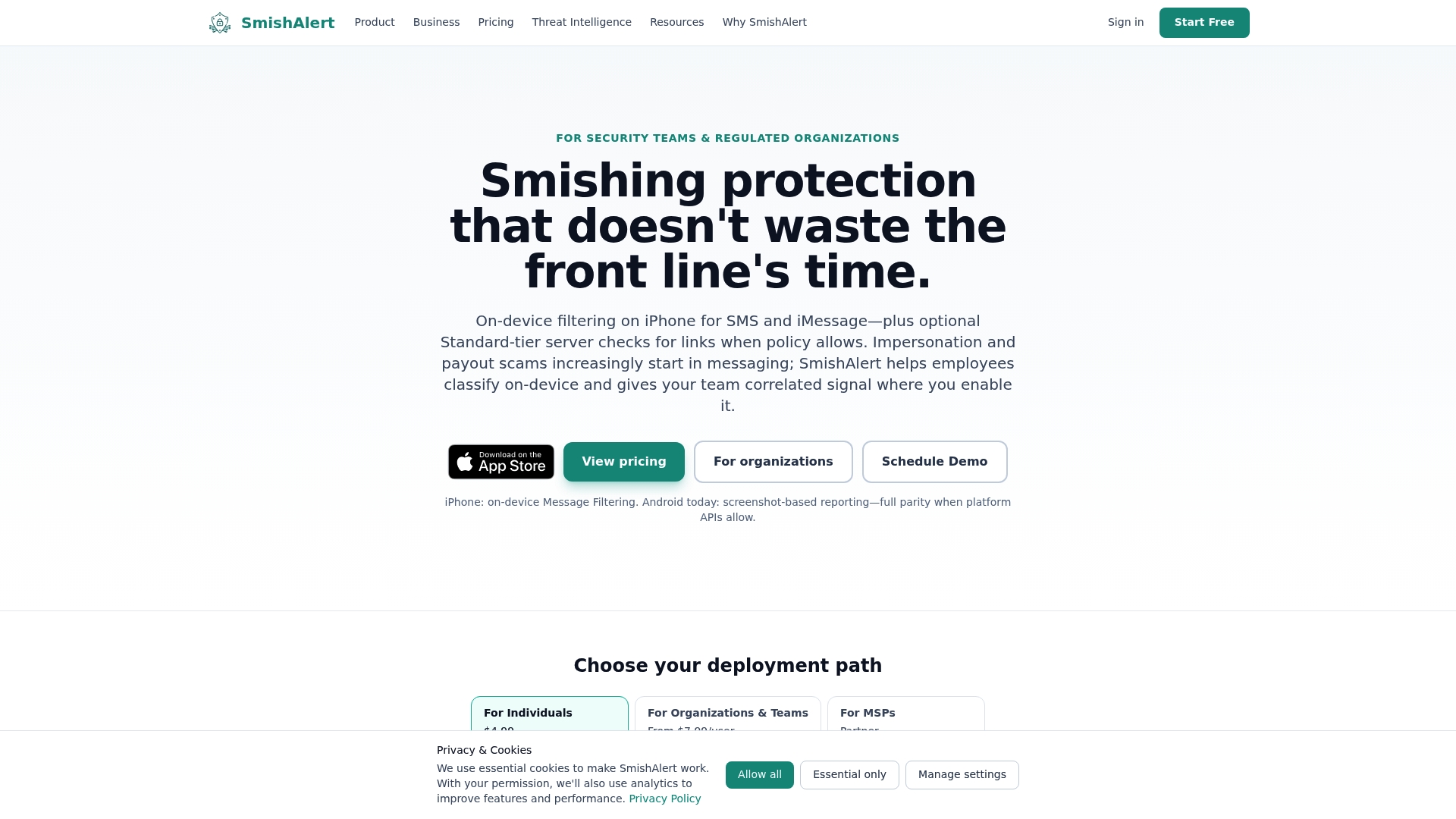
Smishalert gives security teams visibility into smishing campaigns, executive impersonation attempts, credential-harvesting messages, and payroll fraud attacks that arrive through SMS, iMessage, and WhatsApp. These attacks occur outside the corporate perimeter, where MDM telemetry and email security tools have no coverage. Through user reporting, campaign correlation, and threat analysis, Smishalert surfaces the social engineering threats your checklist is designed to prevent. Security teams can also run a 2-minute readiness check to identify gaps in their current messaging security posture before an attacker finds them first.
FAQ
What is a mobile device messaging security checklist?
A mobile device messaging security checklist is a structured audit framework covering technical controls, policy requirements, encryption validation, and endpoint protections for SMS, RCS, and messaging apps on employee devices. Security teams use it to verify that protections are enforced consistently across all devices and channels.
Which messaging apps are considered secure for enterprise use?
Secure messaging apps for enterprise use must support documented E2EE protocols, hardware-backed key storage, forward secrecy, and MDM integration. The specific app matters less than whether your team has validated each of these properties under your actual deployment conditions.
Why is SMS OTP no longer sufficient for MFA?
SMS one-time passwords are interceptable by mobile spyware and redirectable through SIM-swapping attacks. Phishing-resistant MFA methods such as hardware security keys and passkeys eliminate both attack vectors because they do not transmit codes over the cellular network.
How does GSMA RCC.16 affect enterprise RCS security?
GSMA RCC.16 v3.0 defines the MLS-based E2EE standard for RCS messaging. Enterprises using RCS must validate that key delivery completed correctly across all client and provider combinations, not just confirm that the app displays an encryption indicator.
What is out-of-band verification and why does it matter?
Out-of-band verification is a process that requires employees to confirm a request through a separate, pre-established channel before acting on it. It defeats smishing and executive impersonation attacks because the attacker cannot control the verification channel, regardless of how convincing the original message appears.