
Managed Smishing Protection: What Security Teams Need to Know

Managed smishing protection is a dedicated cybersecurity service that detects, analyzes, and responds to SMS phishing attacks targeting enterprise employees. Unlike email security tools, it operates outside the corporate perimeter, where most organizations have no visibility at all. Smishing, the industry term for SMS-based phishing, exploits the personal nature of text messaging to bypass technical controls and manipulate users directly. Platforms like Smishalert combine continuous monitoring, threat intelligence, and human risk management to close this gap before credential harvesting, executive impersonation, or payroll fraud results in a breach.
What is managed smishing protection and how does it work?
Managed smishing protection is a continuous security service that monitors, detects, and responds to phishing attacks delivered through SMS, iMessage, WhatsApp, and similar messaging channels. The service replaces the ad hoc, reactive approach most security teams currently use when employees forward suspicious texts to an IT inbox. It applies the same operational discipline found in managed detection and response (MDR) to the mobile messaging layer.
The core detection mechanism combines AI-driven message analysis with global threat intelligence feeds. When a suspicious message reaches an employee’s device, the platform analyzes sender patterns, URL structures, and message content against known smishing campaign signatures. Smishalert, for example, correlates individual reports across an organization to identify whether a single message is part of a coordinated campaign targeting multiple employees simultaneously.

Integration with Mobile Device Management (MDM) platforms gives security teams policy enforcement and rapid remediation capability. 69% of IT admins report that at least half their connected devices are unmanaged. That gap means most organizations have no technical baseline for detecting or containing a mobile phishing incident without a dedicated service layer.
Incident response for smishing differs from email phishing in one critical way: the attack chain often moves faster. A user who clicks a credential-harvesting link in a text message may enter their credentials within seconds, before any SIEM alert fires. Managed services address this by automating initial containment steps and routing high-confidence threats directly to analysts for immediate action.
- Continuous message monitoring across SMS, iMessage, and OTT messaging apps
- AI-driven campaign correlation to connect individual reports into broader attack patterns
- MDM integration for device-level policy enforcement and remote remediation
- 24/7 analyst escalation for high-confidence smishing incidents
- Threat intelligence sharing to identify emerging mobile phishing infrastructure
Pro Tip: Configure your employee reporting channel to accept forwarded screenshots, not just URLs. Many smishing attacks use phone numbers rather than links, and screenshot-based reporting captures the full context analysts need to correlate campaigns.
Why traditional security tools fail to stop smishing attacks
Email security gateways, endpoint detection tools, and network firewalls share a common blind spot: they were not built to inspect SMS traffic. SMS Sender ID verification reduces brand impersonation at the carrier level, but it does nothing against spear-phishing messages that use legitimate-looking numbers or spoofed identities. US mobile carriers have not closed this gap, and enterprise security stacks have not compensated for it.
The behavioral patterns of mobile device usage compound the problem. Employees read text messages within minutes of receipt, often on personal devices that fall outside corporate MDM enrollment. The informal register of SMS communication also lowers psychological defenses. A message appearing to come from a manager requesting a gift card purchase or a wire transfer approval feels more urgent and personal than a phishing email.
Human risk management addresses the behavioral dimension that technology alone cannot reach. AI-native human risk management platforms enable predictive defense by identifying high-risk users and delivering targeted interventions before an incident occurs. This shifts the security posture from reactive cleanup to proactive risk reduction.
The training gap makes the exposure worse. Organizations that run smishing simulations see measurable improvement in employee recognition rates, yet adoption remains low across the industry. Security teams that rely solely on annual awareness training leave a wide window between learning and reinforcement.
The limitations of standard tools create a clear case for a dedicated service layer:
- Email security gateways do not inspect SMS or OTT messaging traffic by design.
- Endpoint detection tools focus on device-level malware and rarely flag social engineering delivered through native messaging apps.
- Network firewalls cannot intercept messages received on cellular networks outside corporate Wi-Fi.
- Carrier-level filters block known spam but miss targeted spear-phishing sent from legitimate numbers.
- Annual security awareness training does not maintain the recognition skills employees need to identify evolving smishing tactics throughout the year.
Best practices for enterprise smishing attack protection
Technical controls and employee training work together. Neither alone provides sufficient defense against a determined smishing campaign targeting privileged accounts or finance teams.
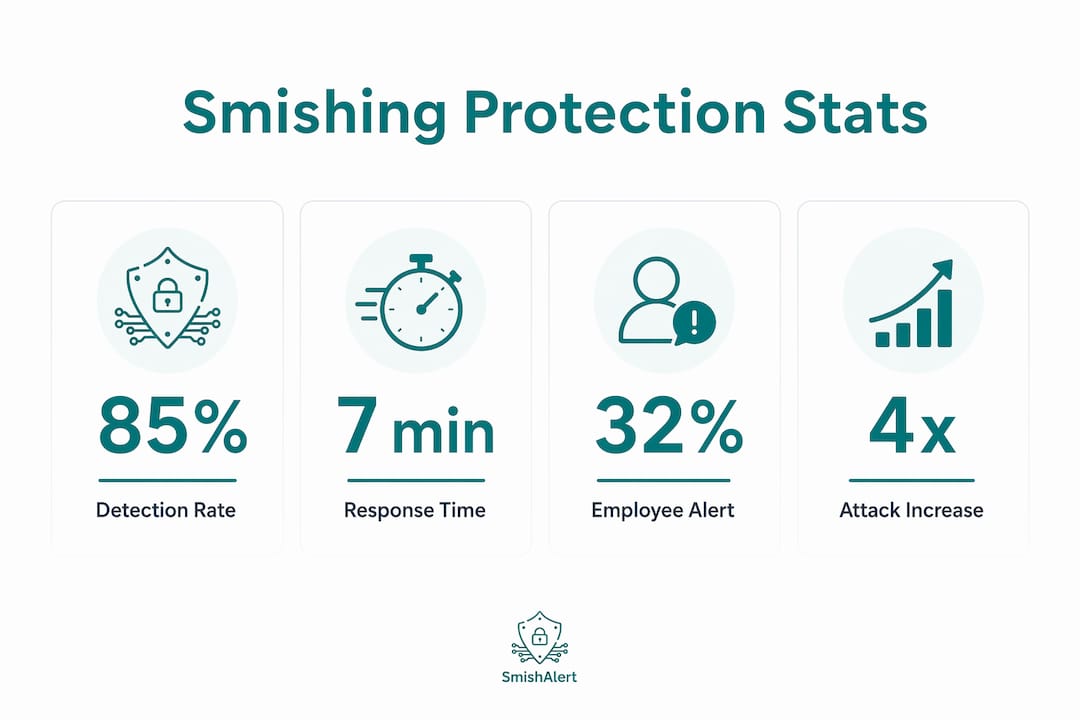
Quarterly simulation testing is the most direct way to measure and improve employee recognition rates. Only 32% of organizations currently run smishing simulations, and targeted training following those simulations improves recognition rates by 87%. Security teams that run simulations quarterly maintain higher baseline awareness than those that test annually. Smishalert’s enterprise smishing best practices framework recommends tying simulation results directly to role-specific training modules.
Authentication method hardening removes the most common smishing payoff: the stolen one-time password. Replacing SMS-based OTPs for privileged accounts with FIDO2 hardware keys or TOTP authenticator apps eliminates the value of credential-harvesting attacks that target those accounts. CISA recommends phishing-resistant multi-factor authentication as a baseline control for all privileged access.
DNS filtering on corporate Wi-Fi blocks malicious domains before credentials are entered, even when a user clicks a smishing link. CISA recommends DNS filtering as a first-line defense against phishing across all network-connected devices. The control is effective even when the user does not recognize the threat.
Structured incident reporting channels reduce containment time significantly. Organizations with structured reporting contained smishing incidents faster than those relying on ad hoc communication. A dedicated reporting alias, a mobile-accessible form, or an in-app reporting button all reduce friction and increase the volume of usable threat intelligence security teams receive.
| Control | Primary defense layer | Implementation complexity |
|---|---|---|
| FIDO2 or TOTP authentication | Credential theft prevention | Medium |
| DNS filtering on corporate Wi-Fi | Network-level URL blocking | Low |
| MDM enrollment | Device visibility and remediation | Medium |
| Quarterly smishing simulations | Human recognition improvement | Low |
| Structured reporting channels | Incident containment speed | Low |
Pro Tip: When deploying mobile phishing protection without MDM, focus on the reporting layer first. A well-designed employee reporting workflow generates threat intelligence even when you have no device-level visibility.
How managed smishing services fit within broader managed security services
Managed security service providers (MSSPs) deliver outsourced security monitoring, threat detection, and incident response to organizations that cannot sustain those functions internally. MSSPs combine technology and skilled analysts to provide proactive defense across an organization’s attack surface. Managed smishing protection operates as a specialized layer within that broader framework, focused exclusively on the mobile messaging threat vector.
The operational fit is direct. An MSSP managing endpoint detection and response (EDR) and vulnerability management for an enterprise can extend coverage to mobile messaging channels through a dedicated smishing protection service. The telemetry from smishing campaigns feeds into the SIEM alongside endpoint and network data, giving analysts a complete picture of an attack chain that may start with a text message and end with lateral movement inside the corporate network.
Managed security services exist specifically to offload complexity from internal IT teams, providing access to specialized, continuously updated threat intelligence that no single organization can maintain alone. For mobile threats, this matters because smishing campaigns evolve faster than most internal teams can track. A managed service with visibility across thousands of organizations detects new campaign patterns days or weeks before they reach any single client.
The operational benefits are concrete. Mean time to ticket for security alerts with MSSP support is reported at 7 minutes and 5 seconds, a response speed that internal teams handling mobile threats reactively cannot match. That speed directly reduces the window between a smishing message landing and a security team acting on it.
Key Takeaways
Managed smishing protection closes the mobile messaging gap that email security, endpoint tools, and carrier-level filters all leave open.
| Point | Details |
|---|---|
| Core service definition | Managed smishing protection monitors, detects, and responds to SMS phishing across messaging channels continuously. |
| Training gap is measurable | Only 32% of organizations run smishing simulations; those that do see 87% improvement in employee recognition. |
| Technical controls are necessary | DNS filtering, MDM enrollment, and FIDO2 authentication each address a distinct layer of smishing risk. |
| MSSP integration adds speed | MSSP-supported alert response averages 7 minutes and 5 seconds, far faster than reactive internal handling. |
| Human risk management is required | Technology alone cannot stop social engineering; behavioral signals and targeted training must complement technical defenses. |
The mobile threat gap most security leaders underestimate
The security teams I speak with consistently underestimate one thing: how fast a smishing attack moves from message to compromise. Email phishing gives defenders hours. A well-crafted smishing message targeting a finance employee on a Friday afternoon can result in a fraudulent wire transfer before the security team sees the first alert.
What I find most telling is the authentication problem. Organizations that have invested heavily in phishing-resistant MFA for web applications still route privileged account resets through SMS OTPs. That single gap erases a significant portion of the investment. Replacing SMS OTPs with FIDO2 keys for privileged accounts is not a complex project. It is a prioritization decision, and most organizations have not made it yet.
The sophistication of current smishing campaigns targeting executives and finance teams has increased noticeably. Attackers now combine LinkedIn reconnaissance with SMS impersonation of known contacts, creating messages that pass a casual credibility check. Generic awareness training does not prepare employees for that level of targeting. Quarterly simulations that mirror real campaign tactics do.
Managed services solve the resource problem, but they also solve the intelligence problem. No internal team monitoring a single organization sees enough smishing volume to recognize a new campaign pattern quickly. A managed service with cross-organization visibility identifies the pattern on day one. That is the operational advantage that justifies the investment, and it is the argument I would make to any CISO evaluating whether to build or buy this capability.
— Sophie
Smishalert’s platform for managed smishing protection
Smishalert gives security teams and managed security providers the visibility they need into messaging-based social engineering threats that traditional tools never reach.
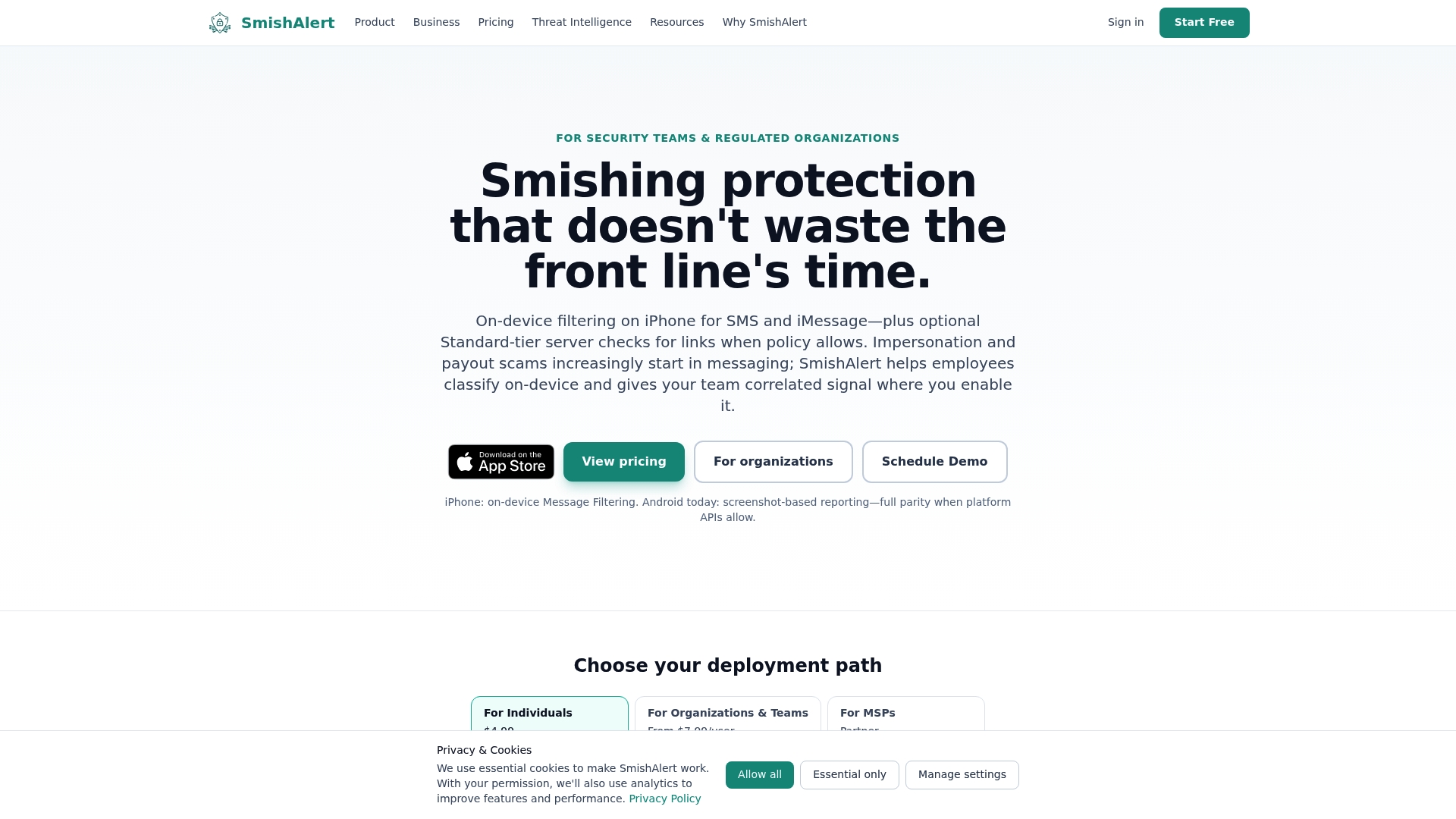
The Smishalert platform captures, correlates, and reports on smishing campaigns across SMS, iMessage, WhatsApp, and other messaging channels. It surfaces threats like credential harvesting in SMS and executive impersonation before they result in compromise, integrating with existing security stacks to automate detection and accelerate response. Security leaders who need to understand their organization’s full human attack surface, including the mobile messaging layer, can explore the platform’s capabilities and request a demo directly through Smishalert.
FAQ
What is smishing and why does it target enterprises?
Smishing is phishing delivered through SMS or mobile messaging apps, exploiting the personal and immediate nature of text communication to manipulate employees into disclosing credentials or authorizing fraudulent transactions. Enterprises are targeted because employees with access to financial systems, privileged accounts, or sensitive data are high-value targets.
How does managed smishing protection differ from email security tools?
Email security gateways inspect email traffic only and have no visibility into SMS, iMessage, or WhatsApp messages. Managed smishing protection monitors mobile messaging channels specifically, applying threat intelligence and behavioral analysis to a threat vector that email tools cannot reach.
What is the most effective way to stop smishing attacks on employees?
The most effective approach combines quarterly smishing simulation training, phishing-resistant MFA for privileged accounts, structured incident reporting channels, and a managed detection service with cross-organization threat intelligence. No single control is sufficient on its own.
How do managed smishing services integrate with existing security operations?
Managed smishing services feed mobile threat telemetry into SIEM platforms alongside endpoint and network data, giving analysts a unified view of attack chains that begin with a text message. They operate as a specialized layer within broader mobile threat detection programs managed by MSSPs or internal security operations centers.
Should organizations replace SMS OTPs for all accounts?
CISA and industry best practices recommend replacing SMS-based OTPs with FIDO2 hardware keys or TOTP authenticator apps specifically for privileged accounts, where the risk of credential harvesting is highest. Broad replacement across all accounts reduces overall smishing exposure and removes the primary incentive for credential-harvesting campaigns.