
Managed Mobile Security Service: 2026 Enterprise Guide

A managed mobile security service is a subscription-based, outsourced solution that protects corporate mobile devices, applications, and data through continuous monitoring, policy enforcement, and threat response. Unlike a one-time audit, this model delivers ongoing protection across Mobile Device Management (MDM), Mobile Application Management (MAM), and compliance support. Understanding what is managed mobile security service matters because mobile endpoints are now primary targets for credential harvesting, smishing, and man-in-the-middle attacks. Continuous monitoring services for mobile apps achieve 70–80% gross margins and renewal rates exceeding 90%, which signals that organizations are committing to this model long-term, not treating it as a short-term fix.
What is managed mobile security service and how is it delivered?
A managed mobile security service is defined as a third-party-operated program that assumes responsibility for securing an organization’s mobile fleet, applications, and data channels. The industry term most commonly used by analysts and vendors is managed mobile security service or, in broader contexts, managed mobility security. Both terms describe the same outsourced protection model.
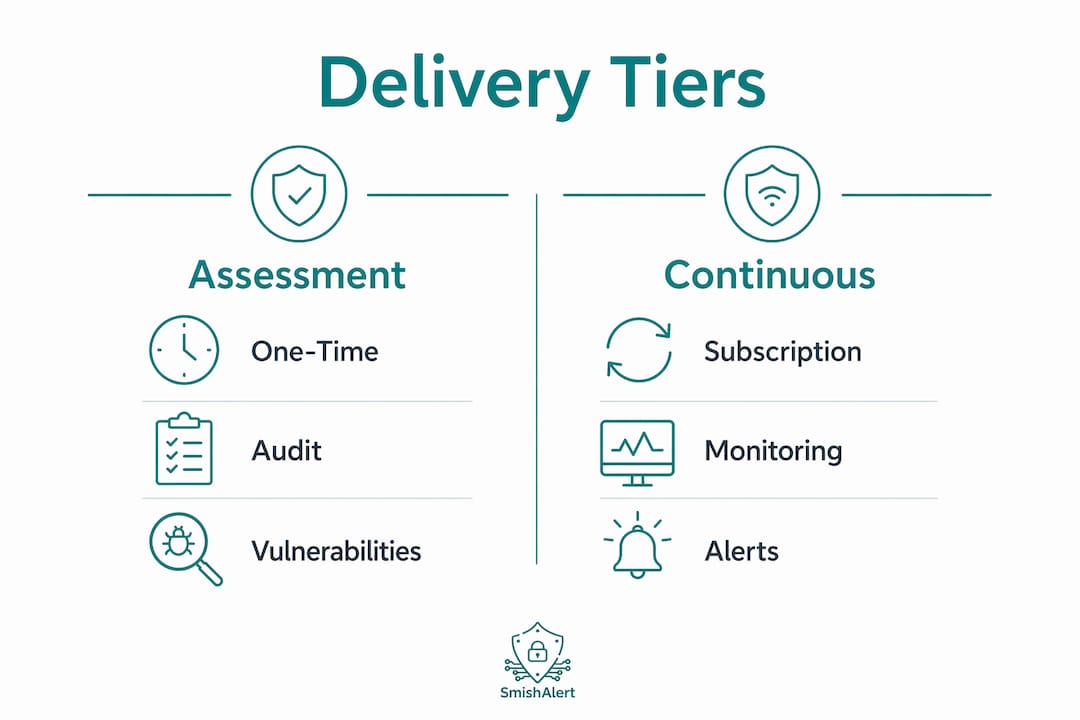
Three delivery tiers define the market today, and each serves a distinct organizational need.

Assessment-as-a-Service is a one-time engagement. A provider evaluates your mobile app portfolio, identifies vulnerabilities, and delivers a remediation report. This model suits organizations preparing for a regulatory audit or launching a new application. It generates lower recurring revenue for providers but serves as a natural entry point for clients.
Continuous Monitoring is a subscription model where the provider runs automated and manual security checks against your mobile apps and devices on an ongoing basis. Pricing for continuous monitoring ranges from USD 300–800 per app per month, depending on portfolio size and complexity. That range reflects the depth of telemetry, alerting, and analyst time included in the service.
Compliance-as-a-Service is a premium bundled tier. It combines continuous monitoring with regulatory alignment support for frameworks such as HIPAA, PCI-DSS, or SOC 2. Compliance-as-a-service commands USD 1,500–3,000 per month, typically structured into multi-year enterprise retainers. Organizations in regulated industries treat this tier as a cost of doing business, not a discretionary spend.
| Delivery model | Best for | Pricing | Contract type |
|---|---|---|---|
| Assessment-as-a-Service | Pre-audit, app launch | One-time project fee | Single engagement |
| Continuous Monitoring | Ongoing threat detection | USD 300–800/app/month | Annual subscription |
| Compliance-as-a-Service | Regulated industries | USD 1,500–3,000/month | Multi-year retainer |
Pro Tip: Match the delivery model to your organization’s maturity. If you have no baseline, start with an Assessment-as-a-Service engagement to identify gaps before committing to a continuous monitoring contract.
What security capabilities define managed mobile security in 2026?
The core of any managed mobile security service is a layered set of technical controls that address both device-level and application-level risk. Providers that deliver only MDM configuration are not delivering managed mobile security. The distinction matters because MDM controls device settings, but it does not detect active threats or test application code.
The following controls define a credible managed mobile security program:
- Strong passcode enforcement. Moving from 4-digit to 6-digit passcodes increases brute-force combinations from 10,000 to approximately one million. Managed services enforce this policy through MDM profiles and verify compliance continuously.
- App-based multi-factor authentication (MFA). MFA blocks 99.9% of account compromises when properly deployed. Managed providers configure MFA across corporate applications and monitor for bypass attempts.
- Device auto-lock under 30 seconds. Physical access remains the most common mobile vulnerability. Managed services set and enforce auto-lock policies to reduce exposure from unattended devices.
- Full-device encryption. Encryption protects data at rest on both iOS and Android. Providers verify encryption status during enrollment and flag non-compliant devices automatically.
- Mobile Threat Defense (MTD) integration. MTD platforms analyze network traffic, detect malicious apps, and identify phishing links in real time. Integrating MTD with MDM creates a defense-in-depth architecture that neither tool achieves alone.
- Continuous app security testing. Point-in-time testing is obsolete; risk-based continuous models align with agile DevSecOps cycles. Penetration Testing as a Service (PTaaS) integrated into CI/CD pipelines catches vulnerabilities before they reach production.
- Bluetooth and peripheral management. Disabling Bluetooth when unused removes a common attack vector. Managed services apply these configurations through policy and audit compliance regularly.
Employee behavior remains the most persistent gap in mobile security. Convenience drives workers to disable screen locks, connect to public Wi-Fi, and approve app permissions without review. Managed services address this through configuration hardening that removes the option to make insecure choices, not just through user training alone.
Pro Tip: When evaluating a managed mobile security provider, ask specifically how they integrate MTD with your existing MDM platform. Providers that treat these as separate, unconnected tools leave detection gaps that attackers exploit.
How does managed mobile security compare with MDM and Managed Mobility Services?
These three terms appear together frequently, and conflating them leads to budget shortfalls and uncovered risk. Each represents a different scope of responsibility.
Mobile Device Management (MDM) is a software tool for centralized device configuration. MDM platforms such as Microsoft Intune or Jamf push policies, manage app deployment, and enforce compliance settings. MDM is a component, not a complete security program.
Managed Mobility Services (MMS) cover the full device lifecycle, from procurement and provisioning through repair, replacement, and decommissioning. MMS providers handle logistics, carrier management, and cost optimization. Confusing MMS and MDM causes scope creep and under-budgeting of operational tasks like device logistics. MMS is an operational service, not a security service.
Managed mobile security service is the overarching protective layer. It uses MDM as one input, adds MTD, application security testing, threat intelligence, and incident response, and delivers a continuous risk reduction program. Organizations that rely solely on MDM leave coverage gaps that sophisticated mobile phishing and smishing attacks exploit directly.
| Service | Primary scope | Security focus | Typical buyer |
|---|---|---|---|
| MDM | Device configuration | Policy enforcement only | IT operations |
| Managed Mobility Services | Device lifecycle and logistics | Minimal | IT procurement |
| Managed mobile security | Threat detection and risk reduction | Comprehensive | Security and IT leadership |
The practical implication is that you likely need all three working together. MDM handles configuration, MMS handles logistics, and managed mobile security handles active threat detection and response. Treating any one of them as a substitute for the others creates gaps that attackers find quickly.
Pro Tip: When budgeting, separate MMS costs from managed mobile security costs in your procurement process. Bundling them into a single line item makes it nearly impossible to measure the ROI of your security investment independently.
What steps should organizations take to implement managed mobile security?
Implementation begins with an honest assessment of your current mobile risk posture. Before selecting a vendor, map your existing capabilities across MDM coverage, app inventory, authentication policies, and incident response procedures. This baseline determines which delivery model fits your needs and prevents overpaying for capabilities you already have.
Vendor evaluation should cover five areas: the technology stack and its integration with your existing MDM platform, the service delivery model and contract flexibility, compliance alignment with your regulatory requirements, the quality of the management portal, and the provider’s incident response process. Multi-tenant management portals with real-time dashboards and single-click provisioning are a meaningful differentiator for organizations managing large device fleets or operating as MSSPs themselves.
Once a vendor is selected, implementation follows a structured sequence:
- Device enrollment. Enroll all corporate and BYOD devices into the MDM platform. Define enrollment policies for each device category.
- Policy configuration. Apply passcode, encryption, auto-lock, and app permission policies. Validate that MTD agents are deployed and reporting.
- User training. Educate employees on reporting suspicious SMS, iMessage, and WhatsApp messages. User reporting is a primary detection signal for messaging-based social engineering attacks that technical controls alone do not catch.
- Monitoring and alerting. Configure dashboards and alert thresholds. Define escalation paths for high-severity detections.
- Continuous improvement. Schedule quarterly reviews to assess threat trends, update policies, and test incident response procedures.
The organizations that get the most value from managed mobile security treat it as a living program, not a deployment event. Threat actors adapt their techniques continuously, and your managed service provider should be adapting your controls in response.
Key Takeaways
Managed mobile security service delivers the most value when it combines continuous monitoring, MTD integration, and compliance support rather than relying on MDM configuration alone.
| Point | Details |
|---|---|
| Define the service correctly | Managed mobile security is an outsourced, subscription-based program covering devices, apps, and data, not just MDM policy enforcement. |
| Match the delivery model | Choose Assessment-as-a-Service for audits, Continuous Monitoring for ongoing protection, and Compliance-as-a-Service for regulated environments. |
| Layer your controls | Combine MDM, MTD, MFA, encryption, and continuous app testing to close the gaps that single-tool approaches leave open. |
| Separate MDM, MMS, and security | Conflating these three services causes budget errors and uncovered risk; each serves a distinct operational purpose. |
| Treat implementation as ongoing | Quarterly reviews, user training, and policy updates are required to keep pace with evolving mobile threat techniques. |
Why most organizations underestimate mobile security responsibility
The most common mistake I see IT leaders make is assuming that deploying an MDM platform means their mobile security is handled. MDM is a configuration tool. It does not detect a credential-harvesting SMS sent to your CFO’s personal iPhone. It does not flag a smishing campaign targeting your finance team through WhatsApp. Those threats live entirely outside the MDM perimeter, and they are the threats that result in actual compromise.
The second mistake is treating mobile security as a subset of endpoint security. Mobile devices operate on different networks, run different operating systems, and are used in contexts that corporate laptops never encounter. The attack surface is genuinely different, and it requires a purpose-built response.
What I have found works is treating managed mobile security as a foundational component of enterprise risk management, not a line item that gets cut when budgets tighten. The mobile security gap in enterprises is real and measurable. Organizations that close it through a managed service model consistently outperform those that rely on internal teams stretched across too many priorities.
Vendor collaboration is also underrated. The best managed security relationships I have observed involve quarterly business reviews where the provider brings threat intelligence specific to the client’s industry. That intelligence loop is what separates a managed service from a tool subscription.
— Sophie
How Smishalert strengthens your managed mobile security program
Smishalert addresses the threat category that MDM and MTD platforms were not built to handle: social engineering attacks delivered through SMS, iMessage, WhatsApp, and other messaging channels. Executive impersonation, credential harvesting in SMS, payroll fraud, and gift card scams operate entirely outside the corporate perimeter. Smishalert gives security teams visibility into these attacks through user reporting, campaign correlation, and threat analysis. For MSSPs and IT teams managing mobile security at scale, the Smishalert platform provides multi-tenant visibility and reporting that integrates with existing managed security workflows. If your current mobile security program does not include coverage for messaging-based social engineering, that is the gap most likely to result in a breach.
FAQ
What is a managed mobile security service?
A managed mobile security service is an outsourced, subscription-based program that protects corporate mobile devices, applications, and data through continuous monitoring, policy enforcement, threat detection, and incident response. It goes beyond MDM to include Mobile Threat Defense, application security testing, and compliance support.
How does managed mobile security differ from MDM?
MDM is a device configuration tool that enforces policies such as passcodes and encryption. Managed mobile security uses MDM as one component but adds active threat detection, MTD integration, and continuous app security testing to deliver a complete risk reduction program.
What does managed mobile security cost?
Continuous monitoring ranges from USD 300–800 per app per month, while Compliance-as-a-Service tiers run USD 1,500–3,000 per month in multi-year enterprise retainers. Pricing varies based on portfolio size, compliance requirements, and service depth.
Why is continuous monitoring better than annual penetration testing?
Annual tests produce a point-in-time snapshot that is outdated the moment development continues. Continuous automated testing integrated into DevSecOps pipelines catches vulnerabilities in each release cycle, eliminating the gaps that traditional annual assessments leave between tests.
What mobile threats does MDM fail to address?
MDM does not detect smishing campaigns, credential-harvesting SMS messages, or social engineering attacks delivered through iMessage or WhatsApp. These threats require dedicated mobile threat defense and messaging security capabilities that operate outside the device configuration layer.