
Top 3 IronScales.com Alternatives for Messaging Security 2026

Messaging channels expose security teams to phishing and executive impersonation that email-only defenses cannot detect early. Many tools restrict detection to email or require SIEM and IAM infrastructure, missing SMS, chat, and mobile phishing signals. This comparison shows which messaging security platforms cover more channels and offer faster pilot or integration paths for enterprise teams.
Table of Contents
SmishAlert
At a Glance
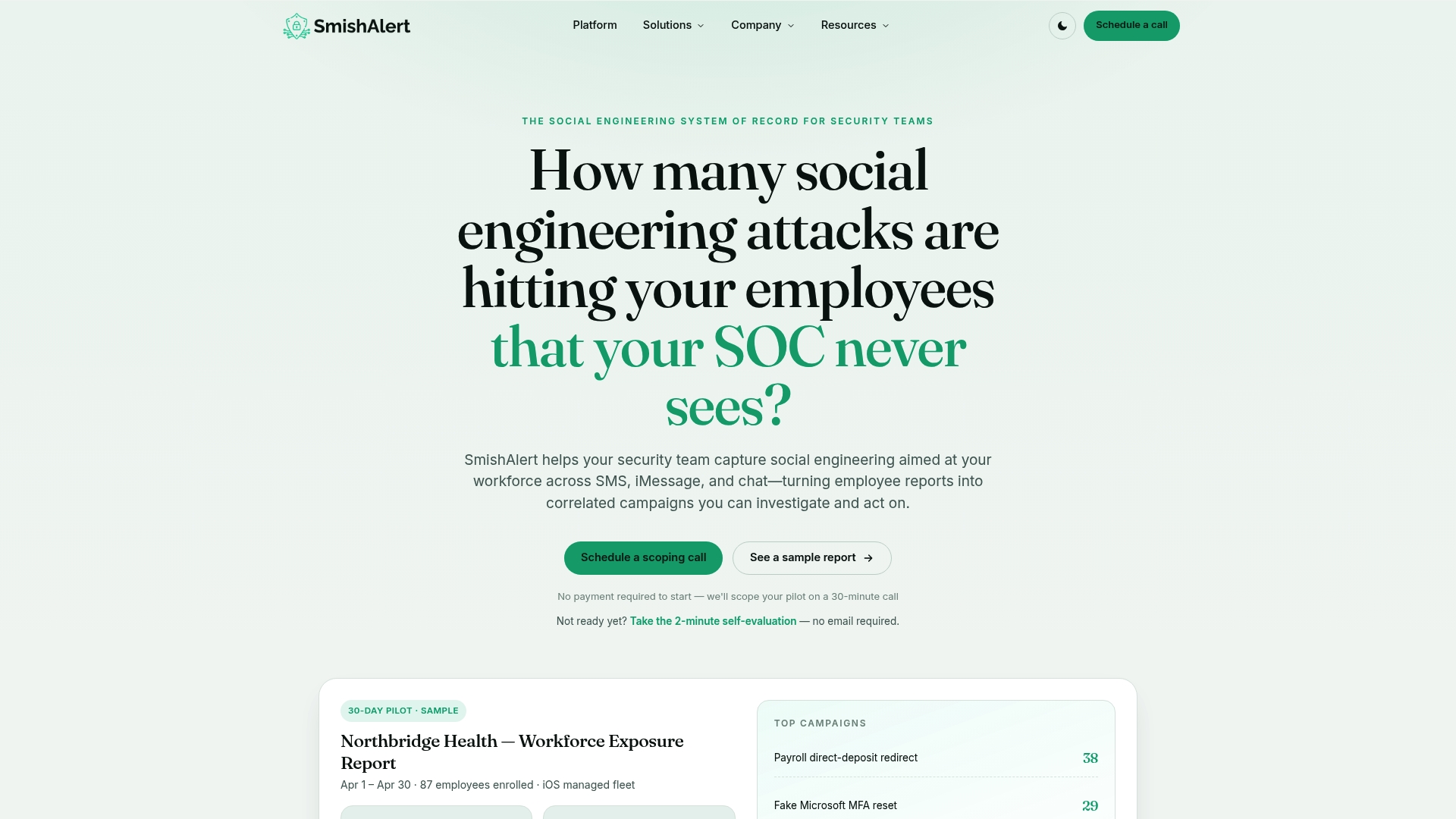
SmishAlert reports a $2,500 30-day pilot for up to 50 users, credited toward an annual subscription. It captures employee reports across SMS, iMessage, and chat to surface mobile phishing and executive impersonation. According to the company, SmishAlert produces executive and board ready reports within 30 days of deployment.
Core Features
The native reporting app captures suspicious messages and funnels them to a central intake for triage and investigation. The platform correlates multiple reports into linked campaigns and preserves an audit grade record for legal and SOC workflows. Deployment supports MDM managed iOS and Android apps and produces executive level findings that teams can act on quickly.
Key Differentiator
SmishAlert fills the messaging visibility gap by combining MDM friendly app deployment with campaign correlation and an auditable evidence trail not available from email security tools. That record lets investigators follow an attack chain across messages and user reports rather than treating incidents as one off alerts.
Pros
Visibility into messaging channels gives security teams first signals from the human layer where credential harvesting and payroll fraud begin. Correlating user reports into campaigns reduces duplicate work and speeds investigation, while the audit grade record supports compliance and incident reviews. SmishAlert’s marketing materials state it scales for pilots of 25 to 100 users and offers a rapid pilot that produces board ready findings.
Cons
- Relies on employee reporting, which can vary in volume and quality across departments.
Who It’s For
The vendor positions this for security leaders at organizations of 200 to 2,500 employees in healthcare, finance, and professional services. Teams responsible for HR and finance protection or SOC augmentation will find the focus on messaging attacks most relevant. Organizations without MDM may need additional effort to reach managed devices.
Unique Value Proposition
A credited 30 day pilot that converts employee reports into campaign level evidence shortens the time to measurable messaging risk. That pilot model validates the human telemetry and produces executive deliverables, which helps justify an annual subscription if the pilot surfaces active campaigns. The MDM friendly deployment keeps rollout practical for regulated environments.
Real World Use Case
A healthcare system deployed SmishAlert to monitor SMS and chat. The system uncovered active impersonation campaigns and compiled a report that highlighted previously undetected scams. That report guided targeted controls and awareness efforts for HR and clinical staff.
Pricing
SmishAlert charges $2,500 for the 30 day pilot for up to 50 users, credited toward an annual subscription. The vendor lists subsequent subscription costs ranging from $4.99 to $7.99 per user per month, scoped on initial findings.
Website: https://smishalert.ai
Abnormal Security
At a Glance
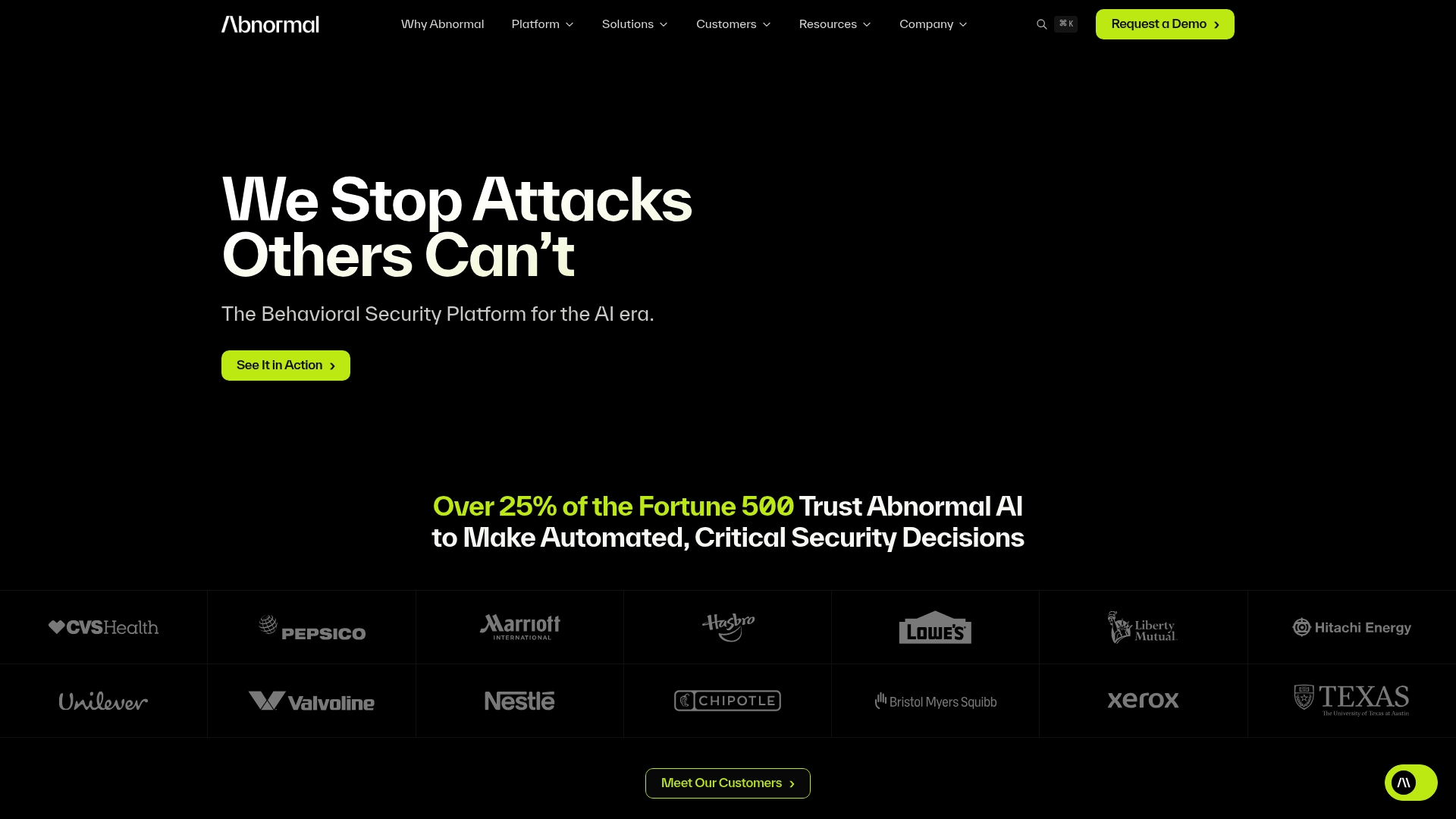
Abnormal Security reports it is trusted by over 25% of the Fortune 500 to make automated, critical security decisions. The vendor positions the platform to detect novel attacks across email, identity, AI tools, and insider threats. That focus targets threats that traditional rule based tools often miss.
Core Features
The platform uses Behavioral AI to model normal user and entity behavior and surface anomalies. It offers automated detection and response for email and identity incidents, plus monitoring for AI tool misuse and insider activity. Native API integrations and an API first deployment model let teams activate protection without changing MX records.
Key Differentiator
Abnormal’s claim centers on the proprietary Attune AI behavioral modeling engine that learns organizational norms and flags deviations. That approach tries to spot subtle, novel attack techniques rather than relying on static rules. The vendor emphasizes lower false positives so security teams see fewer irrelevant alerts.
Pros
According to the company, the platform delivers 46× fewer misses and 60× fewer false positives than some competitors. That accuracy claim, if realized, reduces alert triage and frees analyst time. Fast API based deployment means teams can integrate with Microsoft 365, Google Workspace, and identity providers without long mail flow changes. Enterprise adoption by a portion of the Fortune 500 suggests the platform fits larger security stacks and compliance workflows.
Cons
-
Pages related to pricing, features, integrations, and use cases return 404 errors. That gap makes self service evaluation difficult.
-
The product may require existing SIEM, IAM, or endpoint telemetry to reach full effectiveness. Onboarding details are not fully specified.
-
No public pricing or tier details are available, so procurement requires direct vendor engagement.
When It May Not Fit
Organizations that need transparent, public pricing and feature matrices will find limited information. Small security teams without SIEM or identity infrastructure may struggle to extract full value. Teams seeking a standalone, out of the box gateway for email only could prefer a simpler, MX based appliance.
Notable Integrations
- Microsoft 365
- Google Workspace
- Okta
- CrowdStrike
- Splunk
- ServiceNow
- Slack
- Zoom
Who It’s For
Enterprise security teams and security operations centers that already operate SIEM, EDR, and identity platforms. Teams focused on credential harvesting, business email compromise, insider threats, and AI tool governance will see the closest fit. Organizations that require vendor support for integration and tuning will benefit from the enterprise orientation.
Real World Use Case
Ingersoll Rand and Valvoline adopted Abnormal’s behavioral AI to replace legacy controls and reduce alert noise. Those deployments focused on faster threat detection, fewer false positives, and improved handling of account takeover and BEC scenarios. The cases show how behavior based detection can change analyst workflows in large environments.
Pricing
Not applicable information only. Public pricing and tier details are not posted, and the vendor requests direct contact for procurement and quotes. Expect enterprise licensing models rather than fixed self service plans.
Website: https://abnormalsecurity.com
Mimecast
At a Glance
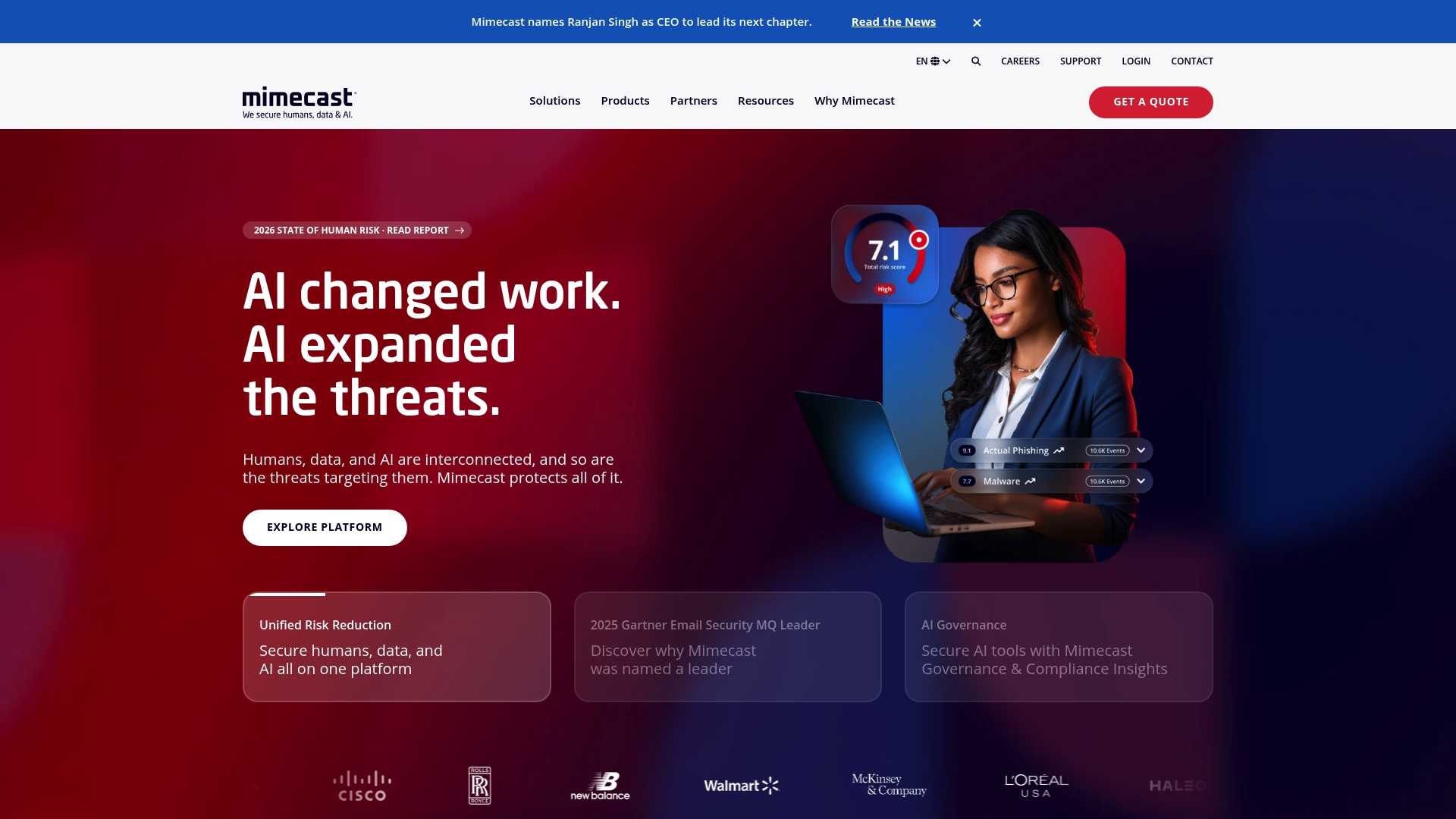
Mimecast reports it serves over 42,000 organizations worldwide since 2003. The company focuses on email security, human risk management, and regulatory compliance. Its messaging highlights AI driven detection to identify phishing, credential harvesting, and insider risk.
Core Features
The platform combines unified human risk management with AI powered email defense and threat detection across mail and collaboration channels. It includes insider threat detection and data protection for regulatory and eDiscovery workflows. Security awareness training and behavioral nudges link telemetry to user behavior to reduce successful social engineering attempts.
Key Differentiator
Mimecast groups email defense, human risk controls, and compliance tooling into a single console. That architecture pairs threat intelligence with behavior analysis to surface early signals in the human layer and reduce lateral movement. The vendor emphasizes proactive detection and training rather than relying solely on post incident remediation.
Pros
The company has long market presence and analyst recognition in email security and communication governance. Strong threat intelligence and AI capabilities increase detection of phishing, malware, and ransomware vectors. A broad suite covering email, collaboration, compliance, and human risk helps centralize policy and reporting for large security teams.
Cons
-
The wide product set can overwhelm new administrators and complicate initial deployments.
-
Comprehensive enterprise deployments can carry a high total cost of ownership.
-
Integration with existing IAM, SIEM, and mail gateways may require dedicated planning and professional services.
Who It’s For
Enterprises seeking integrated email security, data compliance, and human risk management will benefit most. Organizations with dedicated security operations and legal or compliance teams will use the platform effectively. Small IT teams with limited integration bandwidth may find the suite heavier than their needs.
Real World Use Case
A multinational corporation deployed Mimecast to secure email, enforce compliance policies, and run employee training at scale. That deployment centralized legal hold and eDiscovery processes while reducing successful phishing incidents. Security teams used combined telemetry and training nudges to lower credential harvesting and insider risk exposure.
Pricing
Pricing is not applicable in this summary. The vendor publishes pricing by quote and configures costs around modules and deployment scope, so buyers should contact Mimecast sales for a tailored estimate.
Website: https://mimecast.com
Comparison of alternatives
In selecting a platform to address messaging-based social engineering attacks, critical differences arise regarding operational focus, onboarding effectiveness, and scalability support.
Operational focus and alignment
SmishAlert stands out through its enriched reporting from human participants integrated into a centralized intake system. This approach directly addresses threats originating from SMS, iMessage, and chat platforms, a niche not as comprehensively addressed by alternatives. Conversely, Mimecast excels in delivering an extensive compliance and risk management portfolio, incorporating email and data operations into legal workflows, making it highly applicable for complex regulatory requirements. Meanwhile, Abnormal Security differentiates itself with proprietary behavioral AI discerning novel attack patterns and deviations, equipped with false-positive reduction.
Deployment and integration
SmishAlert’s MDM-supported deployment ensures sensitive integration for managed environments while maintaining ease of onboarding. Abnormal Security shifts focus to enterprise-level API-based compatibility, leveraging existing ecosystem connections for integrated functionality. Mimecast, while offering extensive configurability, may entail higher associated resource planning due to its broader scope of services and administrative demands.
Best fit
- SmishAlert: Stands as the preferred choice for organizations tackling messaging-specific threats where user-driven reporting yields key insights.
- Abnormal Security: Best suited for enterprises emphasizing adaptive AI behavior analysis to prevent automated unique threat models.
- Mimecast: Aligns with businesses seeking a vast suite of compliance, legal integration, and human risk alignment capabilities.
Our pick
SmishAlert provides exceptional suitability for identifying and resolving messaging-specific security threats bolstered by targeted reporting capabilities. However, for organizations focused on email compliance or automated AI learning engagement, exploring Abnormal Security or Mimecast respectively might align with their primary objectives.
Evaluating alternatives to ensure robust and compliant messaging security requires focusing on deployment accessibility, feature completeness, and tailored reporting capabilities.
| Product | Core Feature or Use Case | Key Differentiator | Pricing | Notable Limitation |
|---|---|---|---|---|
| Smishalert | Focused on phishing and impersonation | MDM-compatible deployment and audit trail | $2,500 pilot credited toward subscription | Relies on user reporting for full effectiveness |
| Abnormal Security | AI behavioral detection for emails | Behavioral AI for novel threat detection | Price not published | Limited onboarding details and lack of public documentation |
| Mimecast | Comprehensive email/human risk management | Unified ecosystem for risk and compliance | Price not published | High total cost for full-scale deployments |
Addressing Messaging Security Gaps Beyond Email
The article highlights challenges faced by security teams tasked with detecting phishing, credential-harvesting, and executive impersonation occurring outside traditional email channels. Smishalert answers this need by offering visibility into social engineering attacks via SMS, iMessage, WhatsApp, and other messaging platforms. This approach captures threats that often evade email-focused defenses and provides security leaders and IT teams with correlated campaign evidence rather than isolated alerts.
Smishalert enables measurable detection of mobile phishing and payroll fraud through user reporting combined with threat analysis. For organizations exploring ironscales.com alternatives, Smishalert offers a 30-day pilot with up to 50 users to quickly surface real risk and deliver executive-ready reports. Learn more about how Smishalert equips teams to monitor the human attack surface at Smishalert and begin transforming messaging security today.
FAQ
What makes SmishAlert a suitable choice for organizations focused on messaging security?
SmishAlert excels in capturing employee reports across SMS, iMessage, and chat, providing critical visibility into mobile phishing and impersonation threats. The platform generates executive and board-ready reports within 30 days of deployment, making it a quick solution for urgent security matters. Organizations can implement this platform quickly to enhance their defenses against messaging attacks.
How does SmishAlert compare to Abnormal Security in terms of functionality?
Abnormal Security is known for its advanced Behavioral AI, which models user behavior to detect anomalies and prevent novel attacks across email and identity. SmishAlert, on the other hand, specializes in addressing messaging security by correlating user reports into campaigns, a feature not primarily focused on by Abnormal Security. Businesses primarily concerned with messaging vulnerabilities will find SmishAlert more directly aligned with their needs.
What pricing structure does SmishAlert offer?
SmishAlert charges $2,500 for a 30-day pilot for up to 50 users, with this cost credited toward an annual subscription. Following the pilot, the platform’s subscription costs range from $4.99 to $7.99 per user per month, allowing organizations to scale according to their needs.
Can SmishAlert handle reporting for incidents detected through user alerts?
SmishAlert correlates multiple reports into linked campaigns and preserves an audit-grade record for legal and SOC workflows. This capability enables effective triage and investigation of messaging incidents, which is crucial for compliance and incident management within organizations.
How does SmishAlert support organizations with limited device management capabilities?
While SmishAlert supports MDM-managed iOS and Android apps for deployment, organizations without MDM may face challenges in reaching managed devices. This platform still proves beneficial for teams focused on messaging security, allowing them to adapt their approach based on their existing capabilities.