
iMessage Security Vulnerabilities: What You Need to Know

An iMessage security vulnerability is a flaw in Apple’s Messages framework that allows attackers to execute malicious code on a target device, often without any user interaction. These flaws, formally classified as zero-click exploits in the security research community, represent some of the most dangerous attack vectors in mobile security today. Recent disclosures from iVerify, Kaspersky, and Apple itself confirm that these are not theoretical risks. They have been used against journalists, government officials, and corporate executives. Understanding what is iMessage security vulnerability means understanding how a trusted communication channel becomes an entry point for full device compromise.
What is an iMessage security vulnerability?
An iMessage security vulnerability is any exploitable weakness in the code that processes incoming messages, attachments, or profile data within Apple’s Messages app. The term covers a spectrum of flaws, from memory corruption bugs to race conditions, but the most dangerous class is the zero-click exploit. Zero-click exploits require no tap, no swipe, and no approval from the target. The attack arrives silently and executes automatically.
Apple’s iMessage processes a wide range of incoming data automatically. Media previews render before you open a message. Nickname updates sync in the background. iCloud links load thumbnails without prompting. Each of these automatic processes is a potential attack surface. When a parser or handler contains a memory bug, an attacker who controls the incoming data can trigger that bug remotely.

The industry standard term for this class of flaw is a “zero-click remote code execution vulnerability.” The informal phrase “iMessage hack” describes the same event from the victim’s perspective. Security analysts should use the formal term in incident reports and threat intelligence feeds, but both framings describe the same underlying risk.
How do iMessage zero-click exploits work technically?
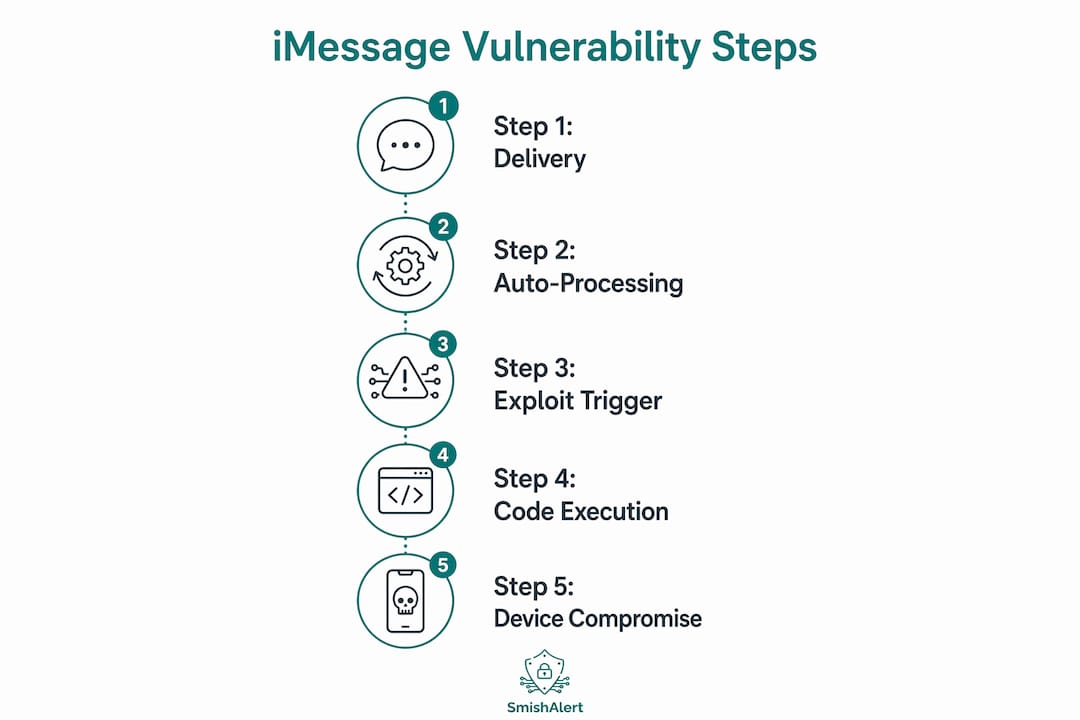
Zero-click exploits work by sending malformed data that iMessage processes automatically, triggering a memory error before the user sees anything. The attack chain typically follows four stages.
- Delivery. The attacker sends a specially crafted message, attachment, or nickname update to the target’s Apple ID or phone number.
- Automatic processing. iMessage hands the content to an internal component, such as the
imagentprocess, a media parser, or the nickname sync handler, without any user action. - Memory corruption. The malformed data triggers a bug, commonly a use-after-free error or a race condition, inside the processing component.
- Code execution. The attacker’s shellcode runs in the context of the compromised process, which can then be used to escalate privileges or fetch additional payloads.
The imagent process is a recurring target because it handles contact data and profile updates continuously in the background. iVerify’s 2025 research documented how rapid nickname updates trigger use-after-free bugs in imagent, allowing code execution without any visible interaction. The “Share Name and Photo” feature and iCloud Link media processing follow the same pattern: automatic handling of user-generated content creates memory pressure that skilled attackers can exploit.
Race conditions are particularly difficult to patch completely. Two threads compete to access the same memory object, and the attacker controls the timing by flooding the target with rapid requests. Use-after-free bugs occur when code references a memory address after that memory has been freed, allowing an attacker to place controlled data at that address before the reference occurs.
Pro Tip: Security teams auditing mobile device management (MDM) policies should flag any device where “Share Name and Photo” is enabled for all contacts. Restricting this feature to contacts only, or disabling it entirely, removes one documented attack surface without affecting core messaging functionality.
What are the most documented iMessage exploits?
Three cases define the current threat picture for iMessage security flaws, and each illustrates a different dimension of the risk.
NICKNAME: a rare but targeted flaw
The NICKNAME vulnerability, documented by iVerify in 2025, exploited the imagent process through rapid nickname update requests. Crash telemetry from 50,000 devices showed a less than 0.0001% occurrence rate, but the affected devices were disproportionately linked to high-value targets including government officials and journalists. That statistical rarity combined with target concentration is the signature of a precision spyware operation, not a mass exploitation campaign. Apple patched the flaw in iOS 18.3 after iVerify’s disclosure.
Apple’s response added an important nuance. Ivan Krstic of Apple Security Engineering described NICKNAME as a conventional software error rather than confirmed spyware infrastructure, stating there was no credible evidence of real-world exploitation. This disagreement between iVerify and Apple reflects a broader challenge in mobile threat intelligence: crash logs prove a bug fired, but they do not always prove intentional exploitation.
Cve-2025-43200: confirmed active exploitation
CVE-2025-43200 is a flaw in the Messages app’s handling of maliciously crafted photos and videos. Unlike NICKNAME, this one carries confirmed exploitation status. Apple confirmed the vulnerability was used to deploy Paragon’s Graphite spyware against journalists in targeted attacks. Apple patched it in iOS 18.3.1 and corresponding macOS and iPadOS releases. The Graphite connection matters because Paragon is a commercial surveillance vendor, meaning this exploit was sold as a service to government clients.
Operation triangulation: the most complex chain
Operation Triangulation, documented by Kaspersky in 2023, remains the most technically sophisticated iMessage attack chain on record. The attack delivered an invisible .watchface attachment via iMessage that silently executed code, fetched additional components, and ultimately gained root privileges. The full chain used four zero-day vulnerabilities and exploited undocumented hardware features to bypass Apple’s memory protections. The spyware accessed files, keychains, and the device microphone. It affected iOS versions up to 16.2.
| Vulnerability | Year Patched | Attack Method | Confirmed Exploitation |
|---|---|---|---|
| NICKNAME (imagent use-after-free) | iOS 18.3 (2025) | Rapid nickname updates | Disputed |
| CVE-2025-43200 (media processing) | iOS 18.3.1 (2025) | Malicious photo/video attachment | Confirmed (Graphite spyware) |
| Operation Triangulation | iOS 16.2 patch (2023) | Invisible .watchface attachment | Confirmed (Kaspersky research) |
“The attack uses an iMessage .watchface attachment to silently run code that fetches further components, ultimately gaining root privileges and spying capabilities.” — Operation Triangulation technical analysis, Wikipedia/Kaspersky
How does apple respond to iMessage vulnerabilities?
Apple’s response to iMessage security flaws follows a consistent pattern: patch the specific component, update the security advisory, and, where appropriate, issue a public statement. The company’s security architecture also includes proactive defenses designed to limit exploit impact before a patch exists.
BlastDoor is Apple’s most significant structural defense against zero-click iMessage attacks. Introduced in iOS 14, BlastDoor is a sandboxed service that parses incoming message content in an isolated process. If a parser crashes inside BlastDoor, the damage is contained. However, BlastDoor does not eliminate all zero-click risks, as Operation Triangulation and CVE-2025-43200 both demonstrated post-BlastDoor exploitation.
The limits of patching are equally important to understand:
- Memory-resident malware erases itself after a reboot but can reinfect on the next boot cycle if the device reconnects to attacker infrastructure. Operation Triangulation spyware followed this pattern, meaning a patch alone does not clean an already-compromised device.
- Detection gaps exist because zero-click exploits leave minimal forensic artifacts. Standard MDM telemetry rarely captures the crash signatures associated with exploitation.
- Vendor disagreements create uncertainty. When Apple disputes a researcher’s exploitation claim, security teams face a difficult triage decision without a definitive answer.
Pro Tip: For devices suspected of compromise, disabling iMessage immediately and performing a factory reset before restoring from a clean backup is the only reliable remediation path. Patch application on a compromised device does not remove resident payloads.
What steps reduce iMessage security risks?
Risk reduction for iMessage vulnerabilities requires layered controls across device configuration, update cadence, and incident response readiness. No single control is sufficient.
For all users and organizations:
- Apply iOS, macOS, and iPadOS updates within 48 hours of release. Patch prioritization is the single most effective control against known iMessage flaws, since most exploits target unpatched versions.
- Disable “Share Name and Photo” or restrict it to contacts only. Nickname and profile data features expand the attack surface by creating additional automatic processing pathways.
- Audit MDM profiles to confirm update enforcement policies are active across all managed devices.
For high-risk users, including executives, journalists, and government personnel:
- Enable Lockdown Mode on iOS 16 and later. Lockdown Mode disables link previews, restricts incoming FaceTime calls from unknown contacts, and limits several iMessage features that have been exploited in documented attacks.
- Disable iMessage entirely on devices that do not require it for business operations. Removing the attack surface is more reliable than hardening it.
- Implement a mobile threat detection program that captures device telemetry and crash logs, since standard MDM does not surface the indicators associated with zero-click exploitation.
For incident response:
- If a device shows unexplained crashes in
imagentor Messages-related processes, treat it as a potential compromise indicator. - Disable iMessage on the suspected device immediately to stop further payload delivery.
- Perform a factory reset and restore from a pre-compromise backup. Do not restore from an iCloud backup made after the suspected compromise window.
- Report the incident to Apple’s Product Security team and, where applicable, to CISA or relevant national cybersecurity authorities.
Understanding iMessage privacy concerns at the organizational level also means tracking which employees have elevated risk profiles. Executives, legal counsel, and finance personnel are the most common targets of precision spyware campaigns delivered through messaging channels.
Key takeaways
iMessage zero-click vulnerabilities allow full device compromise without user interaction, making patch velocity and feature management the two most critical controls for security teams.
| Point | Details |
|---|---|
| Zero-click exploits require no user action | Attackers exploit automatic processing in imagent and media parsers to execute code silently. |
| Three major cases define current risk | NICKNAME, CVE-2025-43200, and Operation Triangulation each demonstrate different exploitation methods and confirmation levels. |
| BlastDoor limits but does not eliminate risk | Apple’s sandbox reduces parser exposure but has not prevented post-BlastDoor exploitation in documented attacks. |
| Patching alone is insufficient post-compromise | Memory-resident spyware survives patches; factory reset is required to remediate a compromised device. |
| High-risk users need Lockdown Mode | Executives, journalists, and government personnel should enable Lockdown Mode and consider disabling iMessage entirely. |
The uncomfortable truth about iMessage vulnerability reporting
Sophie’s perspective
The NICKNAME dispute between iVerify and Apple is the most instructive moment in recent iMessage vulnerability news, and not for the reason most coverage suggests. The real lesson is not “who is right.” The real lesson is that security teams cannot wait for vendor confirmation before acting.
Apple’s position, that no credible evidence of real-world exploitation exists, is technically defensible. Crash logs are not proof of intentional targeting. But the devices showing those crashes were disproportionately owned by people who are historically targeted by commercial spyware. That pattern is not noise. It is a signal that warrants a response regardless of whether Apple agrees.
The broader problem is that the security industry has developed a habit of treating “unconfirmed exploitation” as equivalent to “no exploitation.” These are not the same thing. Sophisticated threat actors specifically design their tools to avoid leaving confirmation-grade forensic evidence. Absence of proof is not proof of absence, and in mobile security, that distinction has real consequences.
My recommendation for security leaders is to treat any zero-click iMessage flaw affecting high-value personnel as confirmed exploitation until proven otherwise. The cost of an unnecessary factory reset is measured in hours. The cost of ignoring a Graphite or Triangulation-class compromise is measured in months of unauthorized access to files, communications, and credentials. The asymmetry is not close.
The attack chain complexity in Operation Triangulation, four zero-days plus hardware exploitation, also signals something important about attacker investment. Nation-state and commercial spyware operators are spending significant resources on iMessage specifically because it is trusted, ubiquitous, and processes data automatically. That investment will continue. The defense posture needs to match it.
— Sophie
How Smishalert helps organizations detect messaging threats
iMessage vulnerabilities represent one layer of a much larger messaging threat surface. Organizations face social engineering attacks across SMS, iMessage, WhatsApp, and other channels simultaneously, and most security stacks have no visibility into any of them.
Smishalert is built specifically for this gap. The Smishalert platform captures, correlates, and reports on social engineering attacks targeting employees through mobile messaging channels, including executive impersonation, credential harvesting, and payroll fraud delivered via iMessage and SMS. Security teams gain visibility into threats that occur entirely outside the corporate perimeter, where traditional email security tools have no reach. For organizations managing elevated-risk personnel or operating in regulated industries, that visibility is the difference between early detection and a months-long breach.
FAQ
What is a zero-click iMessage vulnerability?
A zero-click iMessage vulnerability is a flaw that allows an attacker to execute code on a target device without any user interaction. The exploit triggers automatically when iMessage processes a malformed attachment, media file, or profile update.
How secure is iMessage compared to other messaging apps?
iMessage uses end-to-end encryption and includes BlastDoor sandboxing, making it more secure than many alternatives. However, documented exploits like Operation Triangulation and CVE-2025-43200 confirm that determined attackers can bypass these protections using zero-day vulnerabilities.
Was iMessage actively exploited in 2023?
Yes. Operation Triangulation, documented by Kaspersky in 2023, used an invisible iMessage attachment to deliver spyware that gained root privileges on devices running iOS up to version 16.2. The attack chain used four zero-day vulnerabilities.
Does enabling lockdown mode prevent iMessage exploits?
Lockdown Mode significantly reduces the attack surface by disabling link previews and restricting several iMessage features used in documented exploits. It does not provide absolute protection but is the strongest available control for high-risk users on iOS 16 and later.
What should a security team do if iMessage compromise is suspected?
Disable iMessage on the affected device immediately, perform a factory reset, and restore from a clean backup predating the suspected compromise window. Standard patch application does not remove memory-resident payloads associated with spyware like Graphite or Triangulation.