
How to Manage SMS Security Shift Handover in 2026

SMS security shift handover is the structured process of transferring mobile threat context, authentication status, and active incident ownership between security teams at shift transitions. Without a defined process, critical smishing alerts, SIM swapping events, and credential-harvesting attempts fall through the gap between outgoing and incoming analysts. The risks are not theoretical. Shift transitions are the moments when attackers gain the most ground, because attention is divided and context is incomplete. Security teams that manage SMS security shift handover with documented procedures, digital acknowledgment gates, and encrypted communication channels close that window before it opens.
What are the critical components of a secure SMS handover process?
A secure SMS handover process covers five core information categories: system and production status, active security incidents, pending actions with clear ownership, equipment and safety posture, and compliance holds. Each category must be addressed explicitly. Skipping any one of them creates a blind spot that the incoming shift inherits without knowing it exists.
SMS-specific incidents require their own line items in the handover record. Detected smishing campaigns, authentication anomalies tied to SMS one-time passwords (OTPs), and reports of executive impersonation via text all need documented status, current owner, and next action. A verbal mention at the end of a shift does not constitute a handover.

Verbal-only handovers are the weakest form of knowledge transfer. Experts consistently identify documented processes as the baseline requirement for avoiding assumptions and information gaps. The incoming analyst should never have to guess what happened during the previous shift.
Structured handover templates enforce completeness. A template with required fields for SMS alert status, open phishing investigations, and authentication anomalies prevents analysts from submitting an incomplete record. Digital tools that timestamp each entry and require acknowledgment from the incoming analyst create an audit trail that verbal briefings cannot produce.
- Active SMS incidents: List every open smishing case, SIM swap report, or social engineering attempt with current status and assigned owner.
- Authentication anomalies: Flag any SMS OTP failures, unusual delivery patterns, or suspected interception events.
- Pending actions: Assign each unresolved item to a named analyst with a deadline or escalation trigger.
- Compliance holds: Note any SMS-related regulatory flags that cannot be closed without management sign-off.
- Tool and gateway status: Confirm whether encrypted SMS gateways are operational and whether any fallback alerts are queued.
Pro Tip: Build your handover template so that every field is required before submission. An incomplete form that cannot be submitted is more effective than a complete form that nobody checks.
How can organizations reduce SMS authentication risks during shift changes?
SMS authentication alone is medium-assurance and insufficient for sensitive shift transitions in 2026. That classification matters because shift changes are high-value moments for attackers. An analyst authenticating at the start of a shift via SMS OTP is a predictable target for SIM swapping or social engineering timed to that transition.
Risk-based authentication addresses this gap directly. Combining SMS OTPs with device signals, behavioral analysis, and location context raises the assurance level without eliminating SMS as a delivery channel. The goal is not to abandon SMS but to ensure it is never the only factor.
SIM swapping attacks target the phone number itself, redirecting OTPs to an attacker-controlled device. Security teams should monitor for sudden carrier changes, unexpected OTP delivery failures, and authentication requests from unfamiliar device fingerprints. These signals, when correlated, indicate a SIM swap in progress rather than a routine login issue.
Encrypted enterprise SMS gateways with TLS 1.3 provide the transport-layer security that consumer SMS APIs lack. They also generate delivery and acknowledgment logs that support compliance requirements. Standard consumer SMS APIs do not offer these guarantees, which makes them inappropriate for sensitive shift transition communications.
- Layer authentication factors: Require device certificate or biometric confirmation alongside SMS OTP for shift start authentication.
- Monitor delivery anomalies: Alert on OTP delivery failures or unusual latency that may indicate interception or SIM swap activity.
- Apply contextual phishing warnings: Use tools that flag suspicious SMS content before analysts interact with it. Smishalert’s contextual phishing detection surfaces these warnings at the point of receipt.
- Restrict SMS fallback scope: Use SMS fallback only for delivery confirmation, not for transmitting sensitive incident details in plaintext.
- Audit gateway logs: Review SMS gateway delivery records at each shift handover to confirm no alerts were dropped or delayed.
Pro Tip: Set an automated alert for any SMS OTP request that arrives outside a known analyst’s normal shift window. Off-hours authentication attempts are a reliable early signal of credential-harvesting activity.
What are proven best practices for standardizing shift handover communications?
Standardization removes the variability that creates security gaps. A consistent handover template, applied at every shift transition, means the incoming analyst always receives the same categories of information in the same format. That predictability reduces cognitive load and speeds up the review process.
Handover sessions should run 15–20 minutes and cover all five core categories. Sessions shorter than five minutes risk skipping critical context. Sessions longer than 20 minutes signal that the outgoing shift did not maintain continuous logs and is reconstructing events from memory at the end of the shift.
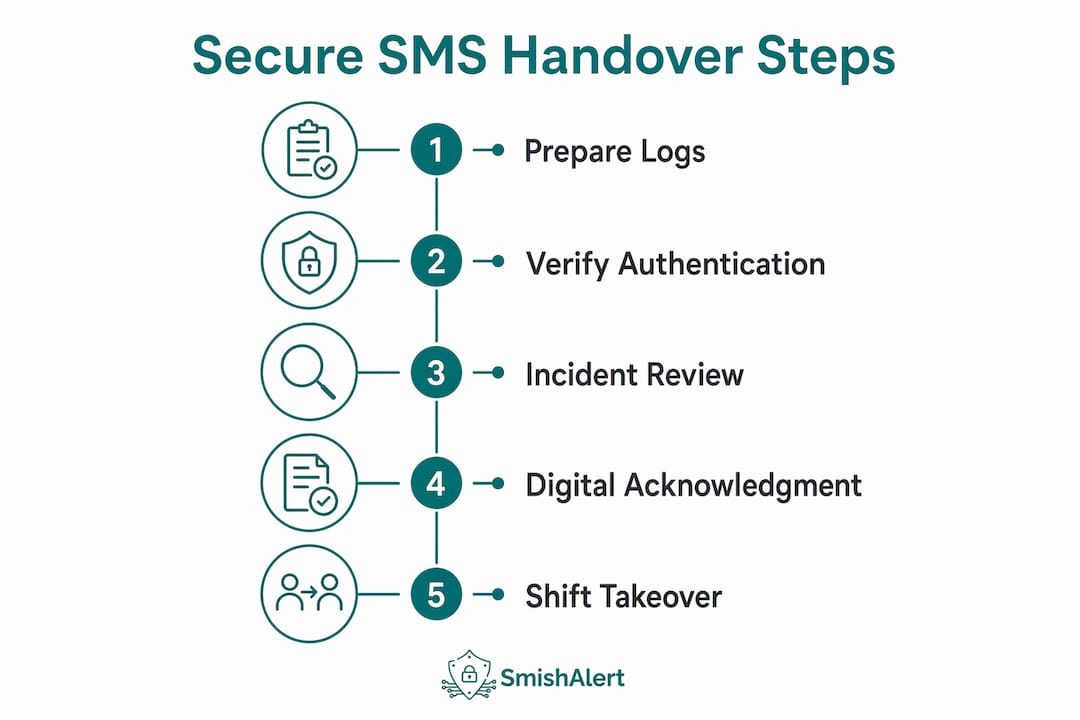
The following numbered sequence defines a standardized SMS security handover workflow:
- Open the live incident register and confirm all SMS-related items are current, owned, and status-accurate.
- Review authentication logs for the outgoing shift period, noting any OTP anomalies or failed logins.
- Assign urgency levels to all open items using a defined scale (critical, high, medium, low) so the incoming analyst knows where to focus first.
- Transfer ownership of each pending action to a named incoming analyst, not to the team as a whole.
- Confirm gateway and tool status, including whether SMS fallback alerts are active and whether any queued messages are pending delivery.
- Complete digital acknowledgment with a timestamped signature before the incoming analyst takes operational control.
The table below shows how urgency levels map to required response actions during a handover:
| Urgency level | Handover requirement | Response window |
|---|---|---|
| Critical | Named owner, live briefing, immediate escalation path | Under 15 minutes |
| High | Named owner, written summary, follow-up checkpoint | Under 1 hour |
| Medium | Named owner, log entry, next-shift review | Within current shift |
| Low | Log entry, no active owner required | Backlog review |
Recurring issues that persist across multiple shifts indicate a management failure, not a handover failure. These items require escalation beyond the shift boundary. Passing the same unresolved SMS security incident from shift to shift without escalation degrades the security posture over time and masks the underlying structural problem.
Pro Tip: Maintain a live register of open SMS security issues that updates in real time throughout the shift. The handover brief should validate that register, not replace it.
How to execute a secure SMS shift handover step-by-step?
Execution quality determines whether the process works in practice. The most common failure point is treating the handover as an end-of-shift task rather than a continuous process. By the time the outgoing analyst sits down to write the handover brief, critical context has already degraded.
Continuous logging throughout the shift converts the handover from a memory exercise into a validation step. When every SMS alert, authentication event, and incident update is logged in real time, the handover brief compiles automatically. The incoming analyst reviews a complete record rather than a reconstructed summary.
The step-by-step execution process runs as follows:
- Log continuously: Record every SMS security event, alert, and action as it occurs during the shift. Do not batch-log at the end.
- Compile the handover brief: Use a digital system that auto-generates the brief from logged events, reducing manual effort and transcription errors.
- Deliver via encrypted channel: Send the handover brief through an enterprise SMS gateway or secure platform. Do not use consumer messaging apps for sensitive incident data.
- Gate the shift start: Require acknowledgment before the incoming analyst takes operational control. The system should prevent clock-in until the acknowledgment is recorded with a timestamp and verified identity.
- Review before acting: The incoming analyst reads the full brief, confirms ownership of assigned items, and flags any unclear entries before the outgoing analyst goes offline.
- Close the loop: The outgoing analyst receives confirmation that the incoming analyst has acknowledged the handover. Both records are stored with immutable timestamps.
Manual handovers rely on analyst discipline and memory. Automated handover systems enforce completeness, timestamp every action, and deliver SMS fallback alerts when the primary channel fails. The efficiency gap between the two approaches widens significantly in 24/7 security operations centers (SOCs) where fatigue and shift overlap create additional risk.
Pro Tip: Never allow the outgoing analyst to go offline before receiving digital confirmation that the incoming analyst has acknowledged the brief. A one-tap acknowledgment with a timestamp is sufficient. Silence is not confirmation.
What common challenges arise in managing SMS security during handovers?
The most persistent challenge is the assumption that the incoming team will intuitively understand the current security state. This assumption is a documented operational risk that explicit communication and structured processes directly prevent. It is not a training failure. It is a process failure.
Sloppy handovers waste over 30 analyst hours per week in SOCs through repeated alert re-triage and lost context. That figure represents real analyst capacity consumed by preventable inefficiency. Standardized handoff templates that include indicators of compromise (IOCs) and pivot points eliminate the re-triage cycle.
“The incoming analyst should never spend the first 30 minutes of a shift reconstructing what the previous shift already knew. That time belongs to active defense, not recovery.”
Additional challenges that security teams encounter regularly include:
- Overreliance on SMS as a sole authentication factor: SMS OTP without additional factors leaves shift start authentication vulnerable to SIM swapping.
- Lack of acknowledgment enforcement: Without a gate system, analysts can begin shifts without reviewing the handover brief, creating an undetected context gap.
- Inadequate tool configuration: SMS platforms without frequency caps, quiet hours, or audit logging introduce operational risk that purpose-built enterprise tools prevent.
- Failure to escalate recurring incidents: Passing the same unresolved issue across three consecutive shifts is not a handover problem. It is a management problem that requires escalation.
- Incomplete ownership assignment: Items listed without a named owner default to nobody. Every open action needs a specific analyst assigned at handover.
The mobile device messaging security checklist from Smishalert provides a practical device-level framework that complements the procedural controls described here.
Key Takeaways
Effective SMS security shift handover requires continuous logging, digital acknowledgment gates, and encrypted delivery channels working together to eliminate context loss at every shift transition.
| Point | Details |
|---|---|
| Continuous logging is non-negotiable | Log SMS security events in real time so the handover brief validates rather than reconstructs the shift. |
| Gate the shift start | Require timestamped digital acknowledgment before incoming analysts take operational control. |
| Layer authentication factors | Combine SMS OTP with device signals and behavioral analysis to counter SIM swapping at shift transitions. |
| Escalate recurring issues | Incidents that persist across multiple shifts require management escalation, not repeated handover entries. |
| Use encrypted gateways | Enterprise SMS gateways with TLS 1.3 provide the audit logs and transport security that consumer APIs cannot. |
What I’ve learned about SMS handover security that most guides miss
Most guidance on shift handovers treats SMS as a delivery channel for notifications. The more accurate framing is that SMS is an attack surface that requires active management at every shift boundary.
The organizations that handle this well share one characteristic: they treat the handover acknowledgment as a security control, not an administrative formality. When the incoming analyst confirms receipt of the brief, that confirmation is tied to their verified identity and a document version number. It is not a checkbox. It is a record that can be audited if an incident later reveals a context gap.
The harder problem is behavioral analysis integration. Real-time behavioral signals during authentication are technically available, but most SOC environments have not wired them into the shift start workflow. The gap between what the tools can do and what the process actually enforces is where most SMS security failures at handover originate.
Recurring SMS security incidents that keep appearing in handover briefs are the clearest signal that something structural needs attention. I have seen teams pass the same unresolved smishing campaign across four consecutive shifts without escalating it. That is not a handover failure. That is a management failure wearing a handover failure’s clothes. The fix is an escalation trigger built into the handover system, not a better template.
— Sophie
How Smishalert supports secure SMS management during shift handovers
Security teams managing shift transitions need visibility into SMS-based threats that occur outside the corporate perimeter. Smishalert captures, correlates, and reports on social engineering attacks across SMS, iMessage, and WhatsApp, giving incoming analysts a complete picture of the mobile threat environment before they take operational control.
The Smishalert platform delivers real-time alert correlation, automated acknowledgment tracking, and audit trail creation that integrate directly into existing shift handover workflows. Security leaders can review active smishing campaigns, credential-harvesting attempts, and executive impersonation incidents as part of the standard handover brief. For teams evaluating their current SMS security posture, the social engineering solutions page outlines the full range of attack types Smishalert surfaces and the controls available to manage them.
FAQ
What is SMS security shift handover?
SMS security shift handover is the structured process of transferring mobile threat context, active incident ownership, and authentication status between security teams at shift transitions. It requires documented procedures, digital acknowledgment, and encrypted communication channels.
How long should a secure shift handover take?
A shift handover should run 15–20 minutes. Sessions under five minutes risk skipping critical context, while sessions over 20 minutes indicate the outgoing shift is reconstructing events from memory rather than validated logs.
Why is SMS authentication risky during shift changes?
SMS authentication is classified as medium-assurance and is vulnerable to SIM swapping and social engineering. Shift transitions are predictable authentication moments that attackers can target, making layered authentication with device signals and behavioral analysis necessary.
What is an acknowledgment gate in shift handover?
An acknowledgment gate prevents an incoming analyst from clocking in or taking operational control until they have confirmed receipt of the handover brief. The confirmation is timestamped and tied to verified identity, creating an immutable audit record.
How do encrypted SMS gateways improve handover security?
Enterprise SMS gateways using TLS 1.3 encrypt messages in transit and generate delivery and acknowledgment logs. Consumer SMS APIs lack these guarantees, making them unsuitable for transmitting sensitive incident data during shift transitions.