
How to Add SMS Security to Your Managed Service Offering

A managed SMS security offering is a contracted service in which a provider delivers phishing detection, compliance automation, and real-time threat monitoring for an organization’s SMS and messaging channels. Security and IT leaders who add an SMS security managed service offering gain visibility into a threat vector that sits entirely outside the corporate perimeter. SMS phishing, also called smishing, targets employees directly on personal and corporate devices through channels that traditional email security platforms never see. Providers like BTS and FRANSiS demonstrate that purpose-built managed SMS security can address executive impersonation, credential harvesting, and payroll fraud at scale.
What prerequisites do you need before adding SMS security managed services?
Deploying managed SMS security protection requires more than selecting a vendor. Your infrastructure, compliance posture, and internal workflows must all be ready before integration begins.
Technical prerequisites are the starting point. Your environment needs API readiness so the managed service can connect to your existing CRM, SIEM, or IAM platforms. Without that connectivity, threat telemetry stays siloed and loses its operational value. Single-API integrations, like those offered by platforms such as Sibersec, allow automated onboarding and billing without requiring deep security expertise on the client side.

Compliance readiness is equally non-negotiable. Any managed SMS security solution operating in regulated industries must align with TCPA, HIPAA, and GDPR frameworks from day one. Selecting a provider that embeds regulatory compliance inside platform workflows removes the risk of manual errors in opt-in documentation, quiet hours enforcement, and carrier registration. Providers that treat compliance as a configuration checkbox rather than a platform feature create legal exposure.
Organizational readiness covers data governance and secure-by-design principles. Before onboarding, confirm that the provider enforces tenant data isolation and uses HTTPS and OAuth for all API communication. Providers certified to ISO 27001 standards ensure that adding SMS security protection does not introduce new privacy liabilities into your environment.
The checklist below covers the core prerequisites:
- API endpoints documented and accessible for integration
- CRM and SIEM connectivity confirmed with your IT team
- Compliance frameworks identified: TCPA, HIPAA, GDPR, or vertical-specific rules
- Data governance policies reviewed for third-party data sharing
- Provider security certifications verified, including ISO 27001
- Internal stakeholders identified: security, legal, and operations leads
Pro Tip: Run a mobile messaging policy review before signing any managed service contract. Gaps in your existing policy become compliance liabilities the moment a new provider starts processing employee message data.
How to deploy and integrate a managed SMS security service
The deployment process for enterprise managed SMS security follows a defined sequence. Implementation typically takes around four weeks post-contract, covering data migration, workflow configuration, staff training, and a monitored launch. Skipping any phase increases the risk of misconfiguration and compliance gaps.
-
Contract and scope definition. Finalize service level agreements, data processing agreements, and escalation procedures before any technical work begins. Confirm that the provider supports 24x7x365 monitoring and has defined incident response times.
-
Data migration. Transfer existing contact lists, opt-in records, and message history to the new platform. FRANSiS platform implementations include sector-specific workflow specialists during this phase to reduce configuration errors.
-
Workflow configuration. Map your organization’s messaging use cases to the platform’s compliance and security rules. Configure opt-out processing, frequency caps, quiet hours, and carrier registration. This step directly determines your compliance posture post-launch.
-
Staff training. Security and operations teams need hands-on training before go-live. Training should cover the reporting interface, incident escalation procedures, and how to interpret threat telemetry from the platform.
-
Monitored launch. Go live with active monitoring from the provider’s operations team. The first two weeks post-launch are the highest-risk period for configuration errors and missed threat signals.
-
Post-launch review. Conduct a structured review at 30 days to validate that detection rules, compliance automation, and reporting outputs match your operational requirements.
The table below compares deployment approaches by complexity and time to value:
| Deployment model | Typical timeline | Key advantage | Main risk |
|---|---|---|---|
| White-label single-API | Days | Fast launch, minimal IT effort | Limited customization |
| Full enterprise integration | 4 weeks | Deep workflow alignment | Requires internal resources |
| Phased rollout | 6–8 weeks | Lower disruption | Slower threat coverage |
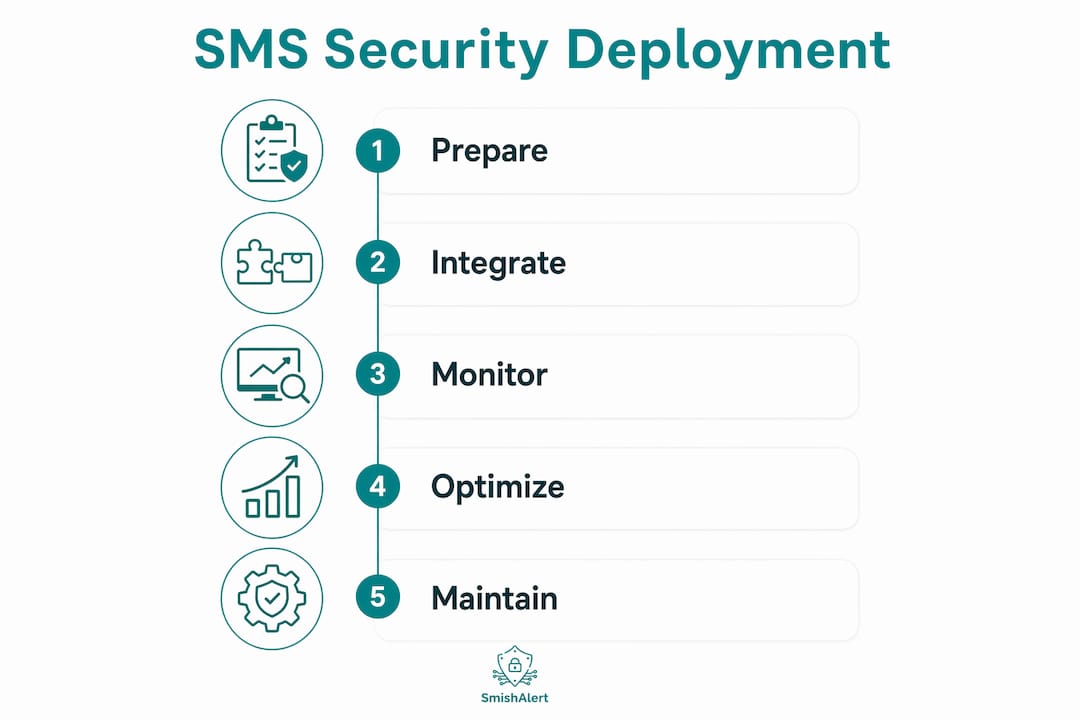
Pro Tip: Treat the monitored launch phase as a live threat exercise. Ask your provider to share real-time detection data during the first two weeks so your security team builds familiarity with the platform before operating independently.
How do managed SMS security services improve operational control?
Post-deployment, managed SMS security services deliver operational benefits that basic SMS security tools cannot replicate. Real-time traffic visibility, fraud protection, and 24x7x365 support give security teams the ability to detect and respond to threats at the speed the attack surface demands.
The contrast with basic SMS security tools is significant. A standalone SMS filtering tool may block known malicious numbers. A managed service correlates message patterns across your entire organization, identifies campaign-level attacks, and feeds that intelligence back into your SIEM. That difference matters when the threat is executive impersonation or a coordinated credential-harvesting campaign targeting multiple employees simultaneously.
Compliance automation is one of the clearest operational gains. Automated compliance features handle opt-in documentation, opt-out processing, quiet hours, and frequency caps without manual intervention. For security teams already stretched across email, endpoint, and network defense, removing that administrative burden is a direct efficiency gain.
The operational benefits of managed SMS security services include:
- Continuous threat monitoring across SMS, iMessage, and WhatsApp channels
- AI-powered incident triage that reduces analyst workload
- Automated compliance enforcement for TCPA, HIPAA, and GDPR
- Campaign correlation that surfaces coordinated attack patterns
- Revenue assurance reporting for enterprise messaging operations
- Transparent analytics that support audit and board-level reporting
Providers certified to ISO 27001 with tenant data isolation and HTTPS/OAuth enforcement ensure that the managed service itself does not become an attack surface. Security leaders should treat provider security architecture as a selection criterion, not an afterthought.
What are best practices for maintaining your SMS security managed service?
Deploying a managed SMS security service is not a one-time event. The threat environment evolves continuously, and your service configuration must evolve with it.
Routine compliance audits should run on a quarterly schedule at minimum. Verify that opt-in records are current, carrier registrations are valid, and frequency caps reflect your current messaging volumes. Selecting providers with transparent operational models and analytics makes this process faster and reduces the risk of compliance drift.
AI-powered detection and incident triage are now standard features in leading managed services. 24x7x365 monitoring combined with AI-driven incident management reduces staffing requirements while improving threat detection accuracy. Your team should review AI-generated triage outputs weekly to confirm that detection thresholds remain calibrated to your organization’s actual risk profile.
Staff education cannot be static. Threat actors update smishing tactics faster than most training programs refresh. Schedule quarterly briefings that incorporate real campaign examples from your provider’s threat intelligence feed. Smishalert’s contextual phishing warning capabilities show how real-time threat context can be embedded directly into employee-facing security workflows.
Best practices for ongoing management include:
- Quarterly compliance audits covering opt-in records and carrier registration
- Monthly review of AI triage outputs and detection rule performance
- Quarterly staff training updates using live campaign examples
- Annual review of provider SLAs and incident response benchmarks
- Integration of SMS threat telemetry into your SIEM for unified visibility
- Regular testing of escalation procedures with your provider’s operations team
Pro Tip: Ask your managed service provider for a monthly threat summary report. If the provider cannot produce one, that is a signal their analytics capability is weaker than their sales pitch suggests.
Key Takeaways
Managed SMS security services deliver the most value when compliance automation, real-time monitoring, and API integration are treated as core requirements rather than optional features.
| Point | Details |
|---|---|
| Start with prerequisites | Confirm API readiness, compliance frameworks, and data governance before selecting a provider. |
| Follow a structured deployment | Enterprise implementations take around four weeks and require data migration, configuration, training, and a monitored launch. |
| Prioritize compliance automation | Automated opt-in, opt-out, and quiet hours enforcement removes legal risk without adding manual workload. |
| Demand operational transparency | Providers should deliver real-time analytics and monthly threat summaries as standard deliverables. |
| Maintain the service actively | Quarterly audits, AI triage reviews, and staff training updates keep detection accuracy aligned with evolving threats. |
Why provider selection is the decision that matters most
Security leaders spend significant time evaluating feature lists when selecting a managed SMS security provider. That is the wrong starting point. The right question is whether the provider’s platform is built around compliance and security by design, or whether compliance is a layer added on top of a basic messaging tool.
I have seen organizations select platforms with impressive dashboards that could not automate TCPA opt-out processing without custom development. That gap created manual workflows, which created human error, which created legal exposure. The feature looked good in a demo. It failed in production.
The providers worth evaluating are those where compliance is embedded in platform workflows rather than documented in a PDF. Ease of API integration matters because a service that requires six months of custom development to connect to your SIEM is not actually managed. It is a product you are managing yourself.
The SMS phishing threat is not static. Attackers are moving faster than most organizations’ annual security review cycles. A managed service that includes active threat monitoring and 24x7 support means your defenses update in near real time, not at your next budget cycle. That is the operational argument for managed SMS security that no feature comparison table fully captures.
— Sophie
How Smishalert supports managed SMS security programs
Smishalert is built for security leaders who need visibility into messaging-based social engineering threats that exist entirely outside the corporate perimeter. The platform captures, correlates, and reports on smishing campaigns targeting employees across SMS, iMessage, and WhatsApp, giving security teams the threat intelligence they need to act before a credential-harvesting or executive impersonation attack reaches compromise.
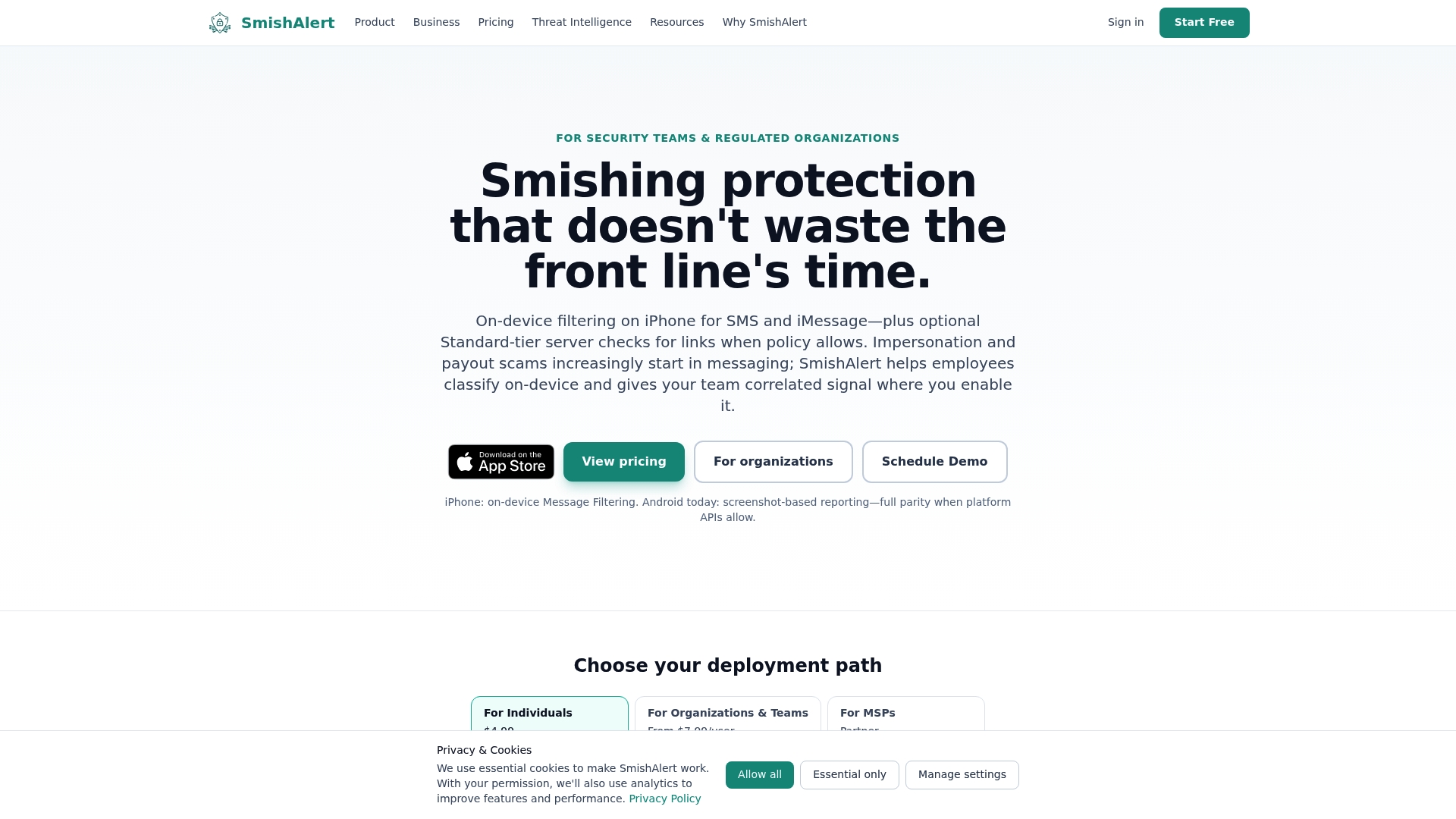
For organizations evaluating managed SMS security solutions, Smishalert’s solutions for social engineering protection cover the full attack surface, from phishing detection and campaign correlation to automated reporting and mobile protection workflows. Security teams can also use the enterprise smishing protection practices resource to benchmark their current defenses before deployment.
FAQ
What is a managed SMS security service offering?
A managed SMS security service offering is a contracted arrangement where a provider delivers phishing detection, compliance automation, and continuous monitoring for an organization’s SMS and messaging channels. It differs from a basic SMS filtering tool by providing active threat management, analytics, and 24x7 support.
How long does it take to deploy managed SMS security?
Enterprise managed SMS security implementations typically take around four weeks post-contract, covering data migration, workflow configuration, staff training, and a monitored launch. White-label single-API deployments can go live in days.
What compliance frameworks does managed SMS security need to cover?
Managed SMS security services operating in enterprise environments must address TCPA, HIPAA, and GDPR at minimum. Providers should automate opt-in documentation, opt-out processing, quiet hours, and carrier registration rather than relying on manual processes.
How does managed SMS security differ from email security platforms?
Email security platforms protect the corporate perimeter. Managed SMS security services provide visibility into threats that occur outside that perimeter, including smishing attacks on personal devices, executive impersonation via iMessage, and credential-harvesting campaigns on WhatsApp.
What should security leaders look for in a managed SMS security provider?
Security leaders should prioritize providers that enforce tenant data isolation, support ISO 27001 compliance, offer single-API integration, and embed regulatory compliance directly into platform workflows rather than treating it as a manual configuration task.