
How SMS Alerts Reach the SOC Queue: 2026 Guide

SMS alerts reach the SOC queue through automated integration of security telemetry into a centralized SIEM, which categorizes incidents using frameworks like MITRE ATT&CK and routes critical notifications via priority-based SMS escalation chains. Understanding how SMS alerts reach the SOC queue is not optional for security teams. It is the difference between a 5-minute response and a 45-minute blind spot. Automated enrichment can reduce manual investigation time by up to 70% by pre-correlating logs and threat intelligence before an alert ever reaches an analyst. This guide breaks down the full delivery path, from telemetry ingestion to analyst notification, with the operational detail security teams need to act on it.
How SMS alerts reach the SOC queue: the end-to-end path
Security alerts enter the SOC queue by flowing from telemetry sources, including EDR, NDR, and IAM systems, into a SIEM. The SIEM normalizes and correlates that data, then applies behavioral rules and threat frameworks to classify each event. When an incident crosses a defined severity threshold, the SIEM triggers a webhook or API call that initiates an SMS notification to the on-call analyst or escalation chain.
This path is not a single hop. It involves at least four distinct layers: the detection source, the SIEM correlation engine, the SMS API provider, and the carrier network. Each layer introduces its own latency and failure modes. Security teams that treat SMS delivery as a black box will eventually discover a gap in their escalation record at the worst possible moment.

The MITRE ATT&CK framework plays a direct role in this process. Alert categorization using MITRE ATT&CK maps detected behaviors to known adversary tactics, which feeds directly into priority scoring. A credential-harvesting event tied to Technique T1078 (Valid Accounts) will score differently than a low-confidence anomaly, and that score determines whether an SMS fires at all.
SMS alerts are primarily used as escalation channels, not as primary real-time monitors. This distinction matters because blocking a critical automation thread on an SMS delivery confirmation would introduce unacceptable latency into the SOC workflow. The SMS channel is the human layer of the escalation chain, not the detection layer.
What is the SMS alert delivery process in a modern SOC?
The SMS alert delivery process is asynchronous by design. When the SIEM triggers an API call to an SMS provider, the message is queued by the provider, routed through an aggregator, and then handed off to the destination carrier. Messages reach carriers in under 0.25 seconds, but delivery receipt (DLR) confirmation back to the originating system can take 2–20 seconds during peak traffic periods.
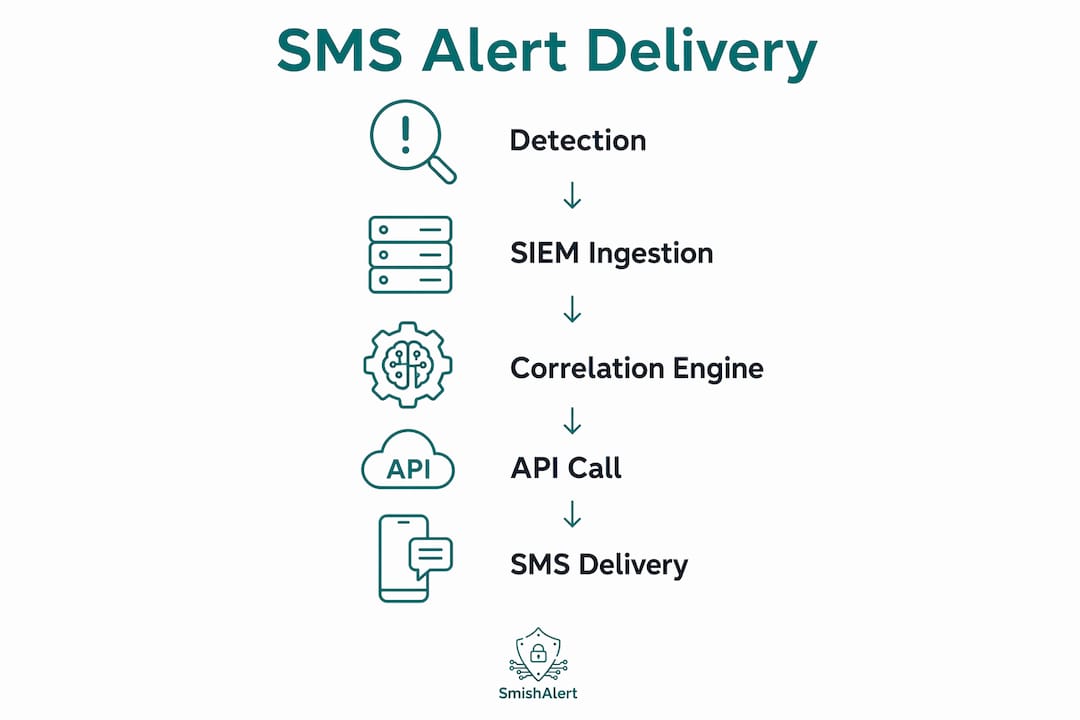
This asynchronous model has a direct consequence for SOC operations. The SIEM does not wait for delivery confirmation before continuing its workflow. That means an analyst could be assumed notified while the message is still queued at the carrier level. Security teams must account for this gap explicitly in their escalation design.
Carrier rate limits add another variable. Carrier throughput ranges from 75 to 4,500+ segments per minute, depending on the carrier and the sender’s registration tier. During a large-scale incident where multiple alerts fire simultaneously, rate limiting can delay delivery by seconds or minutes. That delay is operationally significant when the acknowledgment window for a critical alert is 5 minutes.
Key technical facts about the SMS delivery lifecycle:
- API trigger: The SIEM or SOAR platform calls the SMS provider API when an alert crosses the severity threshold.
- Provider queuing: The provider queues the message and routes it through an aggregator to the appropriate carrier.
- Carrier handoff: The carrier accepts the message in under 0.25 seconds under normal conditions.
- DLR delay: Delivery receipts return to the originating system within 2–20 seconds, longer during high-volume events.
- Rate limit impact: High-volume incidents can hit carrier throughput ceilings, slowing alert fanout across large on-call teams.
Pro Tip: Register your SMS sender ID at the highest throughput tier your provider supports. During a major incident, the difference between 75 and 4,500 segments per minute determines whether your entire on-call team gets notified in seconds or minutes.
How do SOCs prioritize and queue SMS alerts before analysts see them?
Priority queues are the mechanism that separates actionable alerts from noise. A well-configured SOC uses at least four priority tiers: critical, high, normal, and low. Each tier carries different routing rules, acknowledgment windows, and escalation behaviors. Critical P1 alerts require acknowledgment within 5 minutes, with escalation to the next tier firing automatically if no response is received.
The triage lifecycle that begins when an alert enters the queue involves three steps before a human analyst touches it.
- Validation: The SIEM confirms the alert is not a duplicate and that the triggering rule fired correctly. Missing idempotency keys at the API layer are a common source of duplicate alerts that inflate queue volume before this step.
- Enrichment: Automated systems pull threat intelligence, asset context, and historical behavior data to add meaning to the raw alert. Automated enrichment and risk scoring reduce false positives before the alert reaches an analyst, which is the primary lever for reducing analyst burnout.
- Disposition: The enriched alert receives a risk score. Low-confidence alerts are closed automatically or routed to a low-priority queue. High-confidence alerts trigger SMS escalation immediately.
| Priority tier | Acknowledgment window | SMS escalation interval | Typical alert type |
|---|---|---|---|
| Critical (P1) | 5 minutes | Every 5 minutes | Active intrusion, ransomware indicator |
| High (P2) | 15 minutes | Every 15 minutes | Lateral movement, credential compromise |
| Normal (P3) | 60 minutes | Single notification | Policy violation, anomalous login |
| Low (P4) | Next business day | No SMS | Informational, low-confidence anomaly |
SOAR platforms handle the orchestration layer that enforces these rules automatically. Automated orchestration reduces analyst burnout by filtering low-value alerts and ensuring enriched, high-confidence events are the only ones that trigger SMS escalation. Without SOAR, analysts receive raw, unenriched alerts via SMS, which increases cognitive load and slows response.
Pro Tip: Set your SOAR to suppress SMS escalation for any alert that scores below your defined risk threshold unless it remains unresolved after a defined dwell time. This single rule eliminates the majority of low-value SMS notifications without creating blind spots.
What operational challenges arise in managing SMS alert queues?
Duplicate SMS alerts are the most common and most damaging failure mode in SOC queue management. They arise when the SMS API is called multiple times for the same event due to missing idempotency keys in the alerting logic. Each duplicate creates a separate ticket, inflates queue volume, and trains analysts to ignore repeated notifications. That conditioning is exactly the wrong response pattern for a critical alert environment.
Alert fatigue compounds the duplicate problem. When analysts receive unfiltered or redundant SMS notifications, they begin treating all SMS alerts as low-signal noise. The result is slower acknowledgment times and higher risk of a genuine critical alert being dismissed as another false positive.
Common operational pitfalls in SMS alert queue management:
- No idempotency keys: Retry logic fires duplicate SMS alerts for the same incident, flooding the queue.
- Missing DLR integration: Delivery receipts are not fed back into the SIEM, creating false assumptions that analysts were notified.
- Sole reliance on carrier SMS: Treating SMS as the only escalation path ignores carrier latency unpredictability during high-volume events.
- Unfiltered alert routing: All alerts, regardless of confidence score, trigger SMS notifications, destroying signal quality.
- No escalation chain testing: Escalation paths are configured but never tested, leaving gaps that only surface during actual incidents.
Failure to hook delivery receipts back into the SIEM leads to false assumptions about analyst notification. This is a systemic accountability gap. If the SIEM has no confirmation that the SMS was delivered and read, the escalation chain has no ground truth. Security teams should treat DLR integration as a non-negotiable component of any SMS alerting architecture, not an optional enhancement.
The mitigation for most of these challenges is a combination of idempotency enforcement at the API layer, DLR feedback loops into the SIEM, and a secondary escalation channel (such as a voice call or push notification) for critical alerts when SMS delivery cannot be confirmed within the acknowledgment window. Understanding carrier rate limits during high-volume events is also part of sound SOC operational planning.
How do AI and automation improve SMS alert queue management?
AI-driven SOC platforms change the nature of what reaches the SMS escalation layer. Instead of routing raw log events to analysts, these platforms automatically enrich alerts with threat intelligence and asset context, score them by risk, and close low-confidence alerts without human intervention. The result is that SMS notifications carry pre-built context rather than a bare alert ID.
“AI SOCs present alerts as enriched stories instead of raw logs, minimizing analyst cognitive load and enabling faster, better decision-making. The analyst who receives an SMS notification already has the who, what, and where before they open the console.”
The operational impact is measurable. Automated enrichment and behavior correlation reduces manual analysis time by approximately 70%. That reduction comes from eliminating the manual steps of pulling asset data, checking threat feeds, and correlating related events. When those steps happen automatically before the SMS fires, the analyst’s first action can be containment rather than investigation.
Key capabilities that AI brings to SMS alert queue management:
- Behavioral filtering: AI models identify alert patterns consistent with known attack techniques and suppress alerts that do not match behavioral baselines.
- Cross-tool correlation: Alerts from EDR, NDR, IAM, and other telemetry sources are correlated automatically, reducing duplicate notifications for the same underlying event.
- Risk scoring: Each alert receives a confidence score before routing. Only alerts above the threshold trigger SMS escalation.
- Automated triage: Low-confidence alerts are closed automatically, keeping the SMS channel reserved for genuine incidents.
- Escalation chain integration: AI platforms connect directly to SMS escalation chains, ensuring the right analyst receives the right alert at the right priority level.
Securing data in AI-driven environments requires that the enrichment pipeline itself be protected. Threat intelligence feeds and asset databases that power AI enrichment are high-value targets. A compromised enrichment source can manipulate risk scores and suppress legitimate alerts before they reach the SMS layer. Security teams should treat the AI enrichment pipeline with the same rigor as the SIEM itself.
AI and behavioral analysis in SOC alert management also reduce the risk of lateral movement going undetected. When AI correlates an anomalous login with a subsequent credential-harvesting attempt, the combined signal scores high enough to trigger immediate SMS escalation. Neither event alone might have crossed the threshold.
Key Takeaways
SMS alerts reach the SOC queue through a structured pipeline of SIEM ingestion, automated enrichment, priority-based routing, and asynchronous carrier delivery, and each layer requires deliberate configuration to avoid alert fatigue and missed escalations.
| Point | Details |
|---|---|
| SIEM is the routing engine | All telemetry flows into the SIEM, which applies MITRE ATT&CK categorization before any SMS fires. |
| Delivery is asynchronous | SMS handoff to carriers takes under 0.25 seconds, but DLR confirmation can lag 2–20 seconds. |
| Priority queues control noise | Four-tier priority systems (critical through low) determine acknowledgment windows and escalation intervals. |
| Idempotency prevents duplicates | Missing idempotency keys at the API layer are the leading cause of duplicate alerts and inflated queue volume. |
| AI enrichment cuts analyst load | Automated enrichment and behavior correlation reduces manual investigation time by approximately 70%. |
Why SMS alert queue mechanics deserve more attention than they get
Security teams spend significant effort tuning detection rules and threat intelligence feeds, but the SMS escalation layer often gets configured once and forgotten. That is a mistake I have seen play out in real incidents. The detection fired correctly. The SIEM scored it accurately. The SMS never arrived because the sender hit a carrier rate limit during a concurrent high-volume event, and no one had integrated DLR feedback to catch the failure.
The mechanics of asynchronous SMS delivery are not glamorous, but they are operationally critical. A 20-second DLR delay sounds trivial until it is the difference between a 5-minute and a 25-minute acknowledgment on a P1 alert. Carrier rate limits sound like a vendor problem until your entire on-call team is waiting for notifications that are queued behind a burst of lower-priority messages.
The teams that get this right treat SMS alert delivery as a measurable system, not an assumption. They monitor DLR rates, test escalation chains monthly, and build secondary notification paths for critical alerts. They also apply idempotency keys at the API layer from day one, not as a fix after a duplicate alert incident.
AI and SOAR automation are the right long-term answer for reducing alert noise, but they require the same discipline. An AI enrichment pipeline that is not monitored for data quality will eventually suppress a legitimate alert. Automation that is not tested will fail silently. The goal is not to remove humans from the loop. The goal is to ensure that when an SMS reaches an analyst, it carries enough context to act on immediately.
— Sophie
Smishalert’s role in SMS security and alert enrichment
Security teams that understand the SMS alert delivery process also recognize a harder problem. SMS is not just an escalation channel. It is an attack surface. Executive impersonation, credential-harvesting campaigns, and payroll fraud all arrive via the same channel that carries your P1 incident notifications.
Smishalert gives SOC teams visibility into messaging-based social engineering attacks that operate entirely outside the corporate perimeter. Through user reporting, campaign correlation, and threat analysis, Smishalert surfaces the human attack surface that traditional SIEM telemetry cannot see. Security teams can explore Smishalert’s full platform capabilities to understand how SMS threat intelligence integrates with existing alert workflows. For teams evaluating their current readiness, the 2-minute self-evaluation provides a structured starting point.
FAQ
How does an SMS alert get triggered in a SOC?
A SIEM detects an event that crosses a defined severity threshold and triggers a webhook or API call to an SMS provider, which queues and routes the message to the on-call analyst’s device.
What causes delays in SMS alert delivery to analysts?
Carrier rate limits, aggregator queuing, and asynchronous delivery mechanics can delay SMS receipt by seconds to minutes, particularly during high-volume incidents where multiple alerts fire simultaneously.
What is a delivery receipt (DLR) and why does it matter for SOC operations?
A DLR is a confirmation from the carrier that the SMS was delivered to the recipient’s device. Integrating DLRs back into the SIEM prevents false assumptions that analysts were notified when delivery actually failed.
How do priority queues reduce alert fatigue in SMS notifications?
Priority queues route only high-confidence, enriched alerts to the SMS escalation channel. Critical alerts require acknowledgment within 5 minutes, while low-priority alerts never trigger SMS, keeping the channel high-signal.
How does AI reduce the volume of SMS alerts reaching analysts?
AI platforms automatically enrich, score, and triage alerts before routing decisions are made. Low-confidence alerts are closed automatically, and only events that exceed the risk threshold trigger SMS escalation, reducing manual investigation time by approximately 70%.