
How Mobile Threats Affect Cyber Resilience Posture

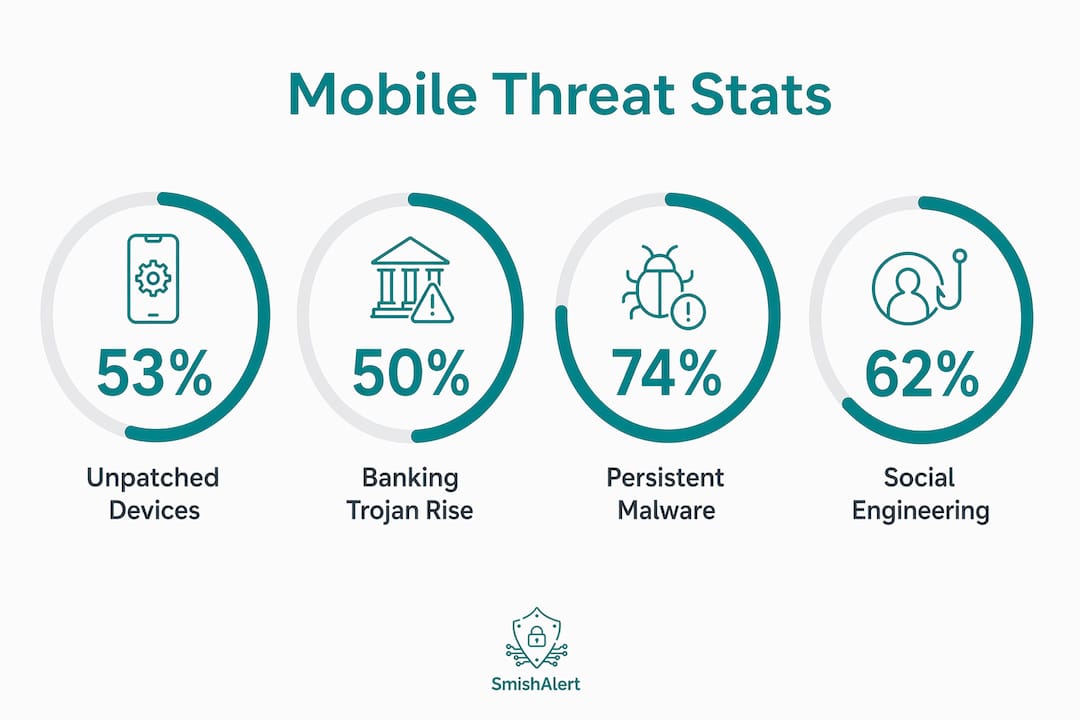
Cyber resilience posture is defined as an organization’s combined capacity to anticipate, withstand, recover from, and adapt to cyberattacks across all endpoints, including mobile devices. Understanding how mobile threats affect cyber resilience posture is no longer optional for security teams. Banking Trojan installs rose 50% in Q1 2026, reaching 162,275 incidents, while exploitation of known mobile vulnerabilities climbed from 20% to 31% in the same period. These numbers signal a structural shift: mobile endpoints are now the primary attack surface, and organizations that treat them as secondary risk are building resilience on a fractured foundation.
How mobile threats degrade cyber resilience posture
Mobile threats degrade resilience through four distinct mechanisms: unpatched software, persistent malware, social engineering, and unmanaged device sprawl. Each one expands the attack surface and reduces an organization’s ability to detect, contain, and recover from incidents.
Outdated operating systems and third-party code create the first layer of exposure. 53% of organizations have at least one device running a critically out-of-date OS. That figure reflects a systemic patch management failure, not isolated negligence. Compounding the problem, 70% of mobile app code originates from third-party libraries, many of which have never undergone a formal security audit. When a critical CVE surfaces in an open-source dependency, the exposure window is often weeks or months before remediation reaches production.

Banking Trojans and remote access malware represent the second mechanism. Modern variants like Mamont do not simply steal credentials. They persist on devices, intercept authentication codes and session cookies, and execute fraudulent transactions without triggering server-side fraud controls. The attack is invisible to both the user and the backend, which means traditional detection logic fails entirely.
Social engineering via SMS, iMessage, and WhatsApp is the third mechanism. Smishing attacks exploit the personal nature of mobile messaging, where employees are less guarded than in corporate email. Credential-harvesting campaigns, executive impersonation, and payroll fraud requests all arrive through channels that most SIEM and IAM platforms do not monitor. The result is a detection blind spot that sits directly in the human attack layer.
Zombie Devices complete the picture. A single unpatched mobile endpoint can give attackers a persistent network foothold and lateral movement capability across the enterprise. Unmanaged devices that drift from secure configuration baselines are not passive risks. They are active entry points that bypass perimeter controls entirely.
- Unpatched OS versions expose devices to known CVEs with public exploit code
- Third-party library vulnerabilities propagate silently across multiple apps
- Banking Trojans bypass server-side fraud detection through on-device transaction manipulation
- Smishing and mobile phishing exploit unmonitored messaging channels
- Zombie Devices enable lateral movement and persistent attacker access
Pro Tip: Run a continuous mobile device compliance audit that flags any endpoint deviating from your approved OS version and configuration baseline. Isolate non-compliant devices automatically rather than waiting for a manual review cycle.
How ai-driven mobile attacks change the resilience challenge
AI has fundamentally changed the speed and scale at which mobile threats operate. The paradigm has shifted from defending mobile devices to building resilience that assumes disruption will occur. Human analysts cannot keep pace with AI-generated attack variants, which means the detection and response architecture must change, not just the policies.
The practical impact shows up in three areas:
-
AI-generated phishing lures. Large language models now produce grammatically perfect, contextually relevant smishing messages at scale. A campaign that previously required hours of manual crafting can be deployed in minutes, targeting thousands of employees simultaneously with personalized content drawn from public data sources.
-
Overlay attacks and session hijacking. AI-accelerated malware variants now adapt their overlay screens in real time to match the exact UI of targeted banking and enterprise apps. Session hijacking tools use machine learning to identify the optimal moment to intercept an authenticated session, reducing the window for detection to near zero.
-
Automated, industrialized attack pipelines. In Q3 2025, 34 malware families targeted 1,243 financial institutions globally, with Android malware for financial fraud increasing 67% year over year. That scale is only achievable through automation. Manual threat hunting cannot match the throughput of industrialized mobile attack infrastructure.
“Organizations must stop treating mobile security as an afterthought and adopt AI-powered mobile defenses due to the scale and speed of AI-driven attacks.” — 2026 Verizon DBIR analysis via Zimperium
The implication for resilience is direct. If your detection depends on human review of alerts, your mean time to detect will always lag behind the attack cycle. AI-powered Mobile Threat Protection platforms that analyze behavioral telemetry in real time are no longer a premium option. They are the baseline requirement for maintaining a defensible posture.
Traditional security vs. mobile-focused resilience strategies
Traditional endpoint security was designed for managed laptops inside a defined perimeter. Mobile resilience requires a different architecture, one that integrates mobile controls into identity, cloud, and endpoint security stacks and designs for trust and recoverability under simultaneous disruptions.
The table below captures the core differences:
| Dimension | Traditional Security Posture | Mobile-Focused Resilience |
|---|---|---|
| Device trust model | Static, perimeter-based trust | Hardware-attested, continuous trust verification |
| Patch management | Scheduled cycles, IT-controlled | Continuous compliance with automated isolation |
| Threat detection | Signature-based, network-layer | Behavioral telemetry, on-device runtime analysis |
| Social engineering coverage | Email-focused (SEG, DMARC) | Messaging channels: SMS, iMessage, WhatsApp |
| Recovery design | Incident response playbooks | Resilience-by-design, assumes disruption occurs |
| Identity integration | IAM tied to corporate directory | Zero-trust with device health as an access signal |
The most significant gap is in identity integration. Zero-trust architecture requires that device health status feed directly into access decisions. A device running an outdated OS or flagged for anomalous behavior should trigger a conditional access block before any lateral movement occurs. Most organizations have zero-trust policies on paper but lack the mobile telemetry to enforce them in practice.
Hardware-attested device trust, available through Apple’s Secure Enclave and Android’s StrongBox, provides cryptographic proof of device integrity at the hardware level. Runtime fraud detection tools then monitor app behavior continuously, catching overlay attacks and session hijacking that signature-based tools miss entirely.
Pro Tip: Integrate your Mobile Threat Protection platform with your IAM solution so that device risk scores automatically adjust access privileges. A device flagged for suspicious behavior should lose access to sensitive resources before a human analyst reviews the alert.
Practical strategies for enhancing resilience against mobile threats
Enhancing cyber resilience against mobile risks requires moving from reactive patching to proactive, automated defense across the full mobile attack surface. The following approaches address the specific gaps that mobile threats exploit.
Automated Software Composition Analysis (SCA) is the starting point for mobile app security. Organizations waste resources by manually testing low-risk mobile app code when automated SCA tools can identify reachable CVEs in third-party libraries far more efficiently. Tools aligned with the OWASP MASVS framework prioritize findings by exploitability, so security teams focus effort where it produces measurable risk reduction.
- Deploy automated SCA tools to scan all third-party dependencies in mobile apps before each release
- Scope anti-tamper and root detection controls to your actual threat model, not a generic checklist
- Use AI-driven Mobile Threat Protection platforms that analyze on-device behavioral telemetry in real time
- Implement continuous device compliance monitoring that isolates endpoints deviating from approved configuration baselines
- Deploy employee reporting mechanisms for smishing and mobile phishing across SMS, iMessage, and WhatsApp
- Integrate mobile threat telemetry into your SIEM for unified visibility across the attack surface
Mitigating mobile phishing and smishing requires visibility into channels that traditional email security platforms do not cover. Employees receive executive impersonation attempts, credential-harvesting links, and gift card scams through personal messaging apps on corporate-enrolled devices. Without a reporting mechanism and threat correlation capability, these attacks go undetected until a credential is compromised or a fraudulent transaction clears.
The integration layer matters as much as the individual tools. Mobile threat telemetry fed into a SIEM, correlated with IAM signals and endpoint data, gives security teams the context needed to distinguish a compromised device from a misconfigured one. That context is what separates a fast, accurate response from a slow, expensive investigation.
For organizations exploring how to close the mobile security gap without overhauling existing infrastructure, the priority is visibility first. You cannot respond to threats you cannot see, and most organizations have significant blind spots in their mobile messaging channels.
Key takeaways
Mobile threats directly undermine cyber resilience posture by exploiting unpatched devices, persistent malware, and unmonitored messaging channels that traditional security stacks cannot see.
| Point | Details |
|---|---|
| Mobile is the primary attack surface | Banking Trojan installs rose 50% in Q1 2026, confirming mobile as the leading threat vector. |
| Outdated OS creates systemic exposure | 53% of organizations run at least one critically out-of-date mobile OS, widening the vulnerability window. |
| AI accelerates attack scale and speed | AI-generated smishing and overlay attacks outpace human detection, requiring automated AI-powered defenses. |
| Zero-trust requires mobile telemetry | Device health signals must feed IAM systems to enforce conditional access and prevent lateral movement. |
| Messaging channels are a detection blind spot | SMS, iMessage, and WhatsApp carry social engineering attacks that email security platforms do not monitor. |
Why most organizations are still getting mobile resilience wrong
After working across enterprise security programs for years, the pattern I see most consistently is not a lack of tools. It is a lack of integration. Organizations deploy Mobile Device Management, a SIEM, and an endpoint detection platform, then treat mobile as covered. It is not.
The blind spot is almost always in the messaging layer. A CISO can show me a mature zero-trust architecture and a well-tuned SIEM, and I will ask one question: what visibility do you have into smishing attempts targeting your finance team on personal devices? The answer is almost always none. That gap is where credential-harvesting campaigns and payroll fraud attacks succeed, not because the security stack is weak, but because it is pointed in the wrong direction.
The organizations that are getting this right have made one structural change: they treat mobile messaging as a monitored channel, not a personal one. They deploy user reporting tools, correlate reported threats across campaigns, and feed that data into their broader threat intelligence workflow. The mobile endpoint protection challenge in 2026 is not purely a technology problem. It is an architecture and visibility problem.
My advice is direct: audit your detection coverage against the five mobile threat mechanisms described in this article. If you cannot answer how you detect smishing campaigns targeting executives, you have a resilience gap that no amount of endpoint hardening will close.
— Sophie
How Smishalert addresses mobile social engineering risk
Security teams that have hardened their endpoint and email stack often discover that mobile messaging remains their largest unmonitored attack surface. Smishalert is built specifically for that gap.
Smishalert captures and correlates social engineering attacks delivered through SMS, iMessage, and WhatsApp, including executive impersonation, credential harvesting via SMS, payroll fraud, and mobile phishing campaigns. The platform gives security teams visibility into threats that occur entirely outside the corporate perimeter, where traditional email security and SIEM integrations have no reach. Smishalert integrates with enterprise mobile security postures and feeds correlated threat data back into existing workflows. Explore the full range of social engineering attack coverage or request a 30-day exposure assessment to understand your organization’s current messaging risk surface.
FAQ
What is cyber resilience posture in the context of mobile security?
Cyber resilience posture refers to an organization’s capacity to anticipate, absorb, and recover from cyberattacks across all endpoints, including mobile devices. Mobile security and cyber resilience are directly linked because unmanaged or compromised mobile endpoints undermine the entire defense and recovery architecture.
How do banking trojans specifically undermine resilience?
Modern banking Trojans persist on devices, intercept authentication codes, and execute fraudulent transactions without triggering server-side controls. This renders traditional fraud detection ineffective and requires on-device runtime protection and hardware-attested device trust as countermeasures.
Why are smishing attacks particularly dangerous for enterprises?
Smishing attacks arrive through SMS, iMessage, and WhatsApp channels that most enterprise security platforms do not monitor. This creates a detection blind spot where credential-harvesting and executive impersonation campaigns can succeed without generating any alerts in a SIEM or email security platform.
How does a zombie device threaten the entire network?
A single unpatched mobile endpoint can provide attackers a persistent network foothold and lateral movement capability across enterprise systems. Continuous compliance monitoring that automatically isolates non-compliant devices is the primary control for eliminating this risk.
What is the most effective first step for enhancing mobile resilience?
Deploy automated Software Composition Analysis tools to identify reachable CVEs in third-party mobile app libraries, aligned with the OWASP MASVS framework. Pair this with a user reporting mechanism for smishing to gain visibility into the messaging attack surface before investing in additional tooling.