
Bundle SMS Security and Endpoint Protection Offers

A bundle SMS security endpoint protection offer is defined as a consolidated security package that combines mobile messaging threat detection with device-level endpoint controls into a single managed service. Organizations that deploy this combination report up to 70% higher profitability and approximately 95% client retention rates. The reason is straightforward: SMS-based social engineering attacks operate at a communication layer that traditional endpoint detection and response tools never see. Closing that gap requires both layers working together. This article explains how to build, deploy, and operate that combined defense, with specific guidance for IT security professionals and MSP decision-makers managing mobile security risk at scale.
Why bundling SMS security with endpoint protection closes critical gaps
Endpoint protection alone does not fully secure mobile messaging. Traditional EDR and antivirus tools monitor process execution, file system activity, and network connections at the OS level. They do not inspect SMS, iMessage, or WhatsApp payloads. A credential-harvesting link delivered via text message bypasses every endpoint control that does not include a dedicated SMS security layer.
The communication layer is where most mobile social engineering attacks begin. Executive impersonation, payroll fraud, and gift card scams all arrive as text messages, not as malware files. Security teams that rely only on endpoint telemetry will see the lateral movement or the credential reuse, but they will miss the first signal in the human layer. That delay gives attackers time to complete the attack chain before any alert fires.

Mobile endpoints present unique challenges that compound this problem. Employees use personal devices for work messaging. Corporate MDM policies often do not extend to personal SMS inboxes. The result is a visibility gap that grows with every new employee and every new messaging channel added to the organization.
Bundling SMS security solutions with endpoint protection services addresses this gap directly. The bundle creates a unified telemetry picture: endpoint agents report device health and process behavior, while SMS security layers report message-level threats, campaign patterns, and user reporting signals. Security teams get correlated data instead of two separate, disconnected alert streams.
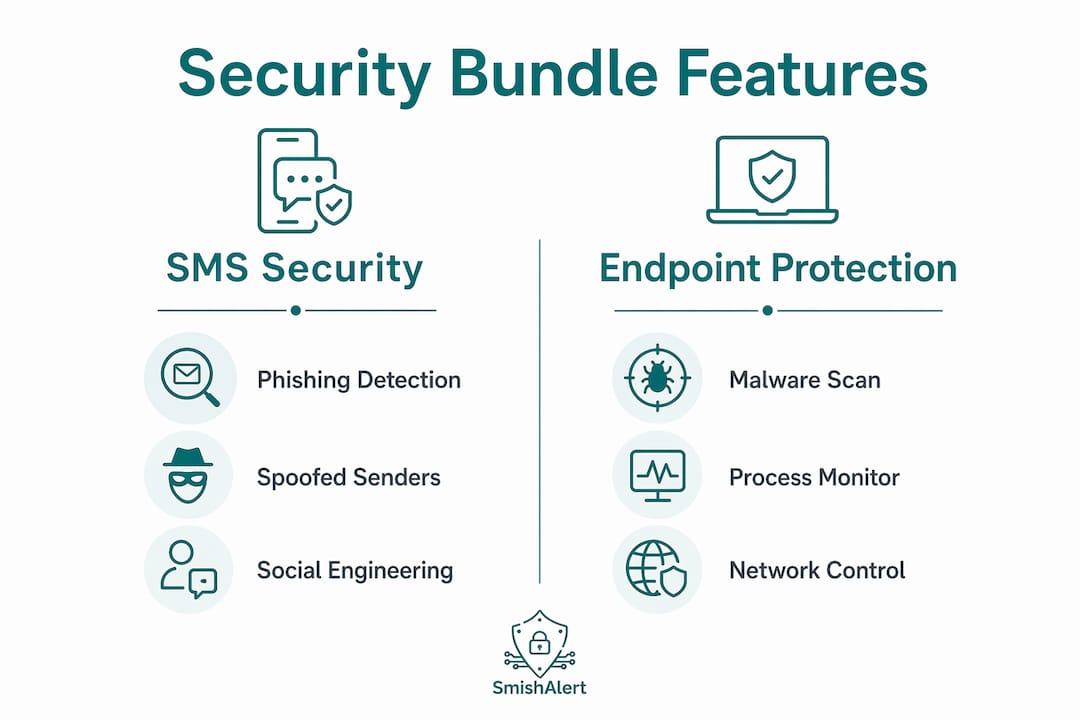
- Communication layer coverage: SMS security monitors inbound messages for phishing links, spoofed sender IDs, and social engineering language patterns.
- Endpoint layer coverage: Endpoint agents monitor device integrity, application behavior, and network connections.
- Correlated alerting: Bundled platforms surface connections between a suspicious SMS and subsequent device activity, accelerating incident response.
- User reporting integration: Employees can flag suspicious messages, feeding threat intelligence back into the detection engine.
Pro Tip: Align SMS security policies with your endpoint detection rules from day one. A phishing link reported via SMS that later appears in endpoint web filter logs is a confirmed attack chain. Without both layers, you see only half the story.
What you need before deploying a bundled SMS and endpoint security package
Successful deployment of a combined mobile security solution requires specific technical and organizational prerequisites. Getting these right before launch prevents the most common integration failures.
On the technical side, the core requirements are an endpoint agent compatible with your device fleet, an SMS security platform that does not require MDM enrollment, and an API connection between the two systems for alert correlation. SMS scam protection deployment typically requires no specialized engineering and completes within 3–5 business days. That speed is possible because modern SMS security platforms operate at the application layer, not the OS kernel, which removes the need for deep device integration.
On the organizational side, security teams need to define scope before launch. Which employee groups will be enrolled first? Which messaging channels are in scope: SMS only, or also iMessage and WhatsApp? Who owns the alert triage workflow? Answering these questions before deployment prevents the operational confusion that slows rollout.
Consolidated billing and unified management panels are a significant operational benefit of bundled endpoint protection services. MSPs that combine identity, endpoint, and SMS security into one invoice reduce overhead and improve client retention. The administrative simplification alone justifies the bundle structure for most managed service providers.
| Feature category | What it covers |
|---|---|
| SMS threat detection | Phishing links, spoofed senders, social engineering language |
| Endpoint agent monitoring | Device health, process behavior, network activity |
| User reporting workflow | Employee-submitted suspicious messages and escalation routing |
| Campaign correlation | Linking SMS threats to endpoint events across the organization |
| Consolidated billing | Single invoice covering all security layers for MSP clients |
Pro Tip: Coordinate cross-team communication before go-live. IT, security operations, and HR all touch mobile security workflows. Aligning them early prevents alert fatigue and ensures that employee-reported threats reach the right analyst.
How to implement and manage a combined SMS and endpoint security bundle
A structured implementation process reduces deployment risk and accelerates time to value. The following steps reflect a proven sequence for organizations launching bundled endpoint protection services alongside SMS threat management.
-
Assess your current coverage. Audit existing endpoint protection tools and identify which messaging channels currently have no visibility. Map the gap between what your EDR covers and where SMS-based attacks could enter undetected.
-
Select a platform with native integration. Choose an SMS security solution that connects to your existing SIEM or endpoint management console via API. Avoid platforms that require separate analyst workflows. The goal is a single pane of glass for both threat types.
-
Define enrollment scope and rollout order. Start with high-risk employee groups: executives, finance teams, and HR. These roles are the most frequent targets of executive impersonation and payroll fraud attacks. Expand enrollment in phases.
-
Deploy the SMS security layer without MDM. Platforms like Smishalert deploy mobile phishing protection without MDM, which removes the primary barrier to employee adoption. Employees install a lightweight reporting tool rather than granting full device management access.
-
Configure alert correlation rules. Set up rules that link SMS threat reports to endpoint events by user identity. A user who reports a phishing SMS and then triggers a suspicious web filter alert on their endpoint is a high-priority incident. Automated correlation catches this faster than manual review.
-
Establish a monitoring cadence. Review SMS threat reports and endpoint alerts together in a daily or weekly security review. Enterprise SMS security covers phishing, SMS pumping fraud, and fake account creation, so the monitoring scope is broader than most teams initially expect.
-
Measure and communicate ROI. Track the number of phishing attempts blocked, credential-harvesting links reported, and endpoint incidents correlated to SMS threats. One deployment saved over $3M in SMS fraud costs after rapid rollout. Presenting these figures to stakeholders builds the business case for expanding the bundle.
-
Review and tune detection thresholds quarterly. Mobile threat patterns shift. Adjust sensitivity settings based on false positive rates and emerging attack techniques observed in your environment.
Common challenges when combining SMS security and endpoint protection
Bundling these two security layers surfaces predictable technical and operational challenges. Knowing them in advance lets security teams resolve issues before they affect coverage or user experience.
The most significant technical challenge is mobile OS API variation. iOS moves malicious SMS messages to a Junk folder silently without notifying the administrator. Android, by contrast, sends alerts to both the admin and the user. This difference means iOS deployments require a user-reporting workflow to compensate for the lack of automatic admin notification. Teams that do not account for this will have blind spots on Apple devices.
- False positive management: Aggressive SMS threat detection flags legitimate messages, particularly from financial institutions and two-factor authentication providers. Tune allowlists during the first two weeks of deployment.
- Privacy constraints on iOS: Apple’s privacy model limits what SMS security tools can read at the OS level. Solutions must rely on user-initiated reporting rather than passive scanning on iOS devices.
- User friction: Employees who receive too many security prompts stop engaging with the reporting workflow. Risk-proportionate detection avoids blocking legitimate users while maintaining threat coverage.
- Scope creep: Teams that add WhatsApp and iMessage to scope without adjusting analyst capacity create alert backlogs. Expand channel coverage in phases, not all at once.
- Vendor consolidation complexity: Bundling requires coordination between endpoint and SMS security vendors. Confirm API compatibility and data format alignment before signing contracts.
The rise of SMS blasters adds another layer of complexity. These devices send thousands of spoofed messages simultaneously, overwhelming detection systems tuned for lower-volume attacks. Detection thresholds must account for burst-volume scenarios.
Pro Tip: Balance security coverage with user experience from the start. A reporting tool that employees ignore is worse than no tool at all. Run a two-week pilot with a small group, collect feedback on friction points, and adjust before full rollout.
Key Takeaways
A bundle that combines SMS security with endpoint protection closes the communication-layer gap that traditional EDR tools miss, and organizations that deploy this combination report measurable gains in both security outcomes and MSP profitability.
| Point | Details |
|---|---|
| Bundling closes the EDR gap | Endpoint tools miss SMS-based attacks; adding SMS security provides the missing communication-layer visibility. |
| Deployment is fast | SMS security layers typically deploy within 3–5 business days without specialized engineering. |
| iOS and Android behave differently | iOS silently moves malicious SMS to Junk; Android alerts admins. Plan user-reporting workflows for iOS devices. |
| Consolidated billing drives retention | MSPs combining endpoint and SMS security on one invoice report approximately 95% client retention. |
| ROI is measurable and fast | Correlated SMS and endpoint data accelerates incident response and can prevent significant fraud losses in the first billing cycle. |
Why I stopped selling features and started selling outcomes
The shift from feature-based selling to outcome-based bundling is the single most important change I have seen in managed security services over the past several years. When I first started working with MSPs on mobile security solutions, every conversation started with a feature checklist. Clients wanted to know which protocols were supported, which OS versions were covered, and what the detection rate was against known signatures. Those are reasonable questions, but they miss the point entirely.
The clients who got the most value from bundled endpoint protection services were the ones who stopped asking “what does it detect?” and started asking “what does it prevent, and how fast?” That reframe changes everything. It shifts the conversation from technical specifications to business risk, and it makes the ROI case much easier to make. Outcome-based security bundles help MSPs focus client discussions on risk mitigation rather than product features, and that is a better conversation for everyone.
Vendor management simplification is an underrated benefit. Running separate contracts, separate billing cycles, and separate support relationships for endpoint and SMS security creates operational drag. Consolidating into a single bundle offer reduces that drag and frees up time for actual security work. MSPs that have made this shift report that consolidated invoicing reduces overhead in ways that compound over time.
The future of bundled mobile threat protection will include tighter integration between SMS telemetry and IAM systems. When a credential-harvesting SMS is reported, the IAM platform should automatically flag that user’s account for step-up authentication. That kind of automated response loop is where the real security value lives, and it only becomes possible when SMS security and endpoint protection share a common data layer.
— Sophie
How Smishalert fits into your bundled endpoint protection offer
Smishalert gives security teams and MSPs the SMS security layer that endpoint protection tools cannot provide on their own. The platform captures employee-reported messages from SMS, iMessage, and WhatsApp, correlates them into campaigns, and surfaces the attack patterns that matter most to your organization.
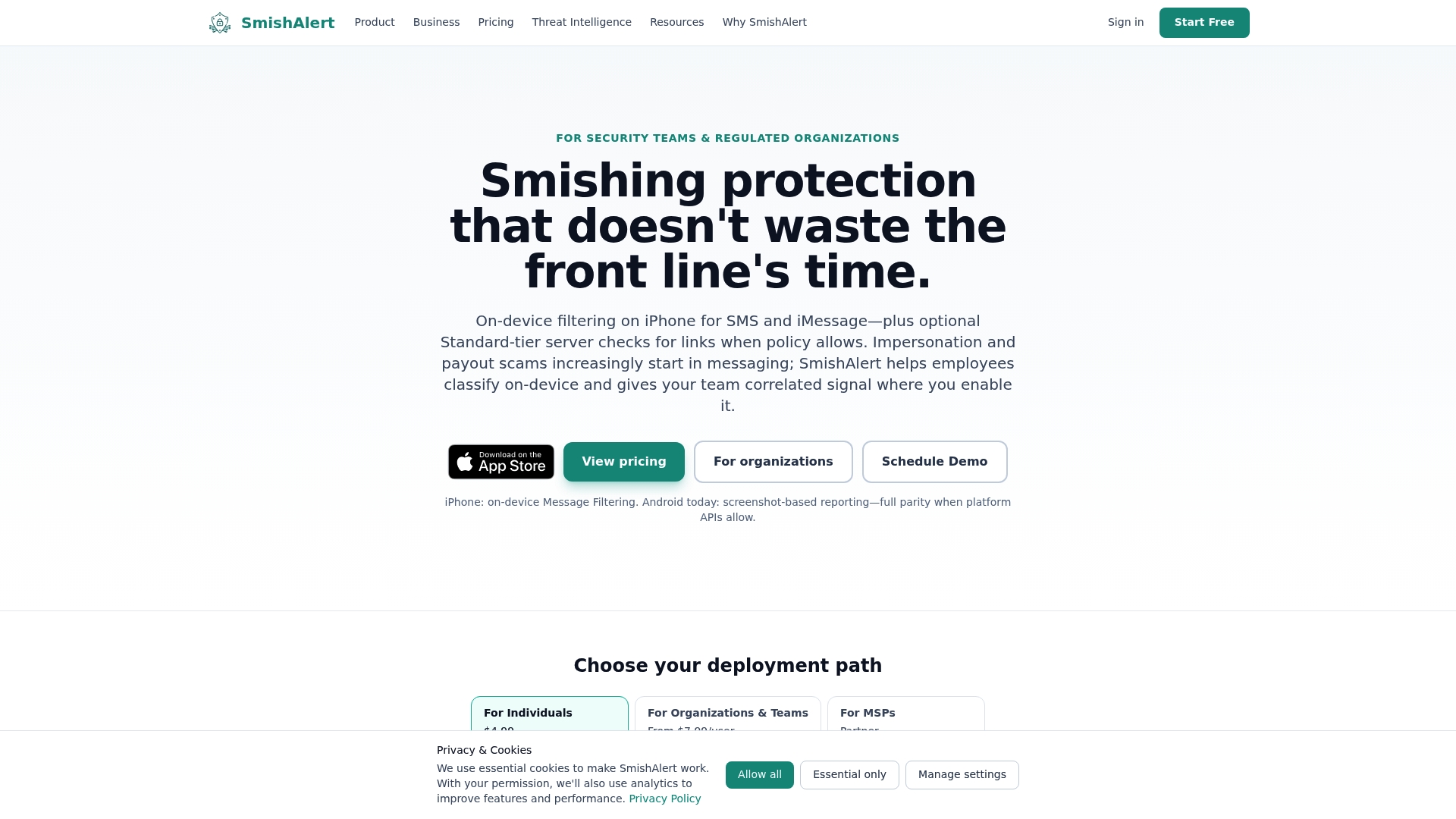
Smishalert deploys without MDM, which removes the primary adoption barrier for both enterprise IT teams and MSP clients. Security leaders can see live threat intelligence and campaign examples from real-world attacks, including executive impersonation, credential harvesting, and payroll fraud. For MSPs building a bundle security offer, Smishalert adds the messaging visibility layer that turns a standard endpoint protection package into a complete mobile security solution. Explore the full platform capabilities to see how SMS threat data integrates with your existing security stack.
FAQ
What is a bundle SMS security endpoint protection offer?
A bundle SMS security endpoint protection offer is a packaged managed security service that combines SMS phishing detection with device-level endpoint controls under a single contract and billing arrangement. It closes the visibility gap between communication-layer threats and OS-level security monitoring.
Why doesn’t endpoint protection cover SMS threats on its own?
Endpoint protection tools monitor device processes, files, and network connections. They do not inspect SMS or messaging app payloads, so SMS-based social engineering attacks bypass them entirely without a dedicated SMS security layer.
How long does it take to deploy an SMS security and endpoint bundle?
SMS security components typically deploy within 3–5 business days and require no specialized engineering. Endpoint agents may take longer depending on device fleet size and MDM configuration.
How do iOS and Android handle malicious SMS differently?
iOS silently moves detected malicious SMS messages to a Junk folder without notifying the administrator. Android sends alerts to both the admin and the user, making iOS deployments more dependent on employee-initiated reporting workflows.
What ROI can organizations expect from bundled mobile security solutions?
MSPs offering bundled endpoint and SMS security report up to 70% higher profitability and approximately 95% client retention. Individual deployments have documented fraud prevention savings exceeding $3M after rapid rollout.