
Align Mobile Threat Policy with Industry Standards

Aligning mobile threat policy with industry standards is defined as the structured process of mapping organizational mobile security controls to recognized frameworks such as NIST SP 800-124 Rev 2, DISA STIGs, and OWASP MASVS to reduce regulatory risk and enforce consistent protection across all mobile endpoints. Security and compliance teams that skip this alignment face increased audit exposure and gaps that adversaries actively exploit. The discipline is formally called mobile security compliance, though practitioners also refer to it as mobile threat policy alignment when discussing governance and control mapping. This guide covers the frameworks, implementation steps, technical controls, and governance cycles that security professionals need to build and sustain compliant mobile threat programs in 2026.
What are the essential industry standards for mobile threat policy alignment?
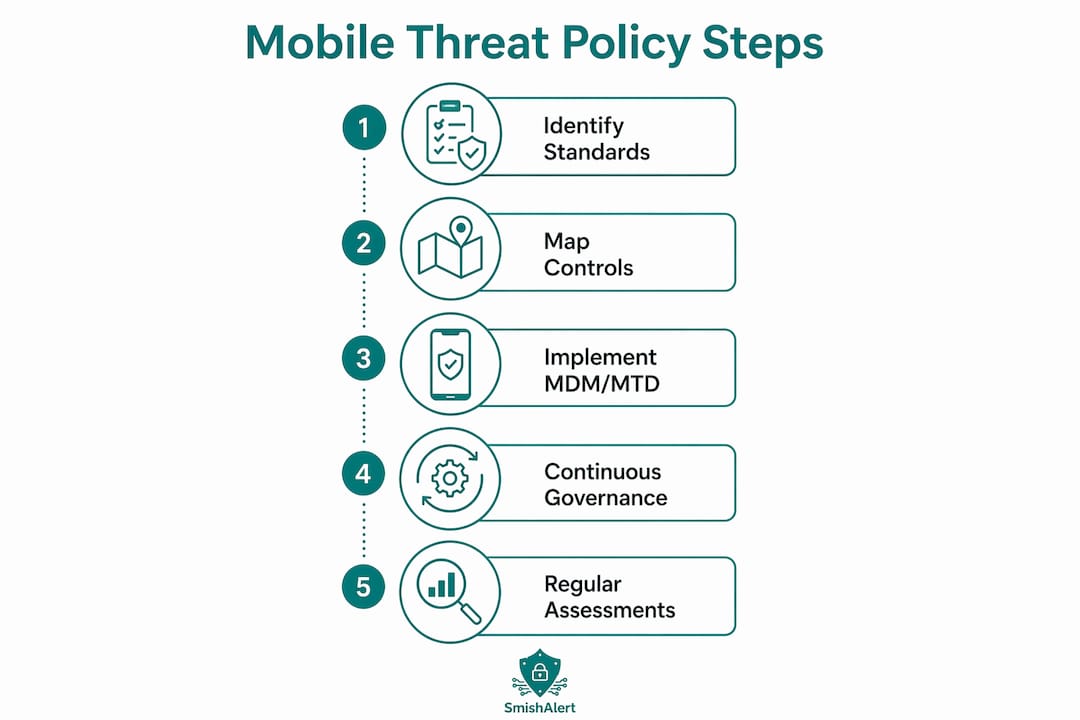
Aligning mobile threat policies with industry standards starts with understanding which frameworks carry regulatory weight and what each one requires. Three frameworks form the foundation for most enterprise programs today: NIST SP 800-124 Rev 2, DISA STIGs, and OWASP MASVS.
NIST SP 800-124 Rev 2 is the primary federal reference for mobile device security. Organizations using NIST SP 800-124 Rev 2 must implement at least 15 mapped controls that align to SOC 2 and ISO 27001. That cross-framework mapping reduces duplication and gives compliance officers a single control set that satisfies multiple auditors simultaneously.

DISA STIGs for Android 16 and iOS 26 go further than configuration checklists. DISA’s Android 16 and iOS 26 STIGs now mandate active Mobile Threat Defense (MTD), moving beyond static Mobile Device Management (MDM) for continuous, on-device threat detection. This is a significant shift. Government agencies and their contractors must treat MTD as a required control, not an optional layer.
OWASP MASVS (Mobile Application Security Verification Standard) defines two primary compliance levels for mobile applications:
- MASVS-L1: Required for any app that handles user data, covering baseline security controls including secure storage, network communication, and authentication.
- MASVS-L2: Required for apps handling regulated data such as financial records or protected health information, adding defense-in-depth controls and anti-tampering requirements.
- MASVS-RESILIENCE: Applies to apps that need to operate in hostile environments, adding obfuscation and runtime protection requirements.
OWASP MASVS compliance also mandates half-yearly vulnerability assessments and yearly penetration tests under 2026 standards. That cadence is now a baseline expectation, not a best-practice recommendation.
| Framework | Scope | Key Requirement |
|---|---|---|
| NIST SP 800-124 Rev 2 | Enterprise mobile devices | 15+ controls mapped to SOC 2 and ISO 27001 |
| DISA STIGs (Android 16 / iOS 26) | Government and contractor devices | Active MTD as a mandatory control |
| OWASP MASVS-L1 | Apps handling user data | Secure storage, network, and authentication |
| OWASP MASVS-L2 | Apps handling regulated data | Defense-in-depth and anti-tampering controls |
| ISO 27001 / SOC 2 | Organizational information security | Control mapping and audit trail requirements |
How to implement a structured mobile threat policy with MDM and MTD
MDM and MTD serve different functions and both are required. MDM manages device configuration, enforces policies, and controls app deployment. MTD detects active threats at the device level, including malicious apps, network attacks, and phishing attempts. Basic MDM is insufficient against modern threats like phishing and app-based attacks. MITRE ATT&CK for Mobile documents adversarial techniques that MDM cannot detect but MTD can surface in real time.
A structured implementation follows this sequence:
- Define scope and asset inventory. Catalog every mobile endpoint, including corporate-owned devices, bring-your-own-device (BYOD) assets, and contractor devices. Scope determines which DISA STIG profiles and NIST controls apply.
- Select and deploy MDM. Configure baseline policies covering screen lock, encryption, app allowlisting, and remote wipe. MDM platforms like Microsoft Intune, Jamf Pro, or VMware Workspace ONE each support NIST SP 800-124 Rev 2 control mappings.
- Layer MTD on top of MDM. Deploy an MTD solution that provides on-device threat detection and feeds telemetry into your SIEM. MTD telemetry covers network anomalies, malicious app behavior, and OS-level exploits that MDM never sees.
- Integrate identity and access management (IAM). Bind device compliance status to access decisions. A device flagged by MTD should trigger an IAM policy that restricts access until the threat is resolved.
- Establish response workflows. Define escalation paths for each threat category. MTD alerts without a response workflow create noise without protection.
- Document control mappings. Map each deployed control to its corresponding NIST, DISA, or OWASP requirement. This documentation is the audit artifact that compliance officers need during SOC 2 or ISO 27001 reviews.
Pro Tip: Operationalize MTD telemetry by routing alerts directly into your SIEM and tagging each event with the corresponding NIST control ID. This creates an automated audit trail and reduces manual reporting effort during compliance reviews.
A common pitfall is deploying MTD as a standalone tool without connecting its output to IAM or SIEM. Disconnected telemetry produces alerts that no one acts on. The mobile security gap in enterprises most often comes from exactly this disconnect between detection capability and response infrastructure.
What technical controls must be prioritized for mobile security compliance?
Technical controls are the measurable, auditable layer of any mobile threat policy. The following controls appear across NIST SP 800-124 Rev 2, DISA STIGs, and OWASP MASVS and represent the minimum configuration baseline for compliance:
- Encryption at rest and in transit. Data at rest requires AES-256 encryption and data in transit must use TLS 1.2 or higher, with TLS 1.3 as the preferred standard. Legacy app versions that cannot meet these requirements must be updated or deactivated within 6 months.
- Phishing-resistant multi-factor authentication (MFA). SMS-based MFA is now considered insecure and explicitly deprecated by CISA guidance. Hardware tokens, passkeys, and biometric authenticators are the compliant alternatives. This is not a future recommendation. It is a current requirement under high-security standards.
- App version and patch lifecycle management. Maintain a register of all approved applications and their version status. Deactivate apps that fall outside the approved version window. Unpatched apps are the most common entry point for credential-harvesting attacks on mobile endpoints.
- Vulnerability assessments and penetration testing. Frequent penetration testing and vulnerability scanning are mandatory compliance components under 2026 standards. Half-yearly assessments and annual pen tests are the minimum cadence under OWASP MASVS.
- Permitted application policy enforcement. Define and enforce an allowlist of approved applications. Block sideloading on corporate devices. Any app outside the allowlist represents an uncontrolled attack surface.
- Secure coding verification for internally developed apps. Apply OWASP MASVS-L1 or MASVS-L2 controls during development and verify compliance before deployment. Internal apps that bypass security verification introduce risk that external auditors will flag.
The mobile endpoints protection challenge grows each year as attack techniques evolve faster than policy cycles. Encryption and authentication controls are table stakes. The differentiator is how quickly your team detects and responds when those controls are tested.
How to establish continuous governance for mobile threat management guidelines
Continuous governance is the practice of maintaining mobile threat policy alignment as a live operational function rather than a periodic compliance exercise. GSMA stresses that policies provide the governance needed to enforce technical standards consistently. Without governance, technical controls drift out of alignment as devices, apps, and threats change.
A governance cycle for mobile security compliance includes four recurring activities:
- Quarterly policy reviews. Review all mobile threat policies against the current versions of NIST SP 800-124 Rev 2, DISA STIGs, and OWASP MASVS. Standards update on their own schedules. Your policy must track those updates.
- Half-yearly vulnerability assessments. Run structured assessments against all mobile endpoints and applications. Document findings and remediation timelines. This output feeds directly into SOC 2 and ISO 27001 audit evidence.
- Annual penetration testing. Commission external penetration tests against mobile infrastructure and applications. Internal teams have blind spots that external testers find. Annual testing is now a compliance requirement, not a discretionary activity.
- Continuous incident response integration. Feed MTD alerts into your incident response platform. Every mobile threat event should generate a ticket, a response action, and a closure record. That record is your audit trail.
“Technical standards and policies go hand in hand. One without the other leaves organizations exposed to both technical exploits and governance failures.” — GSMA
Mapping controls to multiple standards simultaneously reduces duplication and audit fatigue. A single AES-256 encryption control, properly documented, satisfies NIST SP 800-124 Rev 2, ISO 27001, and SOC 2 requirements at the same time. Compliance officers who build cross-mapped control registers spend significantly less time preparing for audits. The mobile messaging regulatory requirements context makes this especially relevant for organizations managing SMS and messaging-based threat vectors alongside device-level controls.
Active Mobile Threat Defense platforms are now the compliance baseline worldwide. Organizations that still treat MTD as optional are already out of alignment with DISA STIGs and increasingly out of step with commercial standards as well.
Key Takeaways
Effective mobile threat policy alignment requires continuous governance, layered technical controls, and cross-framework mapping to NIST SP 800-124 Rev 2, DISA STIGs, and OWASP MASVS.
| Point | Details |
|---|---|
| Framework mapping is non-negotiable | Map controls to NIST SP 800-124 Rev 2, DISA STIGs, and OWASP MASVS to satisfy SOC 2 and ISO 27001 simultaneously. |
| MTD is now a required control | DISA STIGs for Android 16 and iOS 26 mandate active Mobile Threat Defense, not just MDM configuration. |
| SMS MFA is deprecated | Replace SMS-based authentication with hardware tokens, passkeys, or biometric authenticators to meet current standards. |
| Governance must be continuous | Quarterly policy reviews, half-yearly assessments, and annual pen tests are the minimum cadence for sustained compliance. |
| Telemetry must connect to response | MTD alerts routed to SIEM and IAM create audit trails and trigger access controls automatically. |
The shift I keep seeing organizations get wrong
The most common failure I observe in mobile security programs is treating policy alignment as a one-time project. Teams spend months mapping controls to NIST and DISA frameworks, deploy MDM and MTD, and then treat the work as done. Six months later, a new DISA STIG drops, an app version falls out of compliance, or a new phishing technique bypasses the controls they configured. The policy is still on paper. The environment has moved on.
The organizations that sustain compliance are the ones that build governance into operations from the start. They assign ownership to specific controls, schedule reviews on the calendar before they are needed, and route MTD telemetry into systems that generate tickets automatically. The technology is rarely the problem. The gap is almost always in the governance model.
The shift from static MDM to active MTD is the clearest example of this. For years, teams assumed that device configuration was sufficient. DISA’s decision to mandate MTD in the Android 16 and iOS 26 STIGs reflects what threat intelligence has shown for some time: adversaries operate in the spaces that MDM cannot see. Phishing attacks arrive through SMS, WhatsApp, and iMessage. Credential-harvesting campaigns target the human layer, not the device configuration layer. Closing that gap requires both the technology and the governance to keep it current.
My advice to compliance officers is direct: build your control register to map across frameworks from day one, schedule your governance cycle before you finish deployment, and treat MTD telemetry as operational data, not just a compliance artifact.
— Sophie
How Smishalert supports mobile threat policy compliance
Smishalert gives security teams visibility into the threat vectors that sit outside the reach of MDM and MTD device controls. Social engineering attacks delivered through SMS, iMessage, and WhatsApp represent a growing share of mobile risk, and they target employees directly rather than device configurations. Smishalert captures user-reported threats, correlates campaigns, and surfaces patterns that indicate credential-harvesting, executive impersonation, and payroll fraud attempts before they result in compromise.
For compliance officers building cross-framework control registers, Smishalert’s reporting capabilities provide the audit evidence needed to demonstrate coverage of the human attack surface. Explore the full range of mobile threat detection solutions Smishalert provides, or review the platform capabilities that support policy enforcement visibility and social engineering threat correlation across your organization’s messaging channels.
FAQ
What is mobile threat policy alignment with industry standards?
Mobile threat policy alignment is the process of mapping organizational mobile security controls to frameworks such as NIST SP 800-124 Rev 2, DISA STIGs, and OWASP MASVS. The goal is consistent, auditable protection across all mobile endpoints that satisfies regulatory requirements.
What is the difference between MDM and MTD in mobile security compliance?
MDM manages device configuration and enforces policies, while MTD detects active threats at the device level including phishing, malicious apps, and network attacks. DISA STIGs for Android 16 and iOS 26 now require both as separate, complementary controls.
Is SMS-based MFA still acceptable for mobile security compliance?
SMS-based MFA is deprecated under current CISA guidance and Canadian cybersecurity standards. Compliant alternatives include hardware tokens, passkeys, and biometric authenticators, all of which resist phishing-based interception.
How often should organizations conduct mobile vulnerability assessments?
OWASP MASVS and 2026 compliance standards require half-yearly vulnerability assessments and annual penetration tests for mobile applications. Organizations subject to DISA STIGs should align their assessment cadence to those specific control update cycles.
How does continuous governance differ from a one-time policy setup?
Continuous governance treats mobile threat policy as a live operational function with scheduled reviews, ongoing MTD telemetry monitoring, and regular control mapping updates. A one-time policy setup becomes outdated as standards, devices, and attack techniques evolve.